 Ply Yard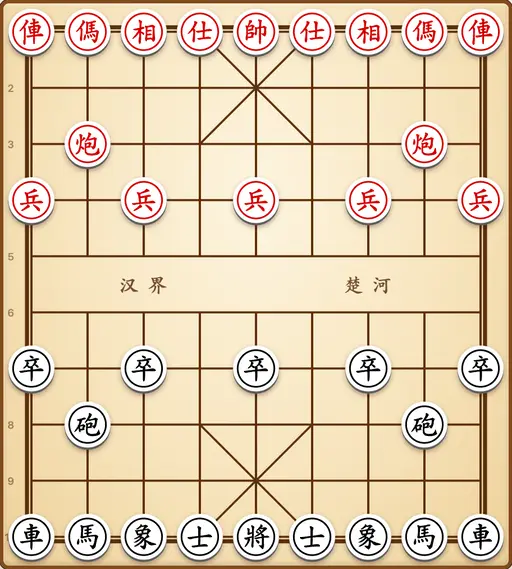
About Xiangqi
Reading a xiangqi position requires more than noticing the apparent attacks of chariots, horses, and cannons. Examine horse legs, elephant eyes, cannon screens, and the facing-generals constraint. Perpetual check, perpetual chase, and repetition are governed by the applicable rules text, not by a single general maxim.
- Ruleset covered
- Basic xiangqi movement, with repetition and perpetual-check provisions treated separately
- Updated
- · Editorial policy and corrections
XiangqiRules and variant distinctions
Intersections, the river, and the palaces
Xiangqi uses a board of nine files and ten ranks. Pieces occupy intersections, not squares. Each side starts with 16 pieces; Red moves first. The river separates the two halves, and each general and its advisors are confined to their own 3×3 palace. Piece names and characters differ by side, but corresponding pieces have the same movement rules.
Chariots, horses, and elephants
A chariot moves any unobstructed distance along a rank or file. A horse first extends one orthogonal step, then one diagonal step outward; an occupied first-step point, the horse's leg, blocks both associated destinations. An elephant moves two points diagonally, but an occupied midpoint, the elephant's eye, blocks that move. Elephants cannot cross the river. These restrictions distinguish the horse and elephant from their chess counterparts.
Cannon movement and capture
A cannon's noncapturing move follows an unobstructed rank or file. To capture, it must have exactly one intervening piece between itself and its target. That piece is the screen and may belong to either side. No screen, or more than one screen, makes the capture illegal. Reassess cannon lines whenever a screen moves or is captured.
Generals, advisors, and soldiers
A general normally moves one orthogonal step within its palace. Advisors move one diagonal step within the palace. A soldier advances one step before crossing the river; afterward, it may also move one step sideways. It never retreats. A move may not leave your general under attack or leave the two generals facing each other on an otherwise empty file.
Checkmate, stalemate, and repetition
The general must be protected against check. A player with no legal move loses under the usual xiangqi rules, whether or not the general is currently in check: stalemate is not the chess draw. Perpetual check, perpetual chase, repetition, and move limits require the applicable competition or platform rules. Do not replace these adjudication provisions with a single repetition-count rule.
Practical strategy
Calculate the constraint as well as the destination
For each horse attack, identify the horse's leg; for each elephant move, inspect the eye; for each cannon capture, count screens. A vacant destination does not establish legality. Moving a blocking piece can change several lines at once, so recalculate the resulting position before proceeding.
Coordinate the major attacking pieces
Use chariots to control open ranks and files, horses to establish supported threats, and cannons to exploit suitable screens. A cannon attack can disappear when its screen moves. Develop pieces together rather than advancing a single attacker beyond its support, and consider whether a soldier advance changes the available lines.
Maintain general safety in the endgame
Fewer pieces do not necessarily mean fewer threats. Facing generals, chariot control, and a changed cannon screen can make an otherwise ordinary capture illegal. Preserve coordination when ahead; when defending, examine general safety and legitimate drawing resources. Do not exchange mechanically because you have more material. In review, identify the precise line or constraint that changed.
A common misconception
Having no legal move without being in check is a draw.
Stalemate is normally a loss in xiangqi, unlike chess. Apply the chosen rules separately to repetition and move-limit adjudication.
Position study: Inspect the horse's leg first
For this local diagram, files are a–i and ranks are 1–10. A friendly horse stands at e5 and a friendly soldier at f5; g4 and g6 are empty. Assume the friendly general is safe and no other condition affects these moves.
May the horse on e5 move to g4 or g6?
Show the answer and analysis
Neither move is legal. Both rightward destinations share f5 as the horse's leg, and the soldier on f5 blocks it. Empty destinations do not remove that obstruction.
Moving the soldier opens both horse moves, but it is not necessarily the best move. Check whether it opens an opposing chariot or cannon line, permits the generals to face each other, or removes important protection.
This position was constructed for instruction. It is not a tournament record or an engine-verified proof of an optimal move. Evaluate it under the stated conditions; do not assume unlisted features of the complete position.
Structured practice
Understand the rules
On an otherwise empty board, list the horse's eight candidate destinations from e5 and mark the leg used by each.
Assessment: Group the eight destinations by their four leg points. Do not treat the horse as a jumping chess knight.
Compare candidate moves
Set up a cannon, a screen, and a target. Change the screen's ownership and then the number of intervening pieces.
Assessment: A capture requires exactly one screen, and that screen may belong to either player.
Review and verify
Review a game and identify the first consequential change to a horse leg, cannon screen, or facing-generals line.
Assessment: Explain the specific change in legal moves or attacks rather than recording only that a move was miscalculated.
Frequently asked questions
How does xiangqi differ from chess?
Xiangqi pieces occupy intersections on a 9-file, 10-rank board, with a river and two palaces. Horse-leg blocking, cannon screens, elephant restrictions, and the prohibition on facing generals all require separate study. The usual stalemate result is also different. Learn each piece's constraints and general safety rather than importing chess rules.
Why can a horse's move be blocked when its destination is empty?
The horse's first orthogonal step identifies its leg. Any piece on that point blocks the two destinations reached through that leg. An empty destination therefore does not guarantee a legal move. When calculating a horse attack, inspect both the destination and the intervening leg point.
Does a cannon capture the same way it moves?
No. A noncapturing cannon move requires an unobstructed rank or file. A capture requires exactly one intervening piece, the screen, which may belong to either side. With no screen or two or more screens, the cannon cannot capture along that line.
Can a soldier retreat after crossing the river?
No. Crossing the river adds sideways movement, one point at a time; it never grants backward movement. Before advancing a soldier deeply, consider its support and the lines it opens. It cannot simply return along the route it used to advance.
What is the facing-generals rule?
The two generals may not face each other on the same file with no intervening piece. Removing the last piece between them may therefore be illegal, even if that piece is not itself under attack. This constraint can also create effective control and pins in endgames.
Is a position with no legal move a draw?
Usually not. In xiangqi, stalemate is normally a loss, unlike stalemate in chess. Repeated checks, repeated attacks, and other cycles are governed by the chosen ruleset; a repetition count alone does not determine every result. Confirm the subsite's end-of-game and repetition provisions before play.
What blocks an elephant, and can it cross the river?
An elephant moves two points diagonally. A piece of either side at the diagonal midpoint—the elephant's eye—blocks that move. The elephant cannot cross the river. Its legal destinations must therefore satisfy both the midpoint restriction and the requirement to remain on its own side.
What do Central Cannon, Screen Horse, and Same-Direction Cannons mean?
The Central Cannon is a common Red opening in which a cannon moves to the central file. Black's Screen Horse Defense develops both horses to support the central soldier and coordinate defense. Same-Direction Cannons is a central-cannon response involving the corresponding flank; not every central-cannon reply belongs to that system. These names identify opening arrangements, not guaranteed attacks.
May the horse on e5 move to g4 or g6 in the example?
Neither move is legal. Both destinations use f5 as the horse's leg, and the friendly soldier on f5 blocks it. Moving the soldier would open both horse moves, but that alone does not make the soldier move best. Check whether it exposes a chariot or cannon line, leaves the generals facing, or removes needed protection.
Does stalemate without check mean a draw?
Not under the usual xiangqi rules: the player with no legal move loses. Apply the agreed competition or platform provisions separately when repetition or move limits are involved. Do not use the chess stalemate rule to adjudicate a xiangqi position.
Put your understanding into practice.
Choose one skill to work on in your next game. A clear reason for each move is more useful than an immediate win.
Play XiangqiRules sources and editorial notes
- Current rules for this game on Ply Yard
Identifies the board variant and interface described here. Platform instructions are not a complete statement of every tournament ruleset.
- Xiangqi Competition Rules, 2020 edition
Distinguishes basic movement from formal repetition, perpetual-check, and perpetual-chase adjudication. This citation does not assert that the platform implements every competition provision.
This guide combines the relevant board's rules with independently constructed examples and exercises. It distinguishes basic rules, variant-specific provisions, and strategic advice. Rules sections draw on the sources listed above. Instructional positions have not been presented as exhaustively engine-verified or certified by professional players.
Written by Ply Yard. Independent review by a named professional player has not been completed. To report an issue, send the game, ruleset, position, and relevant source provision to contact@plyyard.com.