 Ply Yard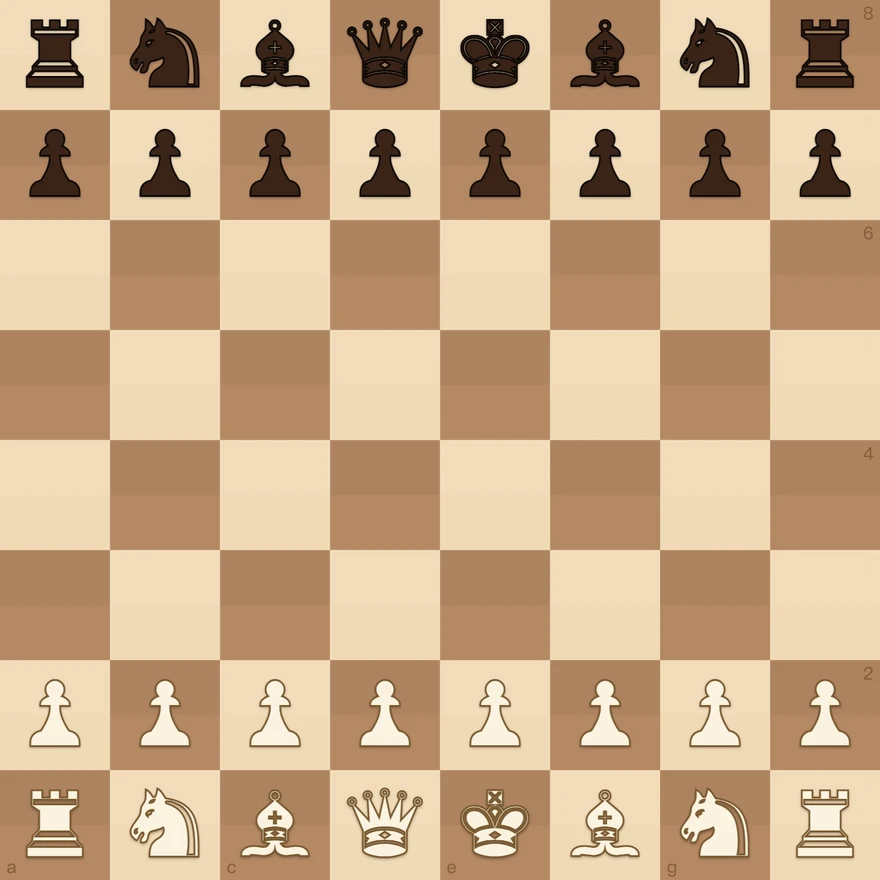
About Chess
The objective in chess is checkmate. Relative piece values are tools for comparing positions, not substitutes for calculation. Effective practice checks king safety, forcing replies, and candidate moves together. A complete account must distinguish checkmate, stalemate, claim-based draws, and automatic draws.
- Ruleset covered
- Standard FIDE chess; platform adjudication distinguished from tournament procedure
- Updated
- · Editorial policy and corrections
ChessRules and variant distinctions
The board, the pieces, and the first move
Chess is played on an 8×8 board with 16 pieces per side. Place the board so that each player's near-right corner is a light square. Each queen begins on a square of her own color. White moves first, and players alternate. Rooks move along ranks and files, bishops along diagonals, and queens along either. These pieces cannot pass through occupied squares. A knight moves two squares in one direction and one perpendicular to it, and can jump over intervening pieces. A king moves one square in any direction, subject to king safety.
Pawn movement, capture, and promotion
A pawn normally advances one square into an empty square. From its starting square, it may advance two squares if both are empty. It captures one square diagonally forward and never moves backward. A pawn reaching the last rank must promote to a queen, rook, bishop, or knight; the choice does not depend on previously captured pieces. En passant is available only immediately after an opposing pawn's qualifying two-square advance, and only if the capture leaves the capturing side's king safe.
Check and checkmate
A move may not leave or place your own king in check. To answer a check, move the king to safety, capture the attacking piece, or interpose a piece where interposition is possible. If no legal response exists, the position is checkmate. The game ends there: the king is not physically captured. Evaluate every proposed move against the opponent's attacks, including attacks exposed by moving a pinned piece.
Castling
Castling moves the king and a rook in one move. Neither participating piece may have moved previously, and the squares between them must be empty. The king may not be in check, pass through an attacked square, or finish on an attacked square. Empty intervening squares alone do not make castling legal. The rook's being attacked does not by itself prohibit castling. Follow the board interface's instructions for executing the move.
Stalemate and other drawn positions
Stalemate occurs when the player to move has no legal move but is not in check; the result is a draw. Under FIDE rules, threefold repetition and the 50-move rule generally involve a valid claim, while fivefold repetition and the 75-move rule provide for an automatic draw, subject to the laws' conditions and the precedence of checkmate. Agreement and dead positions are separate grounds for a draw. Distinguish tournament rules from the platform's actual adjudication.
Practical strategy
Develop with a purpose
In the opening, contest the center, develop minor pieces, and establish king safety. Avoid repeatedly moving one piece without a concrete reason or bringing the queen out merely to attack an undefended pawn. Evaluate development by the activity and coordination of your pieces, not by how many opening moves you can recall.
Check forcing moves before positional plans
At each turn, examine checks, captures, and direct threats for both sides. Practice forks, pins, skewers, and one-move checkmates in short positions. Before executing a combination, calculate the opponent's strongest legal response rather than assuming a convenient reply.
Activate the king in the endgame
As material decreases, the king often becomes an active piece rather than a piece that must remain sheltered. Before advancing a pawn, calculate whether the opposing king can reach the promotion square and whether your own king can provide support. Practice king-and-queen and king-and-rook checkmates against a lone king. These exercises help convert winning positions more reliably than early specialization in complicated openings.
A common misconception
Threefold repetition and the 50-move rule always end the game automatically.
FIDE generally makes these claim-based. Fivefold repetition and the 75-move rule have automatic-draw provisions. Separate eligibility for a claim, automatic adjudication, and the platform's implementation.
Position study: Why Scholar's Mate is not a reliable opening plan
From the standard starting position: 1. e4 e5 2. Bc4 Nc6 3. Qh5 Nf6? White to move.
How does White checkmate, and what did Black overlook?
Show the answer and analysis
4. Qxf7#. The queen captures on f7 with check, protected by the bishop on c4. Black's king cannot capture the queen, and Black has no legal capture of the checking piece, interposition, or king escape.
3…Nf6 did not address the queen and bishop's combined attack on f7. This example is not a forced four-move win from the starting position: a different response, such as 3…g6, changes the continuation and must be calculated separately.
This position was constructed for instruction. It is not a tournament record or an engine-verified proof of an optimal move. Evaluate it under the stated conditions; do not assume unlisted features of the complete position.
Structured practice
Understand the rules
Reconstruct the example without hints and identify every attacker and defender of f7.
Assessment: Explain why the black king cannot capture the queen and examine every category of legal response to check.
Compare candidate moves
Construct one checkmate and one stalemate position, changing a line of attack on the king.
Assessment: Distinguish check with no legal response from no legal move without check.
Review and verify
Choose one move from each game. List checks, captures, and threats before comparing two candidates.
Assessment: Include the opponent's strongest response, not just your intended next move.
Frequently asked questions
Is the objective to capture the opposing king?
No. A normal game ends at checkmate; the king is never captured. Check means that the king is attacked, and the player must remove that attack with a legal response. Depending on the position, the response may be a king move, a capture, or an interposition. If none is legal, the position is checkmate. A move that leaves your own king attacked is illegal.
When may a pawn advance two squares?
Only from its starting square, with both the intervening square and the destination empty. Otherwise, a pawn normally advances one square. Pawns capture diagonally forward, not straight ahead, and cannot retreat. On reaching the last rank, a pawn promotes to a queen, rook, bishop, or knight, regardless of which pieces have previously been captured.
What conditions make castling legal?
The king and the participating rook must never have moved, and no pieces may stand between them. The king must not be in check or cross or finish on an attacked square. Checking only that the path is empty is insufficient. Castling is a single move; the interface may require a particular input sequence to perform it.
What is en passant, and why must it be played immediately?
After an opposing pawn advances two squares from its starting square, an adjacent pawn may be able to capture it as though it had advanced one. The right exists only on the immediately following move. It cannot be exercised later. As with every move, en passant is illegal if it leaves the capturing player's king in check.
Do I lose if I have no legal move but am not in check?
No. In standard chess, that is stalemate, a draw. Checkmate requires both check and the absence of a legal response. When converting a material advantage, verify that your move either produces checkmate or leaves the opponent a legal move; otherwise, a winning position may end in stalemate.
Should I study openings or tactics first?
Start with legal movement, king safety, and basic tactical recognition. Short exercises in forks, pins, and one-move checkmates are more useful than memorizing variations without understanding them. Follow opening principles—central control, development, and king safety—then study named openings once you can explain the purpose of their moves.
What are the usual relative piece values?
A common working scale assigns 1 to a pawn, 3 to a knight or bishop, 5 to a rook, and 9 to a queen. Knights and bishops are minor pieces; rooks and queens are major pieces. The king has no exchange value. These estimates help compare material, but activity, coordination, pawn structure, and king safety can change the value of an exchange.
How does a pin differ from a skewer?
A pin attacks a piece whose movement would expose a more important piece behind it. An absolute pin to the king can make that movement illegal; a relative pin, such as one to the queen, may make it unfavorable without making it illegal. A skewer attacks the more important piece first, seeking to capture the piece behind it after the front piece moves.
How does White checkmate in the example, and what did Black overlook?
White plays 4. Qxf7#. The queen captures the f7 pawn with check, and the bishop on c4 protects the queen, so Black's king cannot capture it. There is no legal capture, interposition, or king escape. Black's 3…Nf6 failed to address the combined attack on f7. This does not prove a forced four-move win: 3…g6 changes the position and requires fresh analysis.
Do threefold repetition and the 50-move rule always end a game automatically?
No. Under FIDE rules, these generally require a valid claim. Fivefold repetition and the 75-move rule have automatic-draw provisions. Repetition concerns the same position with the same player to move and the same legal possibilities, including relevant castling and en passant rights. Confirm which procedures the platform implements rather than treating every online result as a tournament ruling.
Put your understanding into practice.
Choose one skill to work on in your next game. A clear reason for each move is more useful than an immediate win.
Play ChessRules sources and editorial notes
- Current rules for this game on Ply Yard
Identifies the board variant and interface described here. Platform instructions are not a complete statement of every tournament ruleset.
- FIDE Laws of Chess, effective January 1, 2023
Competition provisions covering check, castling, draw claims, and automatic draws.
This guide combines the relevant board's rules with independently constructed examples and exercises. It distinguishes basic rules, variant-specific provisions, and strategic advice. Rules sections draw on the sources listed above. Instructional positions have not been presented as exhaustively engine-verified or certified by professional players.
Written by Ply Yard. Independent review by a named professional player has not been completed. To report an issue, send the game, ruleset, position, and relevant source provision to contact@plyyard.com.