 Ply Yard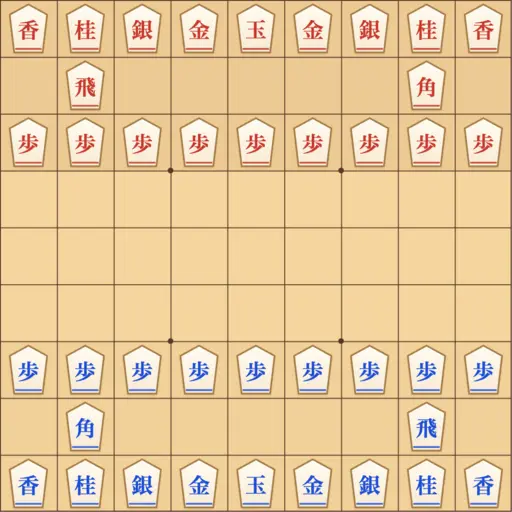
About Shogi
In shogi, captures create pieces in hand that can return through drops, so exchanges do not simply remove threats. Read the board and both piece stands together. Ownership is determined by orientation; the king characters do not assign first- and second-player status.
- Ruleset covered
- Standard 9×9 shogi: pieces in hand, promotion, nifu, and pawn-drop mate
- Updated
- · Editorial policy and corrections
ShogiRules and variant distinctions
The board, ownership, and piece movement
Standard shogi uses a 9×9 board, with 20 pieces per player; sente moves first. Orientation identifies ownership, not the king's character. The king moves one square in any direction. A gold general moves one square in any direction except diagonally backward; a silver general moves one square diagonally or straight forward. A knight jumps two ranks forward and one file sideways. A lance moves any unobstructed distance straight forward, and a pawn moves or captures one square straight forward. Rooks move along ranks and files, and bishops along diagonals, without crossing occupied squares. Every move must leave your own king safe.
Captures, pieces in hand, and drops
Captured pieces become the capturer's pieces in hand rather than leaving the game permanently. On a later turn, a player may drop one onto an empty square instead of moving a board piece, subject to drop restrictions and king safety. Captured promoted pieces return to their unpromoted state. A dropped piece is always unpromoted, even when dropped inside the promotion zone.
Optional and mandatory promotion
The opponent's three nearest ranks form your promotion zone. An eligible move that begins or ends there normally offers promotion. Pawns and lances must promote when moving to their last rank; knights must promote on their last two ranks, since otherwise they would have no future move. Promoted pawns, lances, knights, and silver generals move as gold generals. A promoted rook adds one-square diagonal moves, and a promoted bishop adds one-square orthogonal moves.
Nifu, immobile drops, and pawn-drop mate
Nifu prohibits dropping a pawn on a file already containing your own unpromoted pawn. A promoted pawn does not count for this restriction. A pawn or lance may not be dropped on its last rank, nor a knight on its last two ranks. Uchifuzume prohibits a pawn drop that immediately checkmates the opposing king. This does not prohibit a legal move by a pawn already on the board from delivering mate, nor every pawn drop that gives check.
Checkmate and repetition
Check must be answered by a legal king move, capture, or interposition where possible. No legal response means checkmate. Sennichite concerns a fourth occurrence of the same position, including the player to move and both players' pieces in hand. Ordinary repetition generally requires a replay with the players' move order exchanged; a player responsible for perpetual checking can instead lose under the relevant rules. Confirm the platform's implementation rather than counting board arrangements alone.
Practical strategy
Recognize movement before and after promotion
Compare each pawn, lance, knight, and silver general with its promoted movement, then examine the additional moves of a promoted rook and bishop. A shared piece name does not justify using its old movement after promotion. Captured pieces return unpromoted when dropped, so recalculate their attacks from that state.
Include opposing pieces in hand in your defense
A quiet-looking part of the board may still admit a checking drop of a gold, silver, or knight. Examine escape squares and potential drop squares when arranging your king defense. Before exchanging pieces, calculate whether the material you give the opponent creates a new attack. Familiar castles are defensive systems, not mandatory setups.
Verify every response in mating exercises
Begin with mate-in-one positions and enumerate the defender's king moves, captures, and interpositions, including drops. Check that a proposed solution does not rely on an illegal pawn-drop mate. In practical review, track how one exchange changed both players' pieces in hand and the resulting mating threats.
A common misconception
The jeweled-general character always belongs to sente and the king-general character always belongs to gote.
The names do not determine move order. Orientation and player setup establish ownership, and both kings move identically.
Position study: A pawn in hand does not make every drop legal
Using shogi file numbering, sente has an unpromoted pawn at 5f and another pawn in hand. The square 5d is empty. Assume sente's king is safe.
May sente drop at 5d, and what changes if 5f contains a promoted pawn?
Show the answer and analysis
With an unpromoted pawn at 5f, the drop at 5d violates nifu and is illegal. A promoted pawn at 5f does not trigger nifu, but the drop must still satisfy all other restrictions, including the prohibition on pawn-drop mate.
Nifu concerns a friendly unpromoted pawn on the same file, not every piece derived from a pawn. Evaluate nifu, immobile drops, king safety, and pawn-drop mate together for each proposed drop.
This position was constructed for instruction. It is not a tournament record or an engine-verified proof of an optimal move. Evaluate it under the stated conditions; do not assume unlisted features of the complete position.
Structured practice
Understand the rules
Place pawns, lances, and knights near the opposing back rank. Determine where promotion is optional or compulsory.
Assessment: Identify the last rank and last two ranks relative to each piece's orientation rather than applying fixed rank labels to both sides.
Compare candidate moves
Give both players golds, silvers, and pawns in hand. Identify checking drops near each king.
Assessment: Calculate defensive captures, king escapes, and interpositions, including drops; do not analyze only the board pieces.
Review and verify
Solve mate-in-one positions by listing every legal response, then review how one practical exchange changed the pieces in hand.
Assessment: Explain why the position is mate and reject a solution that depends on an illegal pawn-drop mate.
Frequently asked questions
What is the most important difference between shogi and chess?
Captured pieces become pieces in hand and can be dropped back onto the board under new ownership. Exchanges therefore redistribute attacking and defensive resources instead of simply reducing material. A king that appears safe against the board pieces may still face checking drops. Include both piece stands in every assessment.
When is promotion available or compulsory?
An eligible move beginning or ending in the opponent's three-rank promotion zone normally permits promotion. Promotion is compulsory when an unpromoted pawn or lance reaches its last rank, or a knight reaches either of its last two ranks. A captured promoted piece becomes unpromoted in the capturer's hand.
What is nifu?
Nifu is the prohibited presence of a second friendly unpromoted pawn on a file through a pawn drop. You cannot drop a pawn onto a file already occupied by one of your unpromoted pawns. A promoted pawn does not count for this restriction. Also check that the destination is not the pawn's last rank and that the drop satisfies every other legality condition.
How does pawn-drop mate differ from mating with a pawn move?
Uchifuzume prohibits dropping a pawn that immediately checkmates the opposing king. Moving a pawn already on the board to give mate is a different action and is not prohibited by that rule alone. A pawn drop that merely gives check can be legal if the defender has a legal response and all other drop conditions are satisfied.
Can a dropped piece use its promoted movement immediately?
No. Pieces are dropped unpromoted, even inside the promotion zone. A dropped piece may gain promotion later through an eligible move. Evaluate its attacks immediately after the drop using its unpromoted movement, not the movement it might acquire on a later turn.
What should a chess player avoid assuming when learning shogi?
Do not import chess castling, pawn movement, or exchange logic. Learn shogi promotion, nifu, and drop restrictions first, then practice basic king defenses and short mating problems. Since captured material remains available as pieces in hand, a trade does not necessarily reduce attacking possibilities.
What is a castle, and why do players construct one?
A castle is a coordinated king-defense formation, often using gold and silver generals. Pieces in hand can create sudden checking drops, making an exposed central king vulnerable. Yagura, Mino, and Anaguma are familiar systems. Building a castle is a strategic choice, not a mandatory rule, and its suitability depends on the position.
How does sennichite handle repeated positions?
The same position must occur four times with the same player to move and the same pieces in both players' hands. Ordinary sennichite generally leads to a replay with the move order exchanged. Perpetual checking is treated differently: the player responsible can lose under the rules. A visually repeated board alone is insufficient to establish sennichite.
May sente drop a pawn at 5d if a friendly pawn stands at 5f?
Not if the pawn at 5f is unpromoted: dropping at 5d would violate nifu on file 5. If the piece at 5f is a promoted pawn, it does not trigger nifu. The drop must still satisfy the restrictions on immobile pieces, king safety, and pawn-drop mate. Check all conditions, not just the file.
Does the king's character determine which player moves first?
No. The characters traditionally rendered as king general and jeweled general do not determine sente or gote. Piece orientation and the player setup identify ownership. Both kings have identical movement capabilities.
Put your understanding into practice.
Choose one skill to work on in your next game. A clear reason for each move is more useful than an immediate win.
Play ShogiRules sources and editorial notes
- Current rules for this game on Ply Yard
Identifies the board variant and interface described here. Platform instructions are not a complete statement of every tournament ruleset.
- Japan Shogi Association: Frequently Asked Questions
Further reference on shogi rules and game procedures.
This guide combines the relevant board's rules with independently constructed examples and exercises. It distinguishes basic rules, variant-specific provisions, and strategic advice. Rules sections draw on the sources listed above. Instructional positions have not been presented as exhaustively engine-verified or certified by professional players.
Written by Ply Yard. Independent review by a named professional player has not been completed. To report an issue, send the game, ruleset, position, and relevant source provision to contact@plyyard.com.