 Ply Yard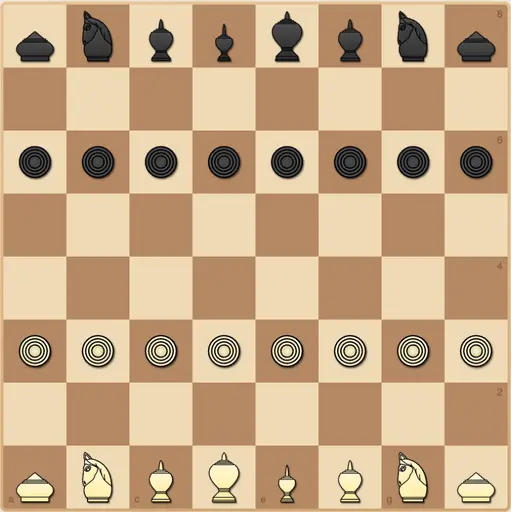
About Makruk
Makruk requires a different reading of piece range and king safety from international chess. The met is not a long-range queen, the khon is not a sliding bishop, and a bia promotes before reaching the opposing back rank. These differences change the control needed to restrict a king and complete a mating attack. This guide uses the platform's starting arrangement and draw provisions, then develops practical calculation through a short-range movement example and promotion and exchange exercises.
- Ruleset covered
- 8×8 Makruk (Thai chess): short-range met and khon; bia promote on their own sixth rank
- Updated
- · Editorial policy and corrections
MakrukRules and variant distinctions
The starting position is not a mirrored chess setup
Makruk, or Thai chess, uses an 8×8 board. White moves first. Viewed from White's side, White's back rank from a1 to h1 is ruea, ma, khon, khun, met, khon, ma, ruea. Black's back rank from a8 to h8 is ruea, ma, khon, met, khun, khon, ma, ruea. The khun is the king: White's starts on d1 and Black's on e8. White's met starts on e1 and Black's on d8. Do not replace this arrangement with the starting position of international chess. The kings and met pieces occupy different files on the two sides. White's eight bia, or pawns, begin on rank 3; Black's begin on rank 6. Identify each side's forward direction before planning pawn advances or khon moves. The two colors use the same movement rules relative to their own orientation.
The six piece types and their movement
The khun moves one square in any direction, provided its destination is not attacked. The met moves one square diagonally. The khon moves one square diagonally in any of the four diagonal directions, or one square straight forward; it cannot move straight backward or sideways. The ruea moves any unobstructed distance along a rank or file, like a rook, but cannot jump over pieces. The ma moves like a knight in international chess: two squares along one axis and one along the other, jumping over intervening pieces. The bia moves one square straight forward to an empty square and captures one square diagonally forward. You cannot land on one of your own pieces. A move onto an opposing piece captures it only when the movement is legal and your khun remains safe. When in check, you must remove the check by a legal king move, capture, or interposition where applicable. There is no castling. The met and khon are short-range pieces, not a queen and long-range bishop. Calculate the squares they actually control before coordinating them with a ruea; familiar-looking symbols do not expand their movement.
Pawn movement and automatic promotion on the sixth rank
A bia advances one square at a time and captures one square diagonally forward. There is no initial two-square advance and no en passant capture. It cannot move straight forward onto an occupied square or capture straight ahead. Promotion occurs on the sixth rank counted from the pawn's own side, not on the far back rank. In the coordinates used here, White promotes on rank 6 and Black on rank 3. Promotion is automatic and produces a met; there is no choice of a ruea, ma, or khon. The promoted piece moves one square diagonally, just like the original met. Recalculate its control after promotion: it gains backward diagonal movement, but it does not become a long-range queen. In planning an advance, compare the new diagonals with the pawn's previous forward movement and capture squares.
Checkmate, stalemate, and platform draw provisions
You win by checkmating the opposing khun: the king is attacked and no legal move removes the attack. If the player to move has no legal move but their khun is not in check, this board records a stalemate draw. A material advantage by itself is not a win. The platform also records draws for insufficient mating material and under its stated fifty-move limit without a capture or pawn advance. A position repeated three times is also drawn in online rooms. These are the implementation provisions described by this guide; do not assume that they replace the material-dependent endgame counting procedures of every traditional or tournament Makruk ruleset. Online players may resign or offer a draw. Computer and same-device play allow resignation or a new game. When analyzing an ending, distinguish a legal mating sequence from a claim based only on piece values, and check the result rules used by the actual board.
Selecting a move and evaluating the reply
Check the status display for the side to move, then select one of that side's pieces. The board highlights its legal empty destinations and capture targets. Selecting a highlighted destination completes the move and passes the turn to the opponent. You may change the selected piece before committing a destination without using the turn. If a piece has no highlighted destinations, inspect both its movement and the khun's safety. A geometrically available move can still be illegal if it leaves the king in check. Do not interpret a blocked or pinned piece as an interface fault. For practical analysis, identify checks and forcing captures, then inspect the short-range control around both kings. After exchanging a ruea, ask which remaining pieces cover the opposing king's escape squares. An apparent material gain may not produce a mating attack if the short-range pieces cannot coordinate.
Common illegal moves and misleading chess analogies
You cannot move the khun onto an attacked square or make a move that leaves it in check. A met cannot move horizontally, vertically, or more than one diagonal square. A khon cannot step straight backward. A bia cannot advance two squares on its first move or capture en passant. There is no king–rook castling move. You also cannot move an opposing piece, land on your own piece, or move a ruea through an occupied square. The ma's jumping movement does not give other pieces permission to jump. For each proposed move, identify the piece, its permitted displacement, any required clear path, the destination occupancy, and the resulting king safety. Apply those tests before considering the move's strategic value. Makruk shares the objective of checkmate with international chess, not every piece's range or every special move.
Practical strategy
On an otherwise empty board, mark the controlled squares of a met, khon, and ruea. Specify each piece's side and forward direction.
Keep the met's one-square diagonals separate from the khon's additional forward square. Distinguish the ruea's sliding movement from both short-range pieces.
Place a White bia one advance away from its promotion rank. Compare its legal movement and attacks before and after promotion, then repeat from Black's perspective.
Locate promotion relative to each side: rank 6 for White and rank 3 for Black. Explain the automatic change to a met without introducing a promotion choice.
Review an exchange that removes a ruea. Analyze whether the remaining short-range pieces can construct a mating attack.
Account for the opposing king's escape squares and legal defensive replies. Do not declare a win solely from a favorable material total.
A common misconception
The met is equivalent to the queen in international chess.
A met moves one square diagonally. Similar names or symbols do not replace the piece's actual movement rules.
Position study: An open diagonal does not turn a met into a queen
A met stands on d4. Squares e5 and f6 are empty, and the diagonal toward f6 is unobstructed. Assume your khun is safe.
Can the met reach f6 in one move?
Show the answer and analysis
No. A met moves only one square diagonally. A move to e5 may be considered if otherwise legal, but d4–f6 exceeds the piece's range. The empty diagonal does not permit a two-square move.
Calculate the squares controlled by each short-range piece before coordinating it with a ruea and other pieces. A symbol resembling the international queen is not evidence of queen movement; the actual legal range must support the variation.
This position was constructed for instruction. It is not a tournament record or an engine-verified proof of an optimal move. Evaluate it under the stated conditions; do not assume unlisted features of the complete position.
Structured practice
Understand the rules
On an otherwise empty board, identify the controlled squares of a met, khon, and ruea, with each side's forward direction specified.
Assessment: Separate the met's adjacent diagonals from the khon's diagonals and one forward square, and distinguish both from the ruea's unobstructed sliding range.
Compare candidate moves
Place a White bia near its promotion rank and compare the threats before and after its advance. Reinterpret the same exercise for Black.
Assessment: Determine the sixth rank from the piece owner's direction, rather than using one fixed board rank for both sides.
Review and verify
Review an exchange that removes a long-range ruea. Analyze whether the remaining short-range pieces can restrict and checkmate the opposing khun.
Assessment: Cover the king's escape squares and account for defensive replies; a material-value comparison is not proof of a mating sequence.
Frequently asked questions
Is castling allowed in Makruk?
No. This game has no castling, no initial two-square pawn advance, and no en passant capture. Protect the khun through development, coordination, and an appropriate pawn structure rather than planning a king–rook move borrowed from international chess. Every king move must still avoid attacked squares.
What does a pawn promote to, and where?
A bia automatically promotes to a met on its own sixth rank. In this guide's coordinates, that is rank 6 for White and rank 3 for Black. It does not need to reach the far back rank, and you cannot choose a ruea, ma, or khon. The promoted met moves one square diagonally.
Is the met equivalent to the queen in international chess?
No. The met moves only one square diagonally. It cannot slide along a diagonal or move along a rank or file. Its role depends on close-range control and coordination with other pieces. A queen-like symbol or a translated piece label does not confer the international queen's movement.
Does the khon move like a bishop?
No. The khon moves one square diagonally or one square straight forward. It cannot slide along a diagonal, move straight backward, or move sideways. Forward is relative to its owner, so the extra non-diagonal move points toward the opposite end of the board for White and Black.
Does White move first in every play mode?
Yes. White moves first in computer play, same-device play, and online rooms. Against the computer, you may choose White or Black. If you choose Black, the computer makes the first move as White. Side selection does not change the move order or the initial arrangement.
Can a game continue indefinitely without progress?
The platform states a fifty-move draw limit when there has been neither a capture nor a pawn advance. A capture-free sequence containing pawn advances does not meet both conditions. Online players may also offer and agree to a draw before the limit is reached. Treat this as the board's stated provision, not a universal description of traditional Makruk endgame counting.
Can a met move from d4 to f6 in one move?
No. Even with e5 and f6 empty and the diagonal unobstructed, d4–f6 is a two-square move. A met may move from d4 to e5 if the resulting position is otherwise legal, but it cannot continue to f6 in that turn. An empty path does not increase a short-range piece's permitted displacement.
Can I analyze the met using the same attacking patterns as a queen?
Not without changing the movement assumptions. The met controls only adjacent diagonal squares, so a queen's long-range checks and horizontal or vertical attacks are unavailable. Calculate its actual control, then coordinate it with a ruea, khon, ma, or other met. Use legal squares and covered king escapes rather than a familiar symbol to justify a mating claim.
Put your understanding into practice.
Choose one skill to work on in your next game. A clear reason for each move is more useful than an immediate win.
Play MakrukRules sources and editorial notes
- Current rules for this game on Ply Yard
Identifies the board variant and interface described here. Platform instructions are not a complete statement of every tournament ruleset.
This guide combines the relevant board's rules with independently constructed examples and exercises. It distinguishes basic rules, variant-specific provisions, and strategic advice. Rules sections draw on the sources listed above. Instructional positions have not been presented as exhaustively engine-verified or certified by professional players.
Written by Ply Yard. Independent review by a named professional player has not been completed. To report an issue, send the game, ruleset, position, and relevant source provision to contact@plyyard.com.