 Ply Yard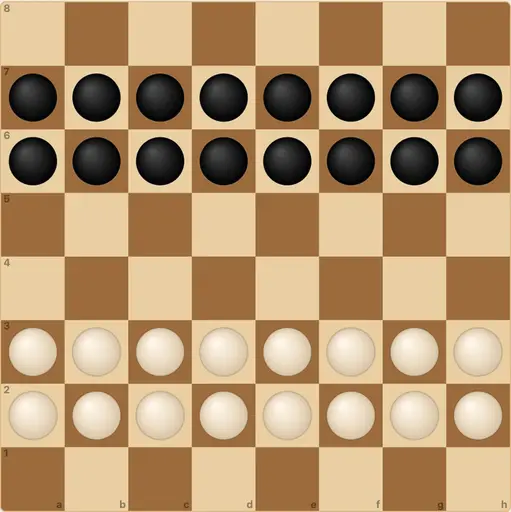
About Turkish Draughts
Turkish Draughts requires rank-and-file geometry rather than diagonal dark-square patterns. Men and kings have different ranges, and capture candidates must first satisfy direction and landing restrictions before their complete captured-piece totals are compared. The platform's stated mid-sequence promotion changes continuation analysis. Familiarity with another draughts variant does not establish a legal route in this one.
- Ruleset covered
- 8×8 Turkish Draughts on Ply Yard: orthogonal captures, flying kings, and maximum capture; documented mid-sequence promotion
- Updated
- · Editorial policy and corrections
Turkish DraughtsRules and variant distinctions
An 8×8 board with all sixty-four squares in play
Turkish Draughts, also called Dama, uses ranks and files rather than diagonal movement. Every square on the 8×8 board can participate, regardless of color. Each player begins with sixteen men on the second and third ranks from their own side, leaving the back rank empty. White moves first, and ordinary turns then alternate. Do not use a dark-square-only board model. A legal orthogonal step changes square color, and a capture follows an allowed rank or file. The same displayed checker symbol does not import American checkers or international draughts movement. On Ply Yard, select a currently eligible piece and then a legal destination. If a quiet move is unavailable, inspect the whole board for a compulsory capture before assuming the piece is blocked or the interface has failed. A geometric destination can be empty yet unavailable because a different capture sequence must be played.
Men advance or move sideways; captures jump an adjacent enemy
An uncrowned man makes a noncapturing move one square straight forward or one square horizontally, onto an empty square. It does not move diagonally or straight backward. Forward is toward the opposing back rank, so it reverses between White and Black. A man captures by jumping an adjacent opposing piece straight forward or sideways and landing on the empty square immediately beyond it. The jumped piece is removed immediately. A friendly piece is not a capture target, and an occupied landing square prevents the jump. A man does not gain a backward capture merely because another draughts variant permits one. If the same piece has a further legal capture after landing, the sequence continues with that piece. Recalculate occupancy after each removal and inspect horizontal branches as well as the forward direction. A complete sequence may change direction; do not count only the first visible jump. At the beginning of a turn, separate two cases: if any legal capture exists, apply the compulsory maximum-capture rule; only when no capture exists may you compare ordinary advances and sideways moves. Tactical planning starts from that legal choice set.
Capture is compulsory, and the full maximum matters
If any of your pieces can capture, you must capture. You may not substitute a quiet move with the same piece or a different one. When several complete capture sequences are available, the platform requires a sequence that captures the greatest number of opposing pieces. Count pieces captured, not travel distance or the number of squares crossed. Compare sequences across all eligible pieces, not just the piece you selected first. A move taking one piece is unavailable if another legal route takes more. Starting with the most attractive first jump does not prove the resulting route is maximal. Explore each legal landing and continuation, including horizontal turns and any platform-specific promotion during the sequence. Once a capturing move begins, complete its legal continuation rather than stop early to preserve a convenient square. Every branch must be checked under the piece's current movement status and the current occupancy. A diagonal route cannot enter the comparison simply because it would capture more material. The cited instructions do not fully define every equal-count tie priority or king-reversal case. Do not import those details from another ruleset. Use the current board's accepted maximum-capture choices to verify the sequence. Strategic preferences are considered only among moves the version actually permits.
Flying kings and the platform's mid-capture promotion
A man reaching the opposing back rank becomes a king. Kings move along clear ranks and files in all four orthogonal directions, rather than only one adjacent square. They do not slide diagonally. A friendly piece blocks the line; flying movement is not permission to cross any occupied square without a legal capture. For a capture, identify the opposing piece on the line and a legal empty landing beyond it. The approach and landing segment must not conceal another obstruction. Different empty landings may produce different continuations, so list the accepted landing choices instead of assuming the square immediately beyond the target is the only one. The maximum-capture requirement still applies to kings. Ply Yard explicitly documents promotion during a capture sequence: after reaching the back rank, the piece may continue searching for orthogonal flying captures as a king. Treat this as the platform's stated behavior, not a universal assertion about tournament promotion timing. Apply the newly available range to the continuation rather than ending the sequence automatically. The computer mode defaults to the human playing White and the computer Black; same-device and online play alternate between the players. The published movement rules are shared across those modes. Do not infer unrestricted reversal or extra actions from the word flying; confirm the complete route under the current implementation.
Win by elimination or lack of legal moves
You win when the opponent has no pieces remaining, or when it is their turn and they have no legal move. Mobility therefore matters alongside material. A position with surviving men can still be lost if neither an allowed quiet move nor a legal capture is available. Players may agree to a draw. The platform also describes a draw after a prolonged sequence with neither a capture nor promotion, but the cited page does not specify an exact counter. Do not substitute a numerical rule from American checkers, international draughts, or a separate Turkish competition. Follow the current board's result display. For a first training game, aim to apply three habits reliably: use orthogonal geometry on all square colors, find the full maximum capture before choosing, and recognize promotion and the platform's continuation rule. Those habits matter more than forcing an immediate material gain from an illegal route. In review, reconstruct each capture branch and the board after each removal. Identify whether an error concerned direction, landing occupancy, maximum count, or promotion timing. Then assess the resulting mobility and material. A later loss does not by itself prove that a compulsory capture was a voluntary strategic mistake.
Practical strategy
On an empty board, mark a man's quiet-move directions and then construct legal forward and sideways capture patterns.
Use forward and horizontal directions only, with an adjacent enemy and empty square beyond for a capture. Include both square colors and exclude every diagonal candidate.
Place a flying king with an opposing piece on a rank or file. List its accepted landing choices and trace each resulting capture continuation.
Check the complete route under the platform's restrictions before comparing captured-piece totals. Identify how landing choice affects the next line instead of treating all destinations as equivalent.
Replay a compulsory maximum-capture position and compare routes from every eligible piece.
Search the whole board, including horizontal branches and promotion continuations. Reject geometric and occupancy violations before counting, and do not mistake longest travel for the most captures.
A common misconception
All draughts variants use only dark squares and diagonal captures.
Turkish Draughts uses ranks and files, with every square color available. Its movement and continuation rules must be assessed separately from diagonal variants.
Position study: A diagonally adjacent enemy is not a capture target
Your man stands on d4, an opposing piece is on e5, and f6 is empty. Assume there is no other available capture.
May you jump from d4 to f6 as in international draughts?
Show the answer and analysis
No. Turkish Draughts does not permit that diagonal capture. Search the allowed ranks and files, then check the direction and landing conditions for the piece involved.
Exclude geometrically illegal routes before comparing maximum captures. A diagonal combination cannot become a candidate through a high material count. In this position, the nearby enemy does not itself impose a compulsory jump.
This position was constructed for instruction. It is not a tournament record or an engine-verified proof of an optimal move. Evaluate it under the stated conditions; do not assume unlisted features of the complete position.
Structured practice
Understand the rules
Mark a man's ordinary movement and capture directions on an empty board.
Assessment: Use all square colors with forward or sideways orthogonal routes. Distinguish the one-square quiet step from the adjacent-enemy jump.
Compare candidate moves
List a flying king's accepted landing choices in rank-and-file capture sequences.
Assessment: Verify complete route restrictions first, then compare the captured-piece count for each continuation.
Review and verify
Review a forced maximum capture and search for omitted horizontal branches.
Assessment: Compare all eligible pieces and legal continuations across the board, not diagonal patterns or the travel distance of a single jump.
Frequently asked questions
Is this the same game as Chinese checkers?
No. Chinese checkers uses a star-shaped race board, with jumps over adjacent pieces to empty destinations and no capture through those jumps. Turkish Draughts uses an 8×8 board with orthogonal moves, captures, and flying kings. Its objective is to remove the opponent's pieces or leave them without a legal move.
May I decline a capture and move a different piece?
No. If any legal capture exists, a capturing move is compulsory. Among complete available sequences, the platform requires the greatest captured-piece count. Check every eligible piece and branch before deciding which sequence can be played; choosing a quiet move is not an alternative.
Can a king move farther than one square?
Yes. It slides along a clear rank or file and makes orthogonal flying captures with legal empty landings beyond the target. It does not ignore intervening obstructions. This differs from American checkers' short-range kings and international draughts' diagonal flying kings. Check the current board's complete capture restrictions.
Who moves first, and may pieces use light squares?
White starts. All sixty-four squares are in play, including light squares. A man moves or captures forward and sideways under its respective step or jump rule; a king has orthogonal flying range. No piece acquires a diagonal move from its square color.
May a man on d4 jump an enemy on e5 and land on f6?
No. That is a diagonal capture pattern, not Turkish Draughts geometry. In the example there is no other capture, so the diagonal proximity does not create a compulsory jump. Find targets and landings on permitted ranks and files, then apply the man or king restrictions before comparing counts.
Must every draughts game use dark squares and diagonal captures?
No. Turkish Draughts uses orthogonal routes and all square colors. Transfer the general habit of calculating captures, not another variant's geometry or promotion timing. A long diagonal combination remains illegal here regardless of how many pieces it appears to take.
Put your understanding into practice.
Choose one skill to work on in your next game. A clear reason for each move is more useful than an immediate win.
Play Turkish DraughtsRules sources and editorial notes
- Current rules for this game on Ply Yard
Identifies the board variant and interface described here. Platform instructions are not a complete statement of every tournament ruleset.
This guide combines the relevant board's rules with independently constructed examples and exercises. It distinguishes basic rules, variant-specific provisions, and strategic advice. Rules sections draw on the sources listed above. Instructional positions have not been presented as exhaustively engine-verified or certified by professional players.
Written by Ply Yard. Independent review by a named professional player has not been completed. To report an issue, send the game, ruleset, position, and relevant source provision to contact@plyyard.com.