 Ply Yard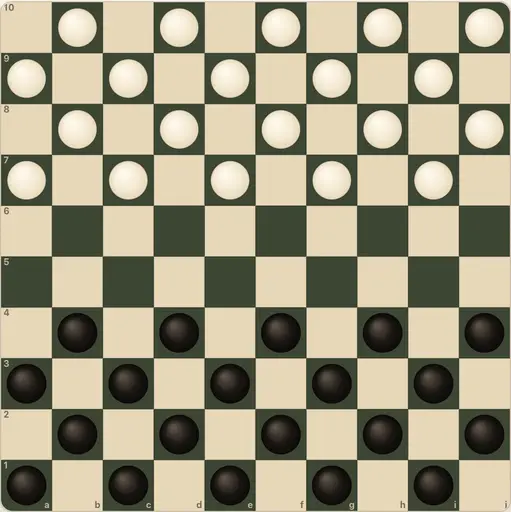
About International Draughts
Backward captures by men and long-range king landings make complete route calculation essential on a 10×10 board. This guide uses the platform's published variant: Black starts, equal-total captures favor more captured kings, and captured pieces are described as being removed immediately. FMJD international draughts instead starts with White, permits free choice among equal-total captures, and removes captured pieces after a multiple-capture sequence. Those differences are identified explicitly so that platform instruction is not mistaken for a tournament-standard rules manual.
- Ruleset covered
- Ply Yard 10×10 draughts variant: flying kings and maximum capture; some provisions differ from FMJD rules
- Updated
- · Editorial policy and corrections
International DraughtsRules and variant distinctions
The 10×10 board and this platform's rule variant
The board has 100 squares, but only the 50 dark squares are used. Each player starts with 20 men on the dark squares of the four rows nearest that player. This site's setup starts with Black, followed by alternating turns. Select one of your pieces and then a legal dark-square destination; light squares are outside the playing area. This guide describes the published Ply Yard variant. It shares backward captures by men, flying kings, and maximum capture with international draughts, but some provisions differ from the FMJD standard. Official FMJD play starts with White; equal-length captures do not receive extra priority for capturing kings; and pieces taken in a multiple capture are removed after the sequence is completed. The platform instead states Black first, preference for more captured kings when capture totals tie, and immediate removal of jumped pieces. These differences matter when calculating routes. Use the platform rules for this board and the official rules for a tournament position; do not combine the two procedures in one analysis.
Men move forward but capture in both directions
An uncrowned piece is a man. An ordinary move advances one square diagonally forward to an empty dark square. A man does not make an ordinary backward move. Captures are different: a man may jump diagonally forward or backward over an adjacent opposing piece onto the empty square immediately beyond it. If another legal capture is available after landing, continue with the same piece. Check all four diagonal capture directions rather than looking only toward the promotion row. A landing occupied by either side makes that segment unavailable. The site's instructions describe removing a captured piece immediately. Under FMJD multiple-capture rules, captured pieces remain until the sequence ends, which can change the routes through the position. Keep that timing distinction explicit when reconstructing a combination; a route calculated with a cleared square is not automatically valid under the official procedure.
Compulsory maximum capture and the platform's tie-break
If any piece can capture, you must capture rather than make an ordinary move. Enumerate complete capture sequences across all eligible pieces and choose one that captures the greatest total number of opposing pieces. Finding a possible first jump is not enough to identify a legal choice. The platform adds a tie-break: among sequences with the same maximum total, prefer those capturing more kings. Only after satisfying both requirements may you compare the strategic consequences of the remaining choices. This captured-king priority is a platform provision, not the FMJD rule. Under FMJD articles 4.13–4.14, a man and a king each count as one captured piece, and equal-total sequences are freely selectable. In either ruleset, maximum capture and completion of the chosen sequence are distinct requirements: you must compare whole routes, then finish the selected legal capture rather than stopping after a favorable intermediate landing.
Flying kings and promotion at the end of a move
A man promotes only when its completed move ends on the opposing back row. Passing through that row during a capture does not make it a king immediately. If the required continuation takes it away from the back row, it remains a man at the end of that move. A king may move any unobstructed distance diagonally to an empty dark square. For a capture, it crosses an opposing piece along a diagonal and may land on an empty square beyond that piece before an obstruction. Different landing squares can enable different subsequent captures, so each must be included when determining the maximum route. A segment cannot cross your own piece or bypass an intervening piece as though it were absent. Do not calculate a man's remaining jumps using flying-king movement just because it touched the promotion row. Promotion changes the piece for subsequent turns, not partway through the current capture. Computer play allows choosing Black or White, while same-device play and online rooms alternate between the two players using the same platform rules.
Winning by capture or immobilization; platform draws
You win if the opponent has no pieces remaining or has no legal move when their turn begins. Immobilization is a loss, not a stalemate draw. A surviving piece count does not prevent defeat if all moves are unavailable. Players may agree to a draw. The platform also describes an automatic draw after an extended period without a capture or promotion. Its published introduction does not specify the numerical threshold; this guide does not invent one or substitute an FMJD endgame limit. Confirm the current board's result provisions when reviewing an online ending. For a first game, establish three habits: stay on dark squares, enumerate captures before considering ordinary moves, and crown a man only when the completed move ends on the promotion row. For further improvement, review the move that created a forced capture and the routes left afterward, not just the material lost during the combination.
Practical strategy
Construct a forward capture and a backward capture by a man. Compare them with the man's ordinary movement and with American checkers.
Separate non-capturing movement from capture direction. Recognize backward captures here without allowing an ordinary backward step.
Enumerate two complete capture sequences and record every captured piece and landing square. Include the different landings available to a flying king.
Compare total captures over the entire route. For this platform, apply captured-king priority when totals tie; keep removal timing consistent with the ruleset being analyzed.
Review a forced capture that initially appears to lose material. Identify the opponent's preceding move that created the combination.
Determine the complete set of legal maximum-capture choices before evaluating strategy. Do not select an attractive shorter route that the rules exclude.
A common misconception
Every draughts variant permits an unrestricted choice among capturing routes.
International draughts uses maximum capture. Variant-specific choice, removal, and priority rules must be checked rather than borrowed from American or Russian draughts.
Position study: A safer route cannot override maximum capture
The player to move has two legal complete capture sequences. Route A captures two pieces, and route B captures three. No longer route exists, and the capture totals have already been calculated under the applicable rules.
May the player choose route A because it appears safer?
Show the answer and analysis
No. Route B captures three pieces and is compulsory. For equal totals, this platform additionally favors capturing more kings before allowing strategic choice; FMJD rules do not give captured kings that extra priority.
The requirement to maximize captures and the requirement to finish a selected sequence are separate. Calculate every route to its endpoint rather than comparing first jumps alone, then evaluate only the choices permitted by the ruleset in use.
This position was constructed for instruction. It is not a tournament record or an engine-verified proof of an optimal move. Evaluate it under the stated conditions; do not assume unlisted features of the complete position.
Structured practice
Understand the rules
Construct both a forward and a backward capture by a man, then compare ordinary movement with American checkers.
Assessment: Judge movement and capture directions separately, allowing backward captures here without inventing backward non-capturing moves.
Compare candidate moves
Enumerate two capture sequences, recording each captured piece and landing. Include alternative flying-king landing squares.
Assessment: Compare complete capture totals, preserve the ruleset's removal timing, and apply this platform's captured-king tie-break only to its own positions.
Review and verify
Review a forced maximum capture that appears unfavorable. Identify the opponent's preparatory move and the continuations it created.
Assessment: Establish the full set of legal sequences before discussing strategic trade-offs; do not evaluate an excluded shorter route as an available move.
Frequently asked questions
Is this the same game as Chinese checkers?
No. Chinese checkers is a race on a star-shaped board: jumps do not capture, and the whole group must reach the destination camp. This guide covers a 10×10 dark-square capturing game with men and flying kings, where the objective is to capture or immobilize the opponent. The shared idea of jumping does not make the movement or winning conditions interchangeable.
May I decline a capture or choose any available jump?
No. Capturing is compulsory, and the selected complete sequence must capture the maximum total number of pieces. On this platform, equal totals are further restricted by preference for capturing more kings. You may choose among the routes that satisfy those requirements, but you cannot substitute an ordinary move or stop a sequence while a required continuation remains.
Can a king move the full length of an open diagonal?
Yes. A flying king can move any unobstructed diagonal distance to an empty dark square. During a capture, its choice of empty landing squares beyond the opposing piece may affect the available continuation and the maximum capture total. A long-range move does not let it pass through your own pieces, land on occupied squares, or ignore an intervening obstruction.
Who moves first, and may pieces use light squares?
This platform starts with Black, and every piece moves and lands on dark squares. Light squares are not used. Official FMJD international draughts starts with White, so the site's first-player color should not be presented as the tournament standard. Identify the ruleset before interpreting a recorded game.
May I choose route A because it is safer, even though route B captures more?
Not in the example. Route A captures two pieces and route B captures three, with no longer route available, so B is compulsory. Strategic preference does not override maximum capture. When totals tie, this platform first prefers more captured kings; FMJD rules do not add that tie-break. Compare the consequences only among the choices legal under the selected ruleset.
Do all draughts variants let me choose any capturing route?
No. International draughts requires the maximum number of captures. American checkers and Russian draughts do not use the same maximum-capture requirement, and other variants may add different priorities. This platform also differs from FMJD provisions in first-player color, captured-king priority, and the stated timing of piece removal. Verify the variant before importing a combination from another board.
Put your understanding into practice.
Choose one skill to work on in your next game. A clear reason for each move is more useful than an immediate win.
Play International DraughtsRules sources and editorial notes
- Current rules for this game on Ply Yard
Identifies the board variant and interface described here. Platform instructions are not a complete statement of every tournament ruleset.
- FMJD: Official Rules for International Draughts, Annex 1
Articles 3.3, 4.11, and 4.13–4.15 distinguish first-player color, removal timing, maximum capture, and promotion. Used to identify platform differences, not to label them tournament-standard rules.
This guide combines the relevant board's rules with independently constructed examples and exercises. It distinguishes basic rules, variant-specific provisions, and strategic advice. Rules sections draw on the sources listed above. Instructional positions have not been presented as exhaustively engine-verified or certified by professional players.
Written by Ply Yard. Independent review by a named professional player has not been completed. To report an issue, send the game, ruleset, position, and relevant source provision to contact@plyyard.com.