 Ply Yard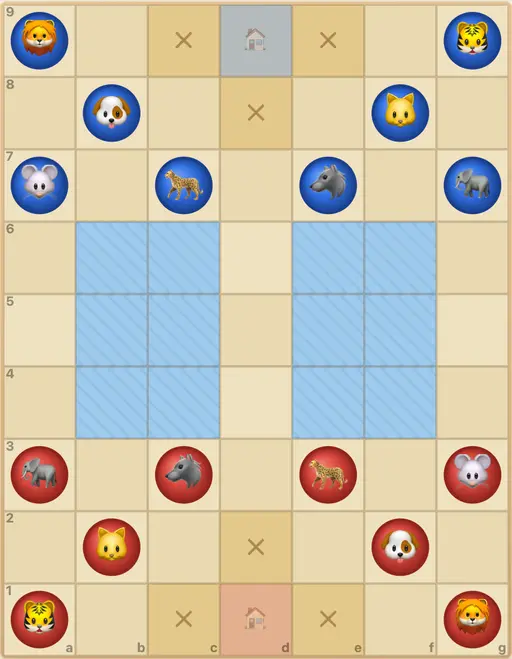
About Jungle
In Jungle, animal ranks must be read together with the terrain. Traps change capture vulnerability, river squares restrict access, and either player's rat can obstruct a lion or tiger crossing. Sound analysis starts with a legal route and a concrete threat to the opposing den, not a comparison of animal ranks in isolation. This guide explains those interactions, then uses a blocked river jump and staged exercises to connect the rules with practical attack and defense.
- Ruleset covered
- 7×9 Jungle (Dou Shou Qi): dens, traps, rivers, and lion–tiger river jumps
- Updated
- · Editorial policy and corrections
JungleRules and variant distinctions
The board, dens, traps, and rivers
Jungle, also known as Dou Shou Qi, is played on a board seven columns wide and nine rows deep. Red's den is at the center of the bottom row, and Blue's is at the center of the top row. Three trap squares surround each den. Two river areas occupy the middle of the board. Red moves first. Your objective is to move any one of your pieces into the opposing den while preventing the opponent from entering yours. You may never move a piece into your own den. Defend the approaches to it rather than trying to occupy the den itself. An animal in an opponent's trap has an effective rank of zero and is vulnerable to capture by any opposing animal. Its normal rank returns when it leaves that trap. Your own traps do not reduce your animals' ranks. Always identify who owns a trap before evaluating a capture; the same terrain has different consequences for the two players.
Animal ranks and ordinary captures
The eight ranks, from lowest to highest, are rat (1), cat (2), dog (3), wolf (4), leopard (5), tiger (6), lion (7), and elephant (8). Under the ordinary rank rule, an animal can capture an opposing animal of equal or lower rank. A dog, for example, can capture a cat or rat but not an untrapped wolf. The rat–elephant relationship is an exception to the ordinary hierarchy: on land, a rat can capture an elephant, while an elephant cannot capture an untrapped rat. Trap-induced vulnerability and terrain restrictions must also be checked; the printed rank alone does not establish legality. An ordinary move is one square horizontally or vertically, never diagonally. You may move onto an empty legal square or capture an eligible opposing piece on the destination. You cannot occupy a square containing one of your own pieces. The lion and tiger have a separate river-jump move, described below.
Rats and the boundary between water and land
Only rats may enter river squares. Other animals cannot step into the water. A lion or tiger may cross a river only by a legal jump that lands on the opposite bank; it does not occupy an intermediate water square. A rat can capture an elephant only when both animals are on land. A rat in the river cannot capture an animal on land, and an animal on land cannot capture a rat in the river. If two opposing rats occupy adjacent river squares, they may capture one another under the ordinary movement rule. Assess the departure and destination terrain together. A low-ranked rat can be strategically important because it can use water routes and obstruct river jumps, not merely because it threatens elephants on land.
Lion and tiger jumps require a clear river path
A lion or tiger next to a river may jump horizontally or vertically across the entire river segment to the opposite bank. The starting square must be adjacent to the water, and every water square along the jump's path must be empty. A rat belonging to either player blocks a jump if it occupies any water square on that path. The landing square may be empty or occupied by an opposing animal that the jumping piece is legally allowed to capture. An occupied landing does not suspend the rank and terrain rules. The destination cannot contain your own piece or be your own den. A river jump is one complete move. You cannot continue moving after landing. Check the entire path before the destination: an empty opposite bank does not make a jump legal when a rat blocks the water between the two banks.
Den entry, immobilization, and the no-capture draw
Entering the opposing den with any one of your animals wins immediately. You also win if the opponent has no legal move when their turn begins. There is no pass that lets an immobilized player continue, and victory is not awarded by counting the animals left on the board. This Ply Yard variant declares a draw after 60 consecutive half-moves without a capture. A half-move means one move by one player, not a pair of moves by both players. The rule therefore measures 60 individual turns without a capture, rather than 60 turns for each side. Online players may resign or offer a draw; an accepted offer ends the game. Computer and same-device play allow resignation or a new game. Treat the stated no-capture limit as a platform rule rather than assuming it applies to every published or household Jungle ruleset.
Selecting and completing a legal move
Check the status display to see whether Red or Blue is to move. Select one of that side's animals. The board highlights its legal empty destinations and eligible capture targets; select one highlighted destination to complete the move and pass the turn to the opponent. If no destinations are highlighted, that animal has no legal move in the current position. You may select a different animal before committing a destination; changing the selection does not consume the turn. Before moving, compare den threats and defensive responsibilities as well as possible captures. A higher-ranked animal may be unable to protect a critical approach because of a river, a trap, or the location of a blocking rat. Use the displayed legal moves to verify the position, not as a substitute for evaluating the opponent's reply.
Common illegal moves and a practical legality checklist
Illegal moves include diagonal steps; ordinary moves of more than one square; entry into your own den; entry into the river by an animal other than a rat; captures across the water–land boundary; and lion or tiger jumps across a path containing a rat. You also cannot move the opponent's animals, land on your own piece, or capture a target that fails the applicable rank and terrain tests. Under the normal, untrapped rat–elephant relationship, an elephant cannot capture a rat. Do not extend that rank exception into a claim that traps have no effect: an animal in an opponent's trap has rank zero. Check trap ownership before applying the ordinary hierarchy. For each candidate move, verify ownership, movement geometry, water access, the full jump path if relevant, destination occupancy, trap effects, and capture eligibility. Only then compare its strategic value. This procedure prevents an attractive but illegal capture from becoming the basis of a longer variation.
Practical strategy
Identify both dens, each player's traps, and the river squares. Compare the legal actions of the same animal on different terrain.
Explain how trap ownership changes effective rank and how the water–land boundary changes capture eligibility. Do not evaluate the position from animal ranks alone.
Set up a lion or tiger river jump with a clear water path, then place a rat on that path without changing the starting or landing squares.
Show why the first jump is legal and the second is blocked. Check every intervening water square, regardless of the rat's owner.
Review an attack on the opposing den. Track the defending animals and control of the adjacent trap squares.
Identify a concrete legal entry threat and the opponent's available replies. Explain how terrain affects the attack rather than merely comparing the attackers' and defenders' ranks.
A common misconception
A higher-ranked animal can always capture a lower-ranked animal.
Rank has exceptions, notably the rat–elephant relationship. Capture also depends on water and land, trap effects, and a legal movement path.
Position study: A rat in the river blocks the crossing
A lion or tiger faces an otherwise valid river crossing. The destination on the opposite bank is empty, but a rat occupies one water square on the jump path. Assume the remaining movement conditions are satisfied.
Can the lion or tiger jump over the rat and land on the opposite bank?
Show the answer and analysis
No. A rat anywhere on that river-jump path blocks the crossing. The empty landing square does not override the obstruction, and the rat's ownership does not change the result.
Evaluate a river jump as a move along a complete path, not merely between two legal endpoints. Rats influence mobility by closing lion and tiger routes; their usefulness is not limited to the special capture of elephants on land.
This position was constructed for instruction. It is not a tournament record or an engine-verified proof of an optimal move. Evaluate it under the stated conditions; do not assume unlisted features of the complete position.
Structured practice
Understand the rules
Identify dens, your own traps, opposing traps, and river squares. Compare one animal's legal actions on different terrain.
Assessment: Explain how effective rank and capture eligibility change with trap ownership and the water–land boundary.
Compare candidate moves
Construct the same river-jump route twice: first with a clear water path, then with a rat on an intervening water square.
Assessment: Change only the water obstruction and explain why it changes the jump's legality, regardless of which player owns the rat.
Review and verify
Review an attack on the opposing den. Track the defending animals and the control of trap squares along the approach.
Assessment: Identify an actual legal den-entry threat and the available defense, rather than evaluating the attack by animal ranks alone.
Frequently asked questions
Can a rat really capture an elephant?
Yes, when both are on land and the move satisfies the ordinary movement and destination rules. The rat–elephant relationship is an exception to the normal rank hierarchy: an elephant cannot capture an untrapped rat. A rat in the river cannot capture an elephant on the bank. Check trap effects separately before evaluating a particular position.
Can lions and tigers always jump across a river?
No. The lion or tiger must begin next to the river, the jump must follow a horizontal or vertical river crossing, and every water square on that path must be empty. Any rat on the path blocks the jump, including a rat of the same color. The landing square must also be legal: empty, or occupied by an opposing animal eligible for capture.
What happens when an animal enters an opponent's trap?
Its effective rank becomes zero, making it vulnerable to capture by any opposing animal. Leaving that trap restores its normal rank. A piece on its own side's trap does not lose rank. Trap ownership matters, so do not treat every trap square as weakening both players equally.
Why can't I move into my own den to defend it?
Your den is the opponent's winning destination, not a legal square for your own animals. None of your pieces may enter it. Defend by controlling the approaches, using the surrounding traps, and preventing legal entry on the opponent's next turn—not by placing a guard inside the den.
Does Red move first in every play mode?
Yes. Red moves first in computer play, same-device play, and online rooms. Against the computer, you may choose Red or Blue. If you choose Blue, the computer takes the first turn as Red. Choosing a side does not reverse the move order.
Can a game continue indefinitely without a capture?
Not under the platform rule described here. The game is drawn after 60 consecutive half-moves without a capture. That is 60 individual moves, counting both players' moves in sequence, not 60 complete pairs of turns. Online players may also offer and agree to a draw before the limit is reached.
Can a lion or tiger jump over a rat in the river if the opposite bank is empty?
No. A rat on any water square of the chosen jump path prevents that jump. Its color is irrelevant, and an empty landing square does not remove the obstruction. Check the full crossing rather than only its endpoints. A rat's strategic value includes blocking these routes as well as threatening elephants on land.
Does a higher-ranked animal always capture a lower-ranked one?
No. Ordinary rank comparison is only part of the test. Rats and elephants have a special relationship, water separates some otherwise adjacent capture opportunities, traps change effective rank, and the movement itself must be legal. Compare the animals only after checking the terrain, path, and destination conditions.
Put your understanding into practice.
Choose one skill to work on in your next game. A clear reason for each move is more useful than an immediate win.
Play JungleRules sources and editorial notes
- Current rules for this game on Ply Yard
Identifies the board variant and interface described here. Platform instructions are not a complete statement of every tournament ruleset.
This guide combines the relevant board's rules with independently constructed examples and exercises. It distinguishes basic rules, variant-specific provisions, and strategic advice. Rules sections draw on the sources listed above. Instructional positions have not been presented as exhaustively engine-verified or certified by professional players.
Written by Ply Yard. Independent review by a named professional player has not been completed. To report an issue, send the game, ruleset, position, and relevant source provision to contact@plyyard.com.