 Ply Yard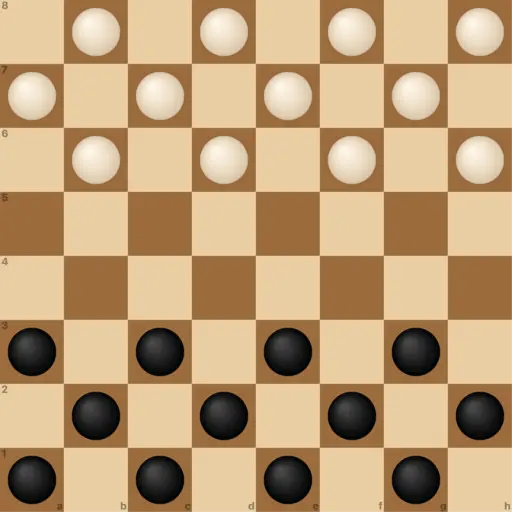
About Checkers
In American checkers, compulsory captures shape the position before ordinary moves enter the calculation. A king is a short-range piece, and a man that reaches the king row ends its turn even during a capture. These rules can change the outcome of an otherwise similar combination. This guide separates legal move selection from strategic evaluation so that a forced capture is analyzed as a consequence of the preceding play, not treated as an interface restriction.
- Ruleset covered
- 8×8 American checkers (English draughts): short-range kings; men capture forward only
- Updated
- · Editorial policy and corrections
CheckersRules and variant distinctions
The board, starting position, and first move
American checkers, also called English draughts, is played on the dark squares of an 8×8 board. Each player starts with 12 men on the dark squares of the three rows nearest that player. Black moves first, and the players alternate turns. Light squares are not playing squares. On Ply Yard, select one of your pieces and then a legal destination. If a move is unavailable, check the entire board for a compulsory capture before assuming that the interface is unresponsive. A piece with an ordinary move may still be ineligible to move because another piece must capture.
Men move and capture forward
An uncrowned piece is called a man. Its ordinary move is one square diagonally forward onto an empty dark square. To capture, it jumps over an adjacent opposing piece diagonally forward and lands on the empty square immediately beyond it. The captured piece is removed. Men cannot move or capture backward in this variant. After a capture, the same piece must continue capturing if another legal jump is available, subject to the promotion rule below. Before calculating a long combination, identify the adjacent opponent, the landing square, and any subsequent capture. An occupied landing square makes that jump illegal.
Captures are compulsory, but the longest sequence is not
If any of your pieces has a legal capture, you must capture; you may not make an ordinary move with that piece or another piece. When several captures are available, you may choose among them. American checkers does not require the sequence that captures the greatest number of pieces. Choosing a sequence does not give you permission to stop partway through it. Continue with the same piece whenever a further legal capture is available, unless the man has just reached the king row. When a move is rejected, check for a compulsory capture, an occupied landing square, or an attempted move onto a light square.
Promotion and short-range kings
A man that reaches the opponent's back row—the king row—is promoted to a king. A king may move one square diagonally forward or backward. It may also capture in either direction by jumping over an adjacent opposing piece to the empty square immediately beyond it. Kings do not slide along a diagonal or capture from a distance. If a man reaches the king row during a capturing sequence, its turn ends there. It cannot immediately continue backward as a newly crowned king. This exception is essential when calculating combinations and distinguishes this game from variants with different promotion rules. In computer play, you control Black and the computer controls White. Two players alternate moves in same-device play and online rooms. The movement and capture rules remain the same in all three modes.
Winning, immobilization, and draws
You win if your opponent has no pieces remaining or has no legal move when their turn begins. Immobilization is a loss, not a draw: a player can lose with pieces still on the board if every legal move is blocked. Players may agree to a draw. Ply Yard also records a draw after an extended period without a capture or promotion. Do not import a numerical move limit from a different ruleset; the applicable threshold is an implementation detail of this board. For a first complete game, focus on three habits: use only dark squares, inspect every compulsory capture before moving, and recognize when a man reaches the king row. Accurate rule application is more useful than an early win obtained by overlooking a forced reply.
Practical strategy
Set up three positions: one with no capture, one with a single capture, and one with a two-jump sequence.
Before choosing an ordinary move, inspect all of your pieces. Explain why a quiet move is legal only when no capture is available anywhere on the board.
Replace the two-jump position with one in which the first jump reaches the king row.
Identify the square of promotion and explain why the turn ends there. Contrast this with Russian draughts, in which a capturing man can continue as a king after promotion.
Review a game in which you were compelled to capture. Find the opponent's preceding move that made the capture available.
Compare the resulting positions after each legal capture choice. Separate a strategically unfavorable sequence from an illegal one; capturing fewer pieces is not itself a rules violation.
A common misconception
A king in American checkers can travel any distance along a diagonal.
This variant uses short-range kings: an ordinary move is one diagonal square, and a capture jumps an adjacent opponent. Flying kings belong to other draughts variants.
Position study: A multiple capture must be completed
Black moves toward higher-numbered ranks. Place a Black man on c3 and White men on d4 and f6. Squares e5 and g7 are empty, and there are no other pieces on the relevant diagonals.
Can Black end the turn after c3–e5?
Show the answer and analysis
No. After jumping over d4 and landing on e5, the same man can capture the White man on f6 and land on g7. Black must complete c3–e5–g7. Neither landing reaches the king row, so promotion does not end the sequence.
List the available capture routes, then verify each landing square in order. American checkers does not require a maximum-length capture, but a chosen sequence cannot be stopped while that piece still has a legal continuation. These are separate requirements: freedom to choose a route does not permit an incomplete route.
This position was constructed for instruction. It is not a tournament record or an engine-verified proof of an optimal move. Evaluate it under the stated conditions; do not assume unlisted features of the complete position.
Structured practice
Understand the rules
Construct positions with no capture, a single capture, and a two-jump capture. Identify which moves are legal before comparing their strategic value.
Assessment: Consider ordinary moves only after checking that no piece has a legal capture anywhere on the board.
Compare candidate moves
Construct a capturing position in which the first landing is on the king row. Decide whether a further backward jump belongs to the same turn.
Assessment: Explain that promotion ends the turn in American checkers and distinguish this procedure from Russian draughts.
Review and verify
Review a compulsory capture from one of your games. Identify the opponent's preceding move and compare your available capture routes.
Assessment: Describe the consequences of each choice without labeling a shorter capture sequence illegal merely because a longer one exists.
Frequently asked questions
Is American checkers the same game as Chinese checkers?
No. American checkers uses the dark squares of an 8×8 board, and the objective is to capture or immobilize the opponent's pieces. Chinese checkers is a race across a star-shaped board: pieces move to an opposite destination area and may jump over pieces without capturing them. The shared English name does not imply shared rules.
May I decline a capture and move another piece instead?
No. If any legal capture is available, you must capture. You may choose among available capturing pieces and routes, but you cannot substitute an ordinary move. Once a sequence begins, continue with that piece while another capture is available, except when a man reaches the king row and its turn ends.
Can a king travel the full length of an open diagonal?
No. Kings in American checkers move one square diagonally and capture by jumping an adjacent opposing piece onto the empty square immediately beyond it. They can move and capture backward, but they are not flying kings. International draughts uses flying kings on a 10×10 board; those rules do not apply here.
Who moves first, and can pieces use light squares?
Black moves first. Every piece starts, moves, and lands on a dark square. Light squares are outside the playing area, so selecting one does not produce a move. If a dark-square move is unavailable, also check whether a capture is compulsory elsewhere.
Can Black end the turn after capturing from c3 to e5?
In the example here, no. With White men on d4 and f6 and empty landing squares e5 and g7, the Black man must capture from c3 over d4 to e5, then over f6 to g7. Black is moving toward higher-numbered ranks, so neither landing square is the king row. The promotion exception does not apply. The complete sequence is c3–e5–g7.
What is the difference between a short-range king and a flying king?
A short-range king, used here, makes an ordinary move to an adjacent diagonal square. A capture requires an adjacent opposing piece and an empty square immediately beyond it. A flying king, used in other draughts variants, has long-range diagonal movement and different capture possibilities. Learn the variant before analyzing a king ending; identical piece placement can produce different legal moves.
Put your understanding into practice.
Choose one skill to work on in your next game. A clear reason for each move is more useful than an immediate win.
Play CheckersRules sources and editorial notes
- Current rules for this game on Ply Yard
Identifies the board variant and interface described here. Platform instructions are not a complete statement of every tournament ruleset.
This guide combines the relevant board's rules with independently constructed examples and exercises. It distinguishes basic rules, variant-specific provisions, and strategic advice. Rules sections draw on the sources listed above. Instructional positions have not been presented as exhaustively engine-verified or certified by professional players.
Written by Ply Yard. Independent review by a named professional player has not been completed. To report an issue, send the game, ruleset, position, and relevant source provision to contact@plyyard.com.