 Ply Yard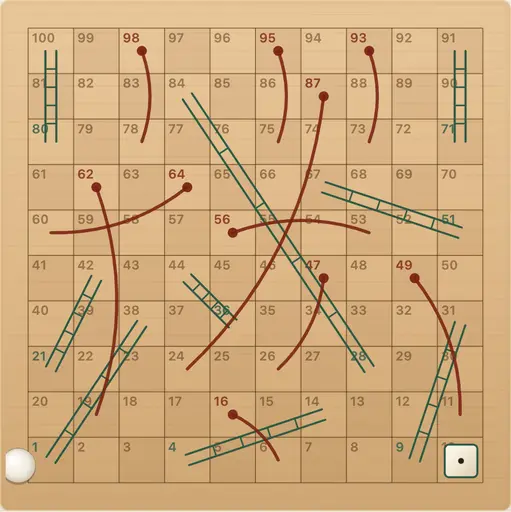
About Snakes and Ladders
The current board gives each player one token and a fixed route determined by the die. There is no capture or landing choice comparable to tactical board games. Teach alternating-row reading, automatic landing transfers, exact-finish handling, and carefully scoped probability. Do not repackage random results as advanced strategy or claim that a computer opponent can select a better legal movement after the roll.
- Ruleset covered
- Ply Yard's hundred-square Snakes and Ladders: exact direct finish, overshoots stay put, and no bonus roll for six
- Updated
- · Editorial policy and corrections
Snakes and LaddersRules and variant distinctions
Read the alternating rows of the hundred-square track
Ply Yard's Snakes and Ladders uses a 10×10 track numbered from 1 to 100. The bottom row runs left to right from 1 to 10; the next runs right to left from 11 to 20. Subsequent rows alternate direction, with 100 at the upper-left corner. Follow the numbers rather than count every row in the same visual direction. Square 11 is directly above 10, not at the opposite edge. Each player has one token, initially off the board at position 0. The first roll advances that token from 0 by the indicated number of squares. No particular roll is required to enter. Rolling 1 on the opening turn lands on the foot of the ladder at 1 and immediately carries the token to 38. The platform's Black player rolls first in every mode. In computer play, choosing White means the computer takes the opening Black turn. Black and White identify the players and tokens, not different movement rules. There are no protected squares or player-built barriers. Practice the row changes before calculating long movements. Locate 10, 11, 20, 21, 99, and 100, and explain why successive numbered squares sometimes run leftward and sometimes rightward. Reading the track correctly prevents movement errors; it does not let a player choose a different route.
One six-sided die, one token, and no bonus for rolling six
On your turn, roll one six-sided die and advance your token by its value along the numbered track, provided that the move does not exceed 100. The board highlights the destination for the roll. Resolve any snake or ladder triggered there, then pass the turn to the opponent. If the roll exceeds the remaining distance to 100, the token stays where it is and the turn still passes. Rolling six does not grant another roll. Tokens may occupy the same square without capturing, blocking, exchanging positions, or sending each other back to the start. These rules differ from Ludo and Aeroplane Chess; their bonus-roll or capture mechanisms do not apply here. There is only one token to move and one fixed route. The roll determines the destination; a player cannot select another landing square to avoid a snake or seek a ladder. The useful task is to understand what the given result does, not to invent tactical choices that the game does not offer. For each turn, record the starting position, rolled value, numbered destination, and any resulting transfer. Keep ordinary movement separate from the snake or ladder effect. That distinction is especially important near a row boundary or the finish.
Snakes and ladders trigger only when the roll lands on their starting square
Landing exactly on a ladder's lower endpoint immediately moves the token to its upper endpoint. Landing exactly on a snake's head immediately moves it to the tail. These effects occur during the same turn, not on the next turn. Passing over a starting square during numbered movement does not trigger its snake or ladder. The platform's ladders are 1→38, 4→14, 9→31, 21→42, 28→84, 36→44, 51→67, 71→91, and 80→100. Its snakes are 16→6, 47→26, 49→11, 56→53, 62→19, 64→60, 87→24, 93→73, 95→75, and 98→78. These are the current board's connections, not a universal layout for every Snakes and Ladders product. Landing on 80 climbs to 100 and wins. Landing on 98 instead slides to 78; passing through 98 while landing on 99 does not trigger that snake. Distinguish a numbered landing from the position after the automatic transfer. Near the finish, identify the destination for each possible roll and apply its trigger if present. This helps explain why a leading token can fall behind, but it does not give the player control over the die. An unfavorable transfer is part of the fixed rules, not evidence of an incorrect tactical choice.
Reach 100 exactly; an overshoot stays put rather than bouncing back
A direct die move to 100 requires the exact remaining distance. From 97, a roll of 3 wins. Rolls of 4, 5, or 6 exceed 100, so the token remains on 97 and the opponent takes the next turn. There is no bounce-back movement, automatic truncation to 100, or extra roll for an overshooting six. A smaller roll can still move the token without finishing, subject to its destination's snake or ladder. From 97, rolling 1 lands on 98 and slides to 78, while rolling 2 reaches 99. Thus not every nonwinning roll leaves the token in place, and the exact-finish rule must be read together with the board's triggers. For a fair six-sided die, any one specified face has probability 1/6. If a token is one to six squares short of 100, the face that reaches 100 directly has that probability on the next roll. This is a one-roll statement, not a guarantee of finishing within six turns or a calculation of the entire game's winning probability. When counting all possible one-turn wins, also inspect a ladder leading to 100. For example, from 79, rolling 1 lands on 80 and wins through the ladder even though no ordinary roll reaches 100 directly. Exact direct arrival and arrival by an authorized ladder are both legal ways to finish. Do not replace a full outcome calculation with distance alone.
A race governed by chance, not a contest of tactical move selection
The first player to reach 100 legally wins, either by the exact direct roll or through the ladder from 80. The game does not award a separate score for ladders climbed, snakes encountered, or distance previously traveled. A player who was ahead earlier has not necessarily secured the result. In this single-token, single-die version, there is no meaningful choice among pieces or routes after a roll. Outcomes primarily depend on the random rolls and fixed track. Professional instruction should teach rule recognition, numerical reading, and probability without claiming a winning opening, an avoidance strategy, or superior computer tactics that the legal actions cannot support. Online rooms allow resignation or an offered draw; an agreed draw is recorded as such. Computer and same-device play allow resignation or starting a new game. These controls do not alter the exact-finish, no-bonus-six, or automatic-transfer rules. In an online room, rolled values are synchronized so both players see the same result; that visible synchronization is not, by itself, a technical claim about randomness verification. Train in three stages: read alternating row directions, distinguish landing-triggered transfers from passing over them, and enumerate next-roll outcomes near 100. In review, describe what each roll required rather than blame a forced move as a strategic error. The learning value lies in applying a clear ruleset and understanding chance honestly.
Practical strategy
Locate 10, 11, 20, 21, 99, and 100 on the alternating-row track.
Follow the numerical sequence across row boundaries rather than read every row from left to right.
Compare landing on a ladder foot, passing over it, and landing on a snake's head.
Only a numbered landing on the starting square triggers the transfer. Apply it immediately during that turn.
Record the remaining distance to 100 and calculate the chance of the exact direct-finishing face on one fair-die roll.
For a distance of one to six squares, that specified face has probability 1/6. Separate this calculation from other winning ladder outcomes and from eventual game-winning probability.
A common misconception
Winning always proves stronger advanced strategy.
This single-token, single-die version offers no meaningful movement choice after a roll. Random results and the fixed track primarily determine the winner; rule accuracy and probability literacy are separate learning goals.
Position study: An overshoot is not a bounce-back move
Your token is on 97 and you roll 4. This implementation requires an exact direct arrival at 100 and leaves an overshooting token in place.
Should the token bounce backward, finish on 100, or stay on 97?
Show the answer and analysis
Stay on 97 and pass the turn. Neither bounce-back movement nor automatic truncation at 100 applies to this ruleset.
The roll produces no legal advance because it exceeds the remaining distance. There is no alternative token or route to select. This exercise develops rule recognition and numerical understanding, not a tactical method for changing the roll. Using 97 also avoids treating the snake head at 98 as a normal settled position after a legal landing.
This position was constructed for instruction. It is not a tournament record or an engine-verified proof of an optimal move. Evaluate it under the stated conditions; do not assume unlisted features of the complete position.
Structured practice
Understand the rules
Find 10, 11, 20, 21, 99, and 100 on the track and describe each row transition.
Assessment: Follow alternating numerical directions rather than assume every row reads left to right.
Compare candidate moves
Compare landing on a ladder foot, passing over it, and landing on a snake's head.
Assessment: Apply a transfer only for a numbered landing on its starting square, during the same turn.
Review and verify
Calculate the probability of the exact direct-finishing roll when one to six squares remain.
Assessment: For a fair six-sided die, the specified face has probability 1/6 on one roll. Do not confuse it with eventual winning probability or ignore other winning ladder outcomes when counting all possible finishes.
Frequently asked questions
Why does rolling six not give me another turn?
This implementation has no bonus roll for a six. Each turn uses one six-sided die roll, followed by the required movement and any landing-triggered transfer. The turn then passes to the opponent. Do not import the extra-roll rules of Ludo or Aeroplane Chess.
Why does my token stay in place when the roll would exceed 100?
A direct finish requires the exact distance to 100. An overshooting roll cannot be played, so your token stays on its current square and the turn passes. You do not bounce backward or stop automatically on 100. Smaller legal rolls may still advance the token and trigger a snake or ladder.
Does a snake or ladder apply immediately or on my next turn?
Immediately, during the turn that lands on its starting square. A ladder carries the token from its foot to its top; a snake carries it from its head to its tail. Merely passing over that square does not trigger the effect. Resolve the transfer before the opponent's turn.
Is this Hasbro's Chutes and Ladders?
No. This is Ply Yard's Snakes and Ladders implementation, not a product presented under Hasbro's Chutes and Ladders name. Use the snake and ladder layout and exact-finish rule stated for this board rather than assume a branded product's rules or artwork apply.
Does Black always roll first?
Yes, in each mode. In computer play, you may choose Black or White. If you choose White, the computer plays Black and rolls first. Player color does not change the movement or finish rules.
What happens to a die result in an online room?
Once rolled, the value is synchronized to the room so both players see the same result. Apply that shared value under the same movement, overshoot, and landing-trigger rules. The published explanation describes synchronization; it does not establish additional claims about server architecture or independent randomness certification.
From 97 with a roll of 4, do I bounce back, finish, or stay put?
Stay on 97 and pass the turn. The roll exceeds the exact distance to 100. Bouncing back or truncating the move at the finish belongs to other variants, not this implementation. There is no alternative piece or route to choose. The exercise tests rule recognition, not a decision that could change the rolled value.
Does winning demonstrate stronger advanced strategy?
Not in this single-token, single-die ruleset. There is no choice among movement routes or pieces, and outcomes primarily depend on random rolls and the fixed track. Players can improve their rule accuracy, numerical reading, and probability understanding, but a win alone does not establish superior tactical decision-making.
Put your understanding into practice.
Choose one skill to work on in your next game. A clear reason for each move is more useful than an immediate win.
Play Snakes and LaddersRules sources and editorial notes
- Current rules for this game on Ply Yard
Identifies the board variant and interface described here. Platform instructions are not a complete statement of every tournament ruleset.
This guide combines the relevant board's rules with independently constructed examples and exercises. It distinguishes basic rules, variant-specific provisions, and strategic advice. Rules sections draw on the sources listed above. Instructional positions have not been presented as exhaustively engine-verified or certified by professional players.
Written by Ply Yard. Independent review by a named professional player has not been completed. To report an issue, send the game, ruleset, position, and relevant source provision to contact@plyyard.com.