 Ply Yard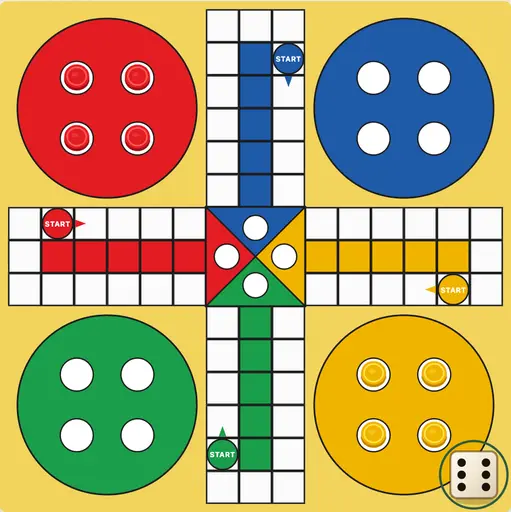
About Ludo
Ludo decisions balance entering more tokens, advancing active ones, capturing, and securing completed tokens. Identify safe squares before counting the opponent's one-through-six landing threats. This implementation permits friendly stacks, captures entire opposing stacks on unsafe squares, and awards specified bonus rolls; those rules should not be assumed identical across household variants. Evaluate the current legal choices without planning around a guaranteed favorable next roll.
- Ruleset covered
- Ply Yard's two-player Red-versus-Yellow Ludo: enter on 6 and finish by exact roll
- Updated
- · Editorial policy and corrections
LudoRules and variant distinctions
Two active colors on a cross-shaped board
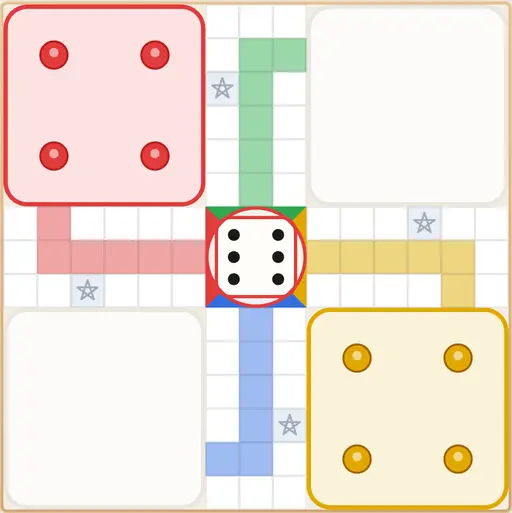
Ply Yard uses a 15×15 cross-shaped Ludo board with corner bases, a shared circuit, and colored home paths leading to the central finish. The current game is for two players: Red and Yellow, with four tokens each. The Green and Blue bases are visible but do not supply additional players. Red rolls first in every mode. A token leaves its base onto its own starting square, travels clockwise around the shared circuit, and then enters its own colored home path. Once inside that path, it continues toward the finish and cannot return to the circuit. Completing the route requires an exact roll: a token cannot overshoot the finish or be placed there simply because the roll is larger than the remaining distance. Keep three locations distinct: the base where a token waits to enter, the starting square on the circuit, and the central finish where its journey ends. Entry is not completion, and reaching the home path does not yet mean the token has finished.
Roll, choose one token, and complete a legal move
Roll the die, then select one of your highlighted tokens. The highlights indicate which tokens can legally use that roll. If there is no legal choice, no token moves and play passes to the opponent under the platform's instructions. A single roll is spent on one token; it is not divided among several. A token in the base requires a 6 to enter. When you roll 6, you may bring a new token onto its starting square or advance an already active token by six squares, provided that move is legal. These are alternative uses of the same roll, not two actions you may combine. If the roll is not 6, a token already in play may still advance by that value; waiting tokens simply remain in the base. Your tokens do not capture one another and may occupy the same square. Do not assume this creates protection against capture: on an unsafe circuit square, the platform allows an opponent to send all your tokens on that square back to base. Other Ludo variants may use different stacking or blockade rules. In the home path, a token is protected from opposing captures, but the exact-finish requirement still applies. If it is three squares from the finish, a 3 completes it and a larger roll cannot move that token. Inspect your other legal choices rather than treating the oversized roll as permission to finish anyway.
Captures and the eight safe circuit squares
On the shared circuit, landing exactly on an opposing token's square captures it unless that square is safe. The captured token returns to its base and needs another 6 to enter again. If several opposing tokens share the unsafe destination, they all return to base. Merely passing an opponent along the route is not a capture; the final landing must coincide. The four starting squares and the four starred circuit squares are safe. Tokens on them cannot be sent back even if an opponent lands on the same square. A token in its own home path is also beyond opposing capture. Identify the destination's status before announcing a hit, rather than assuming every opposing token within the rolled distance is vulnerable. For risk assessment, trace each active opposing token's legal route and check whether a roll from 1 through 6 would land exactly on your proposed destination. Exclude routes that turn into a different home path and exclude safe destinations. If several opposing tokens threaten the same destination, list the actual applicable values; do not simply add distances on the visible grid. A capture removes the opponent's progress and earns another roll here, but the capturing token may itself become exposed. Compare the hit with a safe landing and with progress toward the home path. A safe square is a useful option, not a universal command to abandon a decisive finish or a stronger continuation.
Bonus rolls and the third consecutive 6
The platform awards another roll after a 6, a capture, or a token reaching the finish. Every new roll must still be used through a legal token choice. If it supplies no legal move, the turn ends; a bonus opportunity does not remove the entry or exact-finish restrictions. There is a specific penalty for rolling three consecutive 6s within the same turn. The third 6 is discarded: you do not move a token with it, and the turn passes to the opponent. Moves already completed with the first two 6s remain on the board. Do not undo them or spend the third 6 before applying the penalty. Evaluate a bonus roll as another uncertain opportunity, not as a guaranteed extra six-square move. A legal finish may earn another roll for your remaining tokens, while a capture may create both a new opportunity and new exposure. Plan from the current roll and position rather than assume the next die value will rescue an unsafe token.
Finish all four tokens, not the most captures
The first player to bring all four tokens to the central finish wins. Captures are not a separate score, and completing only one token does not end the game. Track the unfinished tokens individually: those still in base need entry, those on the circuit face capture risk, and those in the home path need exact finishing values. A roll of 6 can present several meaningful choices. Entering another token increases your future options, advancing a threatened token may reduce the cost of a possible capture, and finishing a token secures its progress. Compare the remaining distance, legal alternatives on later rolls, and the opponent's immediate threats. None of those objectives makes one choice best in every position. In an online room, players may resign or propose a draw; a mutually accepted draw is recorded as such. Computer and same-device play also provide resignation or a new game. These options are separate from the automatic four-token finish. For review, record the roll and legal candidates before considering the eventual outcome. Explain whether the choice favored entry, safety, capture, or completion, and whether that tradeoff was justified at the time. A later unfavorable roll alone does not establish that the decision was wrong. Do not import Aeroplane Chess's same-color jumps or cross-board flights into this Ludo route.
Practical strategy
With a token still in base and another active, demonstrate using a 6 to enter the waiting token, then reconstruct the position and use the same 6 to advance the active token.
Treat the two demonstrations as alternative moves, never as two uses of one roll. Confirm the advanced token's destination is legal and explain why entry is optional when another legal six-square move exists.
Choose a candidate circuit destination and trace the opposing tokens' routes backward by one through six squares. Repeat with a starred square as the destination.
Identify only die values that create an actual legal landing. Exclude safe-square captures and routes that diverge into a home path. Passing a token or being geometrically nearby is not sufficient.
In a late position, compare a legal finish, an available capture, and entry of a waiting token using the current roll.
Explain each candidate's concrete gain and cost, including remaining tokens and exposure. Do not assume the next roll is 6, or label one objective universally superior without checking the position.
A common misconception
A 6 may only be used to release a token from base.
A 6 may instead advance an active token when that move is legal. Entry and advancement are alternative uses of the same roll; exact finishing and the third-consecutive-6 penalty still apply.
Position study: A 6 does not require a new entry
Two of your tokens remain in base. One active token can reach the finish exactly with the current 6; advancing your other active token by six would land it on an exposed ordinary circuit square.
Must you spend this 6 on entering a new token?
Show the answer and analysis
No. You may use 6 on any active token with a legal six-square move. Entering, finishing, and the exposed advance are separate options; compare them rather than automatically choosing entry.
Consider remaining distance, future usable rolls, and the cost of being sent back. The exact finish secures one token, entry increases the active choices, and the exposed advance may create risk. The example identifies the alternatives without claiming that finishing is universally best. Spend the roll once, on one token.
This position was constructed for instruction. It is not a tournament record or an engine-verified proof of an optimal move. Evaluate it under the stated conditions; do not assume unlisted features of the complete position.
Structured practice
Understand the rules
Demonstrate entry with a 6 and advancement of an active token with a 6 from the same starting position.
Assessment: Present them as mutually exclusive uses of one roll. Check the active token's destination and do not perform both actions together.
Compare candidate moves
For a proposed landing, trace the opponent's routes by one through six steps and identify genuine capture values.
Assessment: Use legal route distances, exclude safe-square captures, and distinguish exact landing from passing or visual proximity.
Review and verify
Compare a finish, a capture, and an entry in a late position.
Assessment: Explain the specific tradeoffs and remaining-token needs without assuming the next roll will be 6.
Frequently asked questions
Why can a waiting token enter only when I roll 6?
That is the entry rule on this board. A non-6 roll cannot release a token from base, but it can still advance an active token if the move is legal. If you have no legal token for that value, no move is made. With a 6, choose between entering a waiting token and a legal six-square advance of an active one.
Can an opponent capture a token on a safe square?
No. The four starting squares and four starred circuit squares are safe, even when an opponent lands exactly there. Protection depends on the square, not on having several friendly tokens stacked together. An opposing landing on an unsafe square can send the entire stack back to base in this implementation.
Why do I roll again after a token finishes?
Finishing a token is one of this board's bonus-roll triggers, alongside a 6 and a capture. The new roll still needs a legal move with an unfinished token. If no legal choice exists, the turn ends. When the fourth token finishes, the game has already been won; a bonus roll does not continue it.
What happens after three consecutive 6s?
Within the same turn, the third consecutive 6 is discarded without a token move, and play passes to the opponent. The moves completed with the first two 6s stand. Do not apply this penalty to three unrelated 6s separated across different turns.
Why are there no same-color jumps or cross-board flights?
Those are Aeroplane Chess mechanisms, not the route rules of this Ludo board. Move along the prescribed circuit and your own home path according to the die. Board colors identify routes and safe locations; they do not authorize additional movement beyond the roll.
Does Red always roll first on Ply Yard?
Yes. Red begins in every mode. Against the computer, you may choose Red or Yellow; choosing Yellow lets the computer make Red's opening roll. Only Red and Yellow participate in this implementation, despite the four-color board layout.
Must a 6 always be used to enter a new token?
No. In the worked position, two tokens wait in base, one active token can finish exactly with 6, and another would land on an exposed circuit square. Entry, the exact finish, and the exposed advance are distinct candidates. Compare their consequences instead of mechanically entering whenever possible. The example does not claim finishing is always superior in every position.
Is a roll of 6 reserved exclusively for leaving base?
No. It may also advance an active token by six squares when legal. You still choose only one token for that roll. Check exact-finish restrictions, and remember that the third consecutive 6 within a turn is discarded before any token can use it.
Put your understanding into practice.
Choose one skill to work on in your next game. A clear reason for each move is more useful than an immediate win.
Play LudoRules sources and editorial notes
- Current rules for this game on Ply Yard
Identifies the board variant and interface described here. Platform instructions are not a complete statement of every tournament ruleset.
This guide combines the relevant board's rules with independently constructed examples and exercises. It distinguishes basic rules, variant-specific provisions, and strategic advice. Rules sections draw on the sources listed above. Instructional positions have not been presented as exhaustively engine-verified or certified by professional players.
Written by Ply Yard. Independent review by a named professional player has not been completed. To report an issue, send the game, ruleset, position, and relevant source provision to contact@plyyard.com.