 Ply Yard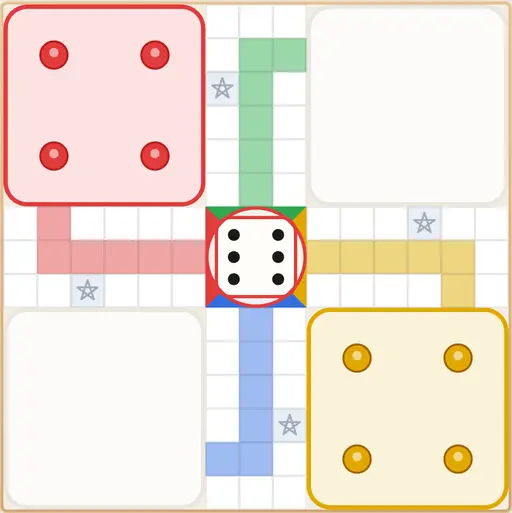
About Aeroplane Chess
Aeroplane Chess on this platform is a two-player race with four aircraft per side, deployment on six, and exact arrival at the finish. It does not use same-color jumps or cross-board flights. Strategic decisions therefore concern how many aircraft to activate, which unsafe destinations expose them to capture, and when to enter the home lane. This guide separates those choices from the uncertainty of future rolls and explains the extra-roll and three-sixes procedures that govern a complete turn.
- Ruleset covered
- Two-player Red-versus-Yellow Aeroplane Chess: no same-color jumps or cross-board flights
- Updated
- · Editorial policy and corrections
Aeroplane ChessRules and variant distinctions
The two-player board and flight route
Aeroplane Chess on Ply Yard uses a 15×15 cross-shaped board. The four corner areas are bases, the shared outer circuit is the main track, and the colored home lanes lead toward the center finish. This version is a two-player race: Red and Yellow each control four aircraft. The Green and Blue bases are not active starting positions. Red rolls first. An aircraft leaves its base for its own starting square, follows the shared track clockwise for one circuit, then enters its own home lane. Reaching the finish requires the exact die result. An aircraft cannot enter the finish with excess movement. The conventional game name does not establish every rule. This guide covers the current platform version, not a physical-board variant with same-color jumps or cross-board flights.
A six allows an aircraft to leave its base
All four aircraft begin in their owner's base. Only a roll of six allows you to move one of them onto its starting square. If several remain in the base, choose which one to deploy. Deployment uses that die result; you do not also advance the newly deployed aircraft six track squares. A six does not compel deployment. If an aircraft already on the route can legally use that result, you may advance it instead. Compare the value of putting another aircraft into play with the progress or capture available to an active aircraft. A result other than six cannot deploy an aircraft, but it may still advance one already on the route. If no aircraft can legally use the rolled result, your turn ends. Having pieces in reserve is not permission to ignore the deployment requirement.
Use the full result with one aircraft and finish exactly
After rolling, choose one aircraft that can legally use the entire result. You cannot split the result among aircraft or use only part of it. Once an aircraft enters its own home lane, it follows that lane toward the finish. A result larger than its remaining distance cannot move that aircraft. Captures do not occur in the home lane. An aircraft that reaches the finish is home and no longer moves. You win immediately when all four of your aircraft have finished; the first arrival alone does not decide the game. Your aircraft may share a square without capturing one another. Still, consider the consequences of grouping them on the main track: on an unsafe square, an opposing landing can send every aircraft in that group back to base.
Captures and safe squares on the main track
On the shared track, landing on an opposing aircraft sends it back to its base unless the destination is a safe square. If several opposing aircraft occupy that unsafe square, all are returned to base together. Each returned aircraft must be deployed again with a six. The four starting squares and the four starred squares on the circuit are safe. An opposing aircraft may land on the same safe square without sending the aircraft already there back to base. Safety comes from the square's designation, not simply from matching your aircraft's color. To evaluate an unsafe destination, trace the opponent's route backward from it and identify which available aircraft could reach it with a result from one through six. Name the actual threatening results and positions instead of describing the move as vaguely risky. Include the opponent's choice of aircraft when evaluating the reply.
Extra rolls and the third consecutive six
Rolling a six, making a capture, or bringing an aircraft home grants another roll within the same turn. Each new result must still have a legal move. If no aircraft can use it, the turn passes to the opponent. An extra roll is an opportunity to act, not permission to move illegally or roll again instead of resolving an available move. The third consecutive six in the same turn is discarded: no aircraft moves for that result, and the turn ends. Aircraft moved after the first two sixes stay in their new positions. The rule does not return those earlier moves to their starting locations. A final arrival that completes all four aircraft wins immediately. There is no further play after that winning result. For other arrivals, compare the benefit of finishing an aircraft with the options that remain for the additional roll.
Winning the race, resignation, and agreed draws
The first player to bring all four aircraft to the finish wins. This is a race objective, not a score based on captures or the number of aircraft currently on the track. A capture can delay the opponent, but it does not replace the need to finish your own aircraft. Online players may resign or offer a draw. If both players agree to a draw, the board records a drawn game. Computer and same-device play allow resignation or a new game. Do not infer a full-board draw or a material-count result from the rules of other board games. In a review, distinguish controllable choices from the die results. Compare the legal alternatives available after a roll: deploying a second aircraft, capturing, advancing toward a safe square, or entering the home lane. A useful decision reduces risk or improves progress; it does not make future rolls certain.
Rolling and selecting an aircraft on Ply Yard
Check whether Red or Yellow is to act, then select the roll control. The board highlights aircraft that can legally use the result. Select one highlighted aircraft to make the move; there is no separate confirmation step. If no aircraft is highlighted, the result has no legal move and the turn passes to the opponent. If a result is waiting for an aircraft selection, you must resolve it before rolling again. An earned extra roll becomes available only after the preceding legal move is completed. Before selecting, inspect the resulting destination and whether the move deploys an aircraft, captures, enters the home lane, or finishes. Evaluate the specific options offered by this roll rather than planning a move that requires a different result.
Moves that this version does not allow
You cannot move before rolling, deploy with a result other than six, move an opposing aircraft, or force an aircraft into the finish with an oversized result. You cannot reroll while a legal selection is pending or change the die result yourself in an online room. This version has no automatic jump to the next square of the same color and no flight across the board to an opposite starting square. A color match on an ordinary track square does not add movement beyond the rolled result. Check these variant rules before calculating a route or exposure to capture. Importing an extra jump from a different edition changes the endpoint, the opponent's possible replies, and the value of every subsequent decision.
Practical strategy
Construct examples of deployment, an extra roll, an exact finish, and a third consecutive six. State the legal action and whether the turn continues in each case.
Distinguish using a six to deploy from using it to advance an active aircraft. Calculate the exact distance to the finish and preserve moves already completed before the third six.
Choose an unsafe destination and count backward one through six squares along the opponent's route. Identify the opposing aircraft that could land there.
List the specific threatening die results and aircraft. Exclude safe destinations and moves that the opponent cannot legally make; do not describe the risk without identifying a route.
Review a decision involving deployment of a second aircraft, a possible capture, and entry into the home lane. Compare the legal alternatives for the actual roll.
Explain each move's benefit and exposure to the next opposing roll. Separate a sound decision from a favorable die result, and do not present luck as a guaranteed tactical win.
A common misconception
This board uses exactly the same rules as editions with automatic same-color jumps.
The current two-player variant described here has no same-color jumps or cross-board flights. Household rules and other platforms may differ.
Position study: A matching color does not grant extra movement
Your aircraft is on the shared track. A roll of three takes it to an ordinary unsafe square matching its color. It has not reached the finish, and no capture occurs.
May the aircraft jump four more squares because the destination matches its color?
Show the answer and analysis
No. This version has no same-color jump. The aircraft stays on the square reached using the rolled result. A special flight or movement bonus from another platform does not apply here.
Verify the edition before calculating routes or risk. An assumed extra jump changes the endpoint and invalidates the analysis of later movement and capture opportunities. Compare strategic choices only within the same ruleset.
This position was constructed for instruction. It is not a tournament record or an engine-verified proof of an optimal move. Evaluate it under the stated conditions; do not assume unlisted features of the complete position.
Structured practice
Understand the rules
Construct examples of deployment, extra rolls, exact arrival, and the third consecutive six.
Assessment: Distinguish deploying on six from advancing along the route, calculate the exact result needed to finish, and identify which completed moves remain after a discarded third six.
Compare candidate moves
For an unsafe destination, count backward one through six squares along the opponent's route and identify possible capturing aircraft.
Assessment: Name the die results that permit a legal capture instead of describing the position only as risky.
Review and verify
Review a choice between deploying a second aircraft, capturing, and entering the home lane, using the alternatives legally available for the rolled result.
Assessment: Explain each action's benefit and next-roll exposure without turning uncertain die outcomes into claims of a forced win.
Frequently asked questions
Why can't an aircraft leave its base without a six?
A six is required to deploy an aircraft onto its starting square. A smaller result cannot move an aircraft out of the base, although it may advance an aircraft already on the route. When you do roll six, you may either deploy an aircraft or use the result with an eligible active aircraft. If no aircraft has a legal move for the current result, the turn ends.
Are aircraft on safe squares protected from capture?
Yes. The four starting squares and four starred track squares are safe. An opponent landing on one of those squares does not send your aircraft back to base. On an ordinary unsafe track square, however, an opposing landing returns all of your aircraft on that square to their base.
Why do I receive another roll after an aircraft finishes?
In this platform version, bringing an aircraft home, making a capture, or rolling six grants an extra roll. The new result still requires a legal move; if none exists, your turn ends. If the arrival brings your fourth aircraft home, you have already won and the game ends instead of continuing.
What happens after three consecutive sixes?
The third consecutive six in the same turn is discarded. You make no move for that result, and the opponent takes the next turn. The moves completed after the first two sixes remain on the board; they are not undone, and the aircraft are not automatically returned to base.
Why can't I jump between matching colors or fly across the board?
Some physical-board editions allow a jump to another square of the same color or a special flight across the board. This Ply Yard version uses neither rule. Aircraft follow their legal route according to the die result, without additional movement merely because a landing square matches their color.
Does Red roll first in every play mode?
Yes. Red makes the first roll in computer play, same-device play, and online rooms. Against the computer, you may choose Red or Yellow. If you choose Yellow, the computer rolls first as Red. Choosing a side does not change the order of play.
After rolling three onto a matching-color square, may I jump four more squares?
No. In the worked example, the aircraft stops at the ordinary unsafe track square reached by the three. There is no same-color jump in this version, no capture has occurred, and the aircraft has not finished. Calculate the position using the stated route and die result rather than adding movement from another edition.
Are these rules identical to every familiar version of Aeroplane Chess?
No. This guide covers the current Red-versus-Yellow two-player version without same-color jumps or cross-board flights. Household editions and other platforms may use different movement bonuses, deployment requirements, or penalties. Confirm the edition before comparing routes, capture risks, or strategies.
Put your understanding into practice.
Choose one skill to work on in your next game. A clear reason for each move is more useful than an immediate win.
Play Aeroplane ChessRules sources and editorial notes
- Current rules for this game on Ply Yard
Identifies the board variant and interface described here. Platform instructions are not a complete statement of every tournament ruleset.
This guide combines the relevant board's rules with independently constructed examples and exercises. It distinguishes basic rules, variant-specific provisions, and strategic advice. Rules sections draw on the sources listed above. Instructional positions have not been presented as exhaustively engine-verified or certified by professional players.
Written by Ply Yard. Independent review by a named professional player has not been completed. To report an issue, send the game, ruleset, position, and relevant source provision to contact@plyyard.com.