 Ply Yard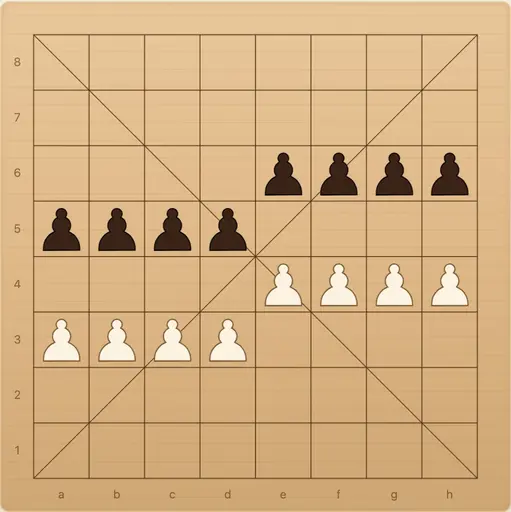
About Sittuyin
Sittuyin makes placement a formal part of the game. Promotion depends on a designated diagonal position, the absence of the player's own general, and a turn spent on the action. Setup plans, the general's survival, and pawn timing therefore belong to one connected analysis. Use the sin's five short-range directions and the sit-ke's one-step diagonals rather than modern bishop and queen assumptions, and apply the platform's prohibition on creating stalemate.
- Ruleset covered
- Ply Yard Sittuyin: formal sit-tee setup and conditional promotion on the opposing-half X diagonals
- Updated
- · Editorial policy and corrections
SittuyinRules and variant distinctions
Setup, short-range pieces, and conditional promotion
Sittuyin, or Burmese chess, begins with a placement phase called sit-tee. The pawns are already on the 8×8 board; White places the other eight pieces first, then Black places theirs. Only after both sides finish setup does White make the first ordinary move. Rooks must be placed on their own back rank, and the other pieces may not be placed there. Two unfamiliar movements deserve immediate attention. The sit-ke, or general, moves one diagonal square. The sin, or elephant, moves one square diagonally or one square straight forward. It does not make the Shatranj alfil's two-square jump or a modern bishop's long diagonal slide. Pawn promotion is neither an automatic reward for reaching the back rank nor a choice of modern pieces. It requires the platform's designated diagonals in the opposing half, the absence of your own sit-ke, and a separate promotion action using a turn. Setup, the survival of your general, and promotion timing must therefore be considered together.
The formal sit-tee placement phase
White's pawns start on a3–d3 and e4–h4, with Black's pawns in the mirrored opposing formation. White places the remaining eight pieces on vacant cells in White's half; Black then completes Black's placement. Use the prescribed pawn formation rather than replace it with a modern-chess second-rank pawn line. Rooks belong on the placing player's back rank. Kings, generals, elephants, and knights must occupy other vacant squares in that player's half, not the back rank. A placement that violates those restrictions is not an ordinary move to be corrected afterward; it is unavailable during setup. Black has an additional rook-placement restriction: a Black rook may not face the White king along an otherwise prohibited direct line unless a non-pawn piece intervenes. The published rule specifically requires a non-pawn screen; a pawn alone does not satisfy it. Check that condition during placement instead of postponing it to the first movement turn. Once both arrangements are complete, White moves first and ordinary turns alternate. There is no castling. Against the computer you may choose either color. Plan the king's shelter and future rook lines during placement, but remember that pawn advances and exchanges can change which lines actually become usable.
Distinguish movement classes before calculating tactics
Both colors use the same movement patterns, with forward direction reversed for Black's pawns and elephants. Kings, generals, and elephants are short-range pieces; rooks slide on ranks and files, while knights jump. Pawns advance straight and capture diagonally forward. A familiar symbol is not a complete movement definition. A queen-like general remains a one-step diagonal piece, and a bishop-like elephant has its own five potential directions. Identify the piece, trace its actual destination, inspect occupancy, and verify the resulting king safety. A friendly piece may not occupy the destination. An opposing piece may be captured only by a legal move onto its square. Rook paths must be clear, while knights may jump. Neither jumping nor a favorable setup plan removes the obligation to answer check or the platform's restriction against creating stalemate.
King: one adjacent square and no castling
The king moves and captures one square horizontally, vertically, or diagonally. It may not enter an attacked square. If it is in check, your move must remove every attack on it; an unrelated threat elsewhere is insufficient. There is no castling shortcut to safety. Test safe king moves, legal captures of the checking piece, and interpositions against a rook's sliding attack. A knight attack cannot be stopped by placing a piece on an imagined intermediate route. Use the actual short-range general and elephant attacks when evaluating a king destination, rather than assigning queen or bishop range to them.
Rook: sliding movement along ranks and files
A rook moves any number of squares horizontally or vertically, without jumping an occupied square. A friendly piece blocks the line; the first opposing piece can be captured on its square but cannot be passed in the same move. The rook has no diagonal move. It is the principal long-range piece in this version. During setup, identify a line that may become open after a pawn advances or an exchange occurs. During play, verify that the expected obstruction has actually gone. A planned rook line is not an existing attack while a piece still occupies its route.
Knight: a jumping two-by-one displacement
A knight moves two squares in one orthogonal direction and one perpendicular square, as in modern chess. Intervening pieces do not obstruct the jump. A friendly destination occupant does, and the move must still leave your king safe. The ability to cross crowded lines can be useful while the staggered pawn formation restricts other pieces. Calculate the precise landing square and the opponent's actual replies instead of treating every nearby piece as a knight target. A pinned knight does not become free to expose its king merely because it jumps.
Sin: one diagonal step or one straight-forward step
The sin, or elephant, moves one square in any diagonal direction or one square straight forward. Thus a diagonal step toward the rear is allowed; a straight-backward step is not. It has no horizontal step, two-square jump, or long diagonal slide. Friendly occupancy and king safety restrict the otherwise available destinations. Its movement produces up to five potential destinations in an unobstructed interior position. Because the forward step changes square color, do not assume the elephant is permanently confined to a bishop's color complex. Count its actual short-range control when coordinating with pawns and the general. This elephant is not the Shatranj alfil: it cannot leap over a piece. With a one-step destination there is no intermediate square to jump; an occupied friendly destination simply prevents the move. Avoid inferring a longer route from the word elephant or from the displayed symbol.
Sit-ke: a one-step diagonal general
The sit-ke, or general, moves and captures one square diagonally. It has no horizontal or vertical move and cannot slide farther down a diagonal. Its role is local support, not the long-range function of a modern queen. Each player may have only one sit-ke on the board at a time. This limit applies separately to the two sides: the opponent's general does not itself prevent your promotion, but your own surviving general does. A pawn can be considered for promotion only after your sit-ke is absent and the pawn satisfies the designated-position and action requirements. Track the general's survival without assuming its loss is automatically desirable. Losing it may create promotion eligibility, but it also removes its current control and costs material. Compare the available replacement and timing before making an exchange solely to unlock promotion.
Nè: single-step pawn movement
A pawn, called nè here, advances one square straight forward into an empty destination and captures one square diagonally forward. It cannot capture straight ahead or make an ordinary noncapturing diagonal move. There is no initial double advance and no en passant. The staggered starting line affects which spaces are available for setup and which rook files may open later. Evaluate a pawn advance for both its immediate effect and the lines it releases. A pawn cannot retreat to recover a promotion opportunity it has passed. Reaching the opposing back rank alone does not create a free choice of promotion piece.
Promotion requires position, eligibility, and a turn
The platform permits promotion to a sit-ke only on the designated large-X diagonals in the opposing half. Your own general must no longer be on the board. A pawn already on an eligible square may use the current turn to become a sit-ke in place instead of moving another piece. Arrival, eligibility, and the expenditure of the turn are three separate tests. Promotion is not automatic when a pawn passes a marked square. If it moves beyond its eligible position, the published instructions do not allow it to retreat and reclaim that opportunity. Nor may you create a second general simply because the destination belongs to the X. Before spending a move on promotion, confirm the individual pawn's current eligibility and the absence of your sit-ke, then check king safety and the board's legal action. The cited page does not fully detail every interface or tactical edge case, so do not substitute another Sittuyin implementation's promotion procedure. A promoted general still has only a one-square diagonal move. Assess the new control and the cost of spending this turn rather than value the result as a modern queen promotion. An eligible action can be useful without being compulsory or optimal in every position.
Checkmate wins; a move creating stalemate is forbidden
Checkmate wins: the opposing king is checked and no legal response removes the check. This platform does not award a win for leaving the opponent without a move while its king is not checked. Instead, a move that would create that stalemate is itself illegal. You may not make it first and then claim a favorable result. According to the published instructions, if no alternative legal move exists apart from such prohibited stalemating moves, the game is drawn. Treat this as the current platform's result handling, not modern chess's procedure of allowing the move and subsequently declaring stalemate, and not Shatranj's winning-stalemate rule. For an endgame candidate, check the opponent's king status and the entire side's legal replies, not only whether the king appears trapped. Then apply the current version's prohibition before comparing tactical gains. Setup, promotion, and ordinary moves all require a correct legality model before strategic evaluation is meaningful.
Practical strategy
Complete White's sit-tee placement and then Black's. Check both back-rank restrictions and every Black rook line facing the White king.
Treat placement as a formal game phase. Put only rooks on the back rank, use vacant squares in the correct half, and test the required non-pawn screen rather than treating a pawn as sufficient.
Place the same pawn on a designated promotion square in two positions: one with its own general present and one with that general removed.
Explain the eligibility difference and the need to spend a turn on promotion. The opposing general's presence is not the one-general limit for your side. Check position and king safety in addition to material eligibility.
Review a rook line planned during setup and compare it before and after a pawn advances or is exchanged.
Identify the actual blocking squares and when the line becomes usable. Evaluate placement by a concrete plan and resulting legality, not only the physical distance between pieces.
A common misconception
A pawn reaching the last rank may freely promote to any major piece.
This Sittuyin version has different promotion locations, piece limits, and action requirements. A pawn may become a sit-ke only when the specified conditions permit it; it does not receive a modern-chess promotion choice.
Position study: The promotion square alone is not enough
Your pawn occupies a designated promotion square on an X diagonal in the opposing half. Your original sit-ke is still on the board. It is your turn, and your king is safe.
May you use this turn to promote the pawn into a second general?
Show the answer and analysis
No. The platform permits only one sit-ke per side on the board. Only after your general is absent can you consider promotion, subject to the pawn's position and the remaining legality conditions.
Check position, eligibility, and the action's turn cost separately. Meeting one condition does not remove the others. Do not substitute modern chess's automatic back-rank promotion or treat the opponent's general as the relevant one-general limit.
This position was constructed for instruction. It is not a tournament record or an engine-verified proof of an optimal move. Evaluate it under the stated conditions; do not assume unlisted features of the complete position.
Structured practice
Understand the rules
Complete White's placement before Black's and verify the rook–White-king restriction during Black's setup.
Assessment: Respect the formal phase, vacant-square and back-rank rules, and the specified non-pawn screen. Do not begin ordinary movement before both arrangements are complete.
Compare candidate moves
Compare the same eligible pawn with its own general present and absent.
Assessment: Identify the change in eligibility and the turn required for promotion, keeping the position test separate from the material limit.
Review and verify
Review a rook route planned during setup and track a pawn-line change that opens it.
Assessment: Name the blocking squares and the actual moment the route becomes usable rather than evaluate setup solely by visual proximity.
Frequently asked questions
Is Sittuyin the same game as modern chess?
No. Burmese chess is a distinct Southeast Asian chess ruleset. This platform includes a formal setup phase, a short-range sin and sit-ke, and conditional promotion on designated diagonals. It is neither modern chess nor simply Makruk with different artwork; establish the current setup, promotion, and result rules before transferring tactics.
Why can't I make an ordinary move immediately?
Sit-tee is part of the rules. The pawns are pre-positioned, White places the other pieces, Black then places theirs, and White makes the first movement turn afterward. That phase is not optional decoration or an informal arrangement before the real game begins.
Can the elephant jump a blocking piece?
No. The sin moves one diagonal square or one square straight forward, not two squares with a jump. It cannot land on a friendly occupant or leap to a farther square. Unlike the Shatranj alfil, it has no occupied intermediate square to ignore; distinguish the movement from the shared elephant name.
May a pawn promote while my original general remains?
No. Each side may have only one sit-ke at a time. Your general must be absent, and the pawn must occupy an eligible opposing-half X-diagonal square; promotion then uses a turn. The limit is per player, not a prohibition on both colors having their generals simultaneously.
Why is Black's rook placement restricted when it faces the White king?
The rule applies during setup: the published instructions prohibit that direct rook–king alignment unless a non-pawn piece intervenes. A pawn alone does not satisfy the stated condition. Reject the placement at that stage rather than arrange it first and postpone the check question until normal movement.
Can I win by leaving the opponent without a legal move?
Only checkmate supplies the stated win. A move that leaves the opponent without a move while its king is not checked is prohibited on this board. If no alternative legal move exists, the published instructions give a draw. This differs from both modern chess's allowed stalemate and Shatranj's winning stalemate.
Can I spend this turn promoting a pawn into a second general?
No. In the worked position, your pawn occupies a designated promotion square but your original sit-ke survives. The position requirement is satisfied, but the one-general eligibility requirement is not. Only after your general is absent should you check the remaining promotion conditions and whether spending the turn is legal and useful.
May a pawn reaching the back rank choose any stronger piece?
No. This version permits only a sit-ke promotion under its designated-position and eligibility conditions, using a turn. It does not offer the modern-chess choice of queen, rook, bishop, or knight, and merely reaching the back rank does not establish eligibility. Verify the current marked promotion region and the pawn's history.
Put your understanding into practice.
Choose one skill to work on in your next game. A clear reason for each move is more useful than an immediate win.
Play SittuyinRules sources and editorial notes
- Current rules for this game on Ply Yard
Identifies the board variant and interface described here. Platform instructions are not a complete statement of every tournament ruleset.
This guide combines the relevant board's rules with independently constructed examples and exercises. It distinguishes basic rules, variant-specific provisions, and strategic advice. Rules sections draw on the sources listed above. Instructional positions have not been presented as exhaustively engine-verified or certified by professional players.
Written by Ply Yard. Independent review by a named professional player has not been completed. To report an issue, send the game, ruleset, position, and relevant source provision to contact@plyyard.com.