 Ply Yard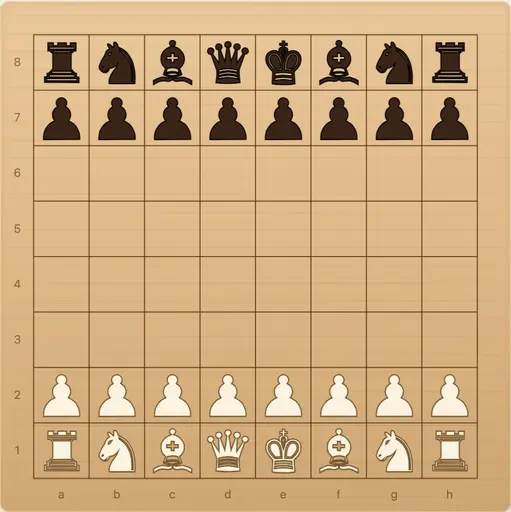
About Shatranj
Shatranj requires its own movement and endgame model, not modern chess with a few options removed. The ferz moves one diagonal square, the alfil jumps two, and pawns cannot advance twice. Stalemate and bare-king conditions must be assessed under the current version, including the documented immediate-reply exception. Accurate analysis checks the real attack sets instead of relying on familiar piece symbols.
- Ruleset covered
- Ply Yard Shatranj: one-step ferz, jumping alfil, and winning stalemate
- Updated
- · Editorial policy and corrections
ShatranjRules and variant distinctions
White moves first; there is no castling
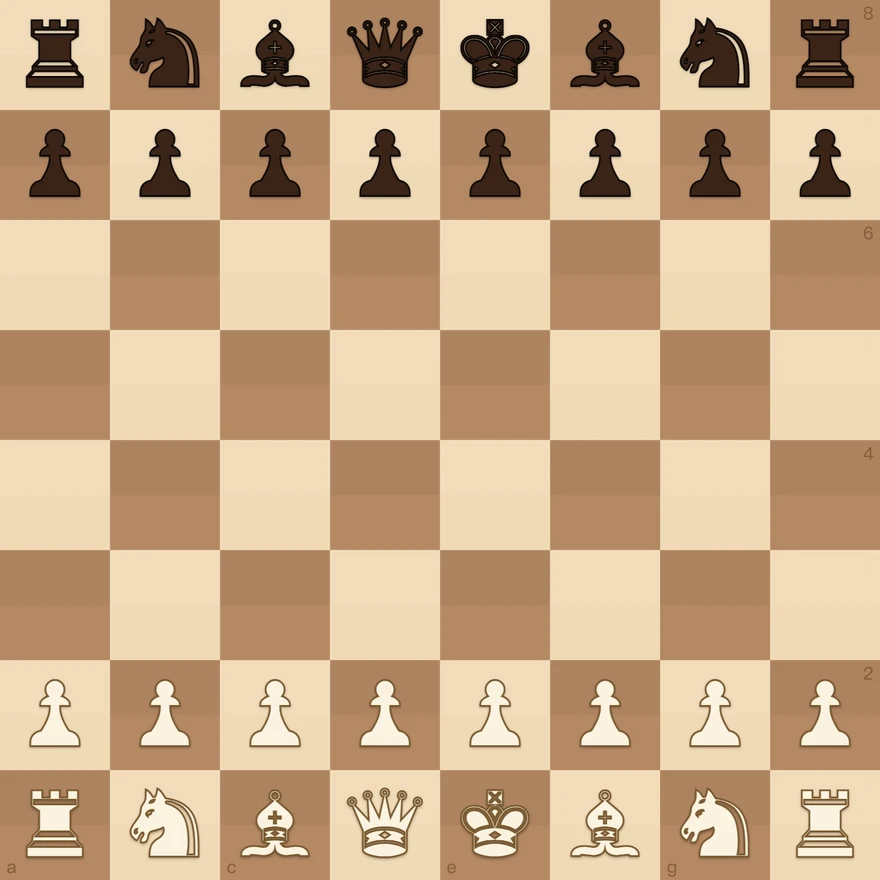
Shatranj, also called Persian chess, is a historical predecessor of modern chess. Ply Yard uses an 8×8 board with White moving first, followed by alternating single moves. Against the computer you may choose White or Black; in same-device and online play, follow the displayed turn order. There is no castling. The king must move by its ordinary one-square rule, and a rook does not accompany it in a special king move. Familiar modern-chess symbols do not authorize modern movement: the ferz and alfil have their own restricted rules, and pawns have neither an initial double advance nor en passant.
Identify the piece before calculating the move
Both colors use the same piece movements, with pawn direction reversed for the opposing side. Identify king, rook, knight, alfil, ferz, and pawn from the position before tracing a move. A queen-like symbol represents the ferz here; a bishop-like symbol represents the alfil. Neither acquires the modern piece's range from that resemblance. For every candidate, separate its movement pattern, any intervening-square restriction, the destination's occupancy, and king safety. A piece may capture an opponent at a legal destination but cannot land on a friendly piece. Jumping removes an intermediate obstruction, not a destination restriction or the obligation to leave your king safe. In review, classify an error before assessing the tactic. Did you assume a long-range ferz, a sliding alfil, a blocked knight, or a modern pawn option? Correcting the movement model is necessary before a familiar chess combination can be evaluated in this ruleset.
King: one adjacent square and mandatory check responses
The king moves one square horizontally, vertically, or diagonally, and captures by the same movement. It may not move onto a square attacked by an opposing piece. If your king is in check, the move must remove that check; an unrelated attack elsewhere is not a legal response. Consider a safe king move, a legal capture of the checking piece, or an interposition against a sliding rook attack. Each response must resolve all attacks on the king. Short-range and jumping attacks cannot be stopped simply by inserting a piece between attacker and king. There is no castling escape. When judging a king move, use the opponent's actual Shatranj attacks. Do not count a ferz as a queen or an alfil as a modern bishop, but do not overlook their nearby or jumping destinations either.
Rook: clear ranks and files
A rook moves any distance along a rank or file without crossing an occupied square. A friendly piece blocks the line; an opposing piece can be captured at the first occupied destination, but the rook cannot continue beyond it in the same move. The rook does not move diagonally. The rook is the principal long-range piece in this version. An open line can support checks, attacks on loose pieces, and restrictions on the opposing king. Evaluate whether opening that line also exposes your own king or leaves a supporting piece undefended. Geometric reach is not permission to ignore a pin or an unsafe resulting position.
Knight: a jumping two-by-one move
A knight moves two squares in one orthogonal direction and one square perpendicular to it, reaching the familiar modern-chess knight destinations. Intervening pieces do not block it. It may not land on a friendly piece, and the move must still preserve your king's safety. Use the knight's ability to attack across occupied lines, but calculate the exact destination. A nearby opposing piece is not necessarily within a knight move. Against a knight check, interposing on an imagined path does not stop the attack; consider a safe king move or a legal capture of the knight instead.
Alfil: exactly two diagonal squares, with a jump
The alfil moves exactly two squares diagonally. It jumps the intervening square whether that square is empty or occupied by either color. The destination must be empty or hold an opposing piece; a friendly occupant prevents the move. It cannot move only one diagonal square or slide along an arbitrary diagonal distance. From c1, the geometric destinations on an 8×8 board are a3 and e3. A piece on d2 does not block c1–e3, but a friendly piece on e3 does. The alfil remains on its starting square color, yet its fixed jump restricts it further than a modern bishop's same-color movement. Not every square of that color is reachable. Calculate its real attack set before relying on it to defend a pawn or restrict a king. Treating it as a long-range bishop can overestimate both its attacking and defensive contribution.
Ferz: one diagonal square, not a queen
The ferz moves one square diagonally, with captures made in the same way. It has no horizontal or vertical move and no long diagonal slide. Board edges, friendly occupancy, and king-safety restrictions may reduce its available moves. This is a short-range supporting piece. It can help protect nearby squares, cooperate with pawns, or cover an escape square during a rook attack. However, a ferz only covers its immediate diagonal destinations; it cannot provide a distant queen check or defend a piece several squares down a file. When planning a mating net, write down the ferz's actual controlled squares. A rook and ferz may cooperate usefully, but the modern queen's mating patterns cannot be transferred without recalculation.
Pawn: one-step advances and forward-diagonal captures
A pawn advances one square straight forward into an empty square and captures one square diagonally forward. It cannot capture straight ahead or make a noncapturing diagonal advance. There is no initial two-square move, even from the starting rank, and no en passant. A blocked forward square prevents that advance; an available diagonal capture remains a separate possibility. When evaluating a king destination, include the pawn's diagonal attacks rather than confuse them with its forward movement. Reaching the far rank promotes the pawn to a ferz only.
Promotion produces a ferz, not a choice of modern pieces
On reaching the opponent's back rank, a pawn promotes only to a ferz. It cannot become a queen, rook, knight, alfil, or king. The resulting piece follows the one-square diagonal ferz rule. Promotion is therefore a change of movement, not an automatic acquisition of a modern queen's range. Evaluate which adjacent diagonal squares the new ferz will control and whether the promotion square leaves it vulnerable. A passed pawn remains strategically relevant, but its potential promotion must be valued under this ruleset. When calculating the promotion move, retain the pawn's ordinary advance or capture pattern for the arrival itself. Only afterward apply the ferz's movement to subsequent turns. The absence of a starting double move and en passant continues to govern every unpromoted pawn.
Checkmate, winning stalemate, and the bare-king exception
Checkmate wins: the opposing king is attacked and no legal response removes the attack. Stalemate also wins for the player who creates it on this board: the opposing side has no legal move even though its king is not in check. Keep those positions distinct, and do not import modern chess's stalemate draw. Capturing every opposing piece except the king is another winning condition, called baring the king. The platform documents an immediate-reply exception: if the opponent can also bare your king on the next move, your capture is not recorded as an immediate win and play continues. Check the legal reply instead of counting only the pieces removed on your move. The cited instructions do not fully specify every later adjudication following that exception. Do not invent an automatic result beyond the published immediate handling; follow the board's recorded continuation and result. For an endgame review, identify which condition is being claimed, list any remaining legal responses, and check the bare-king exception where relevant. Material advantage, a restricted king, and a legally completed winning condition are not the same statement.
Practical strategy
Place an alfil on c1 and list its geometric destinations. Add a piece on d2, then place a friendly piece on e3 and compare the available moves.
Identify a3 and e3 before occupancy checks. Explain that d2 does not obstruct the jump, while friendly occupancy at e3 prevents that destination. Reject a one-square move to d2.
Construct a position where a ferz supports a rook attack on the opposing king. List the ferz's immediate diagonal control squares and test the king's replies.
Calculate with a one-step ferz, not a queen. Confirm king safety and legal responses before calling the net checkmate; do not claim remote control the ferz lacks.
Construct a checked position with no legal response and an unchecked position with no legal move. Compare the platform's result conditions.
Distinguish checkmate from stalemate while recognizing that both award a win to the player who creates them here. Do not apply modern chess's automatic stalemate draw.
A common misconception
The Shatranj alfil is simply a modern bishop under another name.
This version's alfil jumps exactly two diagonal squares, ignoring an intermediate occupant. It neither stops one diagonal square away nor slides along an arbitrary diagonal distance.
Position study: The alfil jumps over d2 but cannot stop there
Your alfil stands on c1. A piece occupies d2 and e3 is empty. Your king is safe, and no other restriction affects the move.
May the alfil reach e3? May it stop on d2?
Show the answer and analysis
It may jump to e3 because the alfil moves exactly two squares diagonally and the intermediate occupant does not obstruct it. It may not stop on d2, which is only one diagonal square away.
A fixed leap produces a restricted reachable-square set. The alfil's same-color property does not give it a modern bishop's full diagonal access. Treating it as a sliding bishop overstates its range and can invalidate both attack and defense calculations.
This position was constructed for instruction. It is not a tournament record or an engine-verified proof of an optimal move. Evaluate it under the stated conditions; do not assume unlisted features of the complete position.
Structured practice
Understand the rules
List the alfil's geometric destinations from c1, then add an intermediate piece and a friendly destination occupant.
Assessment: Separate jump immunity from landing restrictions: intermediate pieces do not block, but a friendly destination does. Identify a3 and e3, not d2.
Compare candidate moves
Use a one-step ferz to support a rook's restriction of the opposing king.
Assessment: Calculate the ferz's actual short-range attacks and all legal replies rather than substituting queen range.
Review and verify
Compare checkmate with an unchecked position where the opposing side has no legal move.
Assessment: Distinguish the positions while applying the platform's winning-stalemate rule instead of modern chess's draw.
Frequently asked questions
Is Shatranj the same ruleset as modern chess?
No. It is a historical predecessor of modern chess, not modern chess with castling disabled. The ferz moves one diagonal square, the alfil jumps exactly two diagonal squares, and pawns have neither a double advance nor en passant. Promotion produces a ferz only, and stalemate and bare-king results also differ.
Is the platform's game Chaturanga rather than Shatranj?
No. The platform presents Shatranj, or Persian chess. Chaturanga is an earlier Indian ancestor mentioned for historical context, not an alternative rules mode on this board. Do not infer identical legal moves or results from the games' historical relationship.
Can the alfil jump an occupied intermediate square?
Yes. Its two-square diagonal leap ignores the intervening occupant, regardless of color. The destination still must be available, and your king must remain safe. It cannot stop one diagonal square away or slide farther along the diagonal.
Why does stalemate win rather than draw?
The platform's Shatranj rules award the win to the player who leaves the opponent without a legal move, even when the opposing king is not in check. Checkmate requires check; stalemate does not. Evaluate the entire side's legal moves, not only the king's, before declaring either result.
From c1, can an alfil reach e3 over a piece on d2, or stop on d2?
It can jump to e3 when that destination is available and the move leaves its own king safe. The intervening d2 occupant does not block it. It cannot stop on d2 because that is only one diagonal step. Its fixed leap also restricts its reachable squares more than a modern bishop's continuous diagonal movement.
Does the alfil have the modern bishop's movement?
No. It jumps exactly two diagonal squares and may cross an occupied intermediate square. A modern bishop slides any clear diagonal distance; that is not the alfil rule. Verify both destination and king safety rather than assigning modern bishop attacks to its symbol.
Put your understanding into practice.
Choose one skill to work on in your next game. A clear reason for each move is more useful than an immediate win.
Play ShatranjRules sources and editorial notes
- Current rules for this game on Ply Yard
Identifies the board variant and interface described here. Platform instructions are not a complete statement of every tournament ruleset.
This guide combines the relevant board's rules with independently constructed examples and exercises. It distinguishes basic rules, variant-specific provisions, and strategic advice. Rules sections draw on the sources listed above. Instructional positions have not been presented as exhaustively engine-verified or certified by professional players.
Written by Ply Yard. Independent review by a named professional player has not been completed. To report an issue, send the game, ruleset, position, and relevant source provision to contact@plyyard.com.