 Ply Yard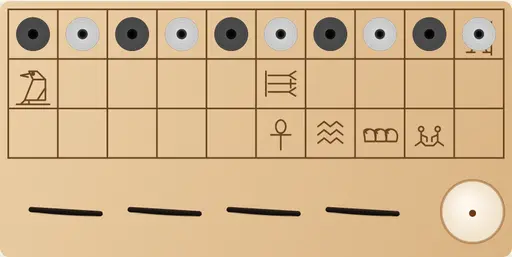
About Senet
Senet's playable rules here are a modern reconstruction, not an unqualified ancient-original claim. The platform combines opposing-piece blocks, a mandatory stop at square 26, a water penalty at 27, and exact exits. Those conditions change which actions a stick result actually permits. Accurate analysis follows the numbered route, checks the piece's checkpoint history, and distinguishes a legal destination from one suggested by arithmetic alone.
- Ruleset covered
- Modern Senet reconstruction in the Kendall tradition: five pieces per side and thirty squares
- Updated
- · Editorial policy and corrections
SenetRules and variant distinctions
The thirty-square route and three key houses
Ply Yard uses a modern Senet reconstruction in the Kendall tradition, with five pieces per player on a 3×10 board. Ancient boards, pieces, and images survive, but they do not constitute a complete operating rulebook. This guide describes the site's chosen reconstruction, not an unchanged or uniquely authoritative ancient ruleset. Black rolls first. The ten pieces start alternately on squares 1 through 10. Follow the numbered route in a continuous sequence: the first row runs left to right from 1 to 10, the second returns right to left from 11 to 20, and the third runs left to right from 21 to 30. Squares 10 and 11 meet at the right-hand turn; 20 and 21 meet at the left-hand turn. Forward movement follows increasing route numbers, not a permanent left-to-right screen direction. Square 15, the House of Rebirth, is protected against exchange and is the return location for the water penalty. Square 26 is also protected and serves as a mandatory landing checkpoint, called the House of Happiness in the platform's Chinese instructions. A piece must stop there before entering squares 27–30. Passing across 26 without landing does not satisfy that requirement. Landing on square 27, the House of Water, sends the piece back to 15 under the published instructions. The cited page does not fully explain every case in which that return square is occupied; use the current board's legal highlights and recorded result rather than invent a fallback destination. Exiting the board requires the exact movement value.
Throw the sticks and select one legal piece
Throw the four casting sticks, then select one of your highlighted pieces. The movement results are 1 through 5: one through four marked faces give their corresponding values, while four blank faces count as 5. There is no result of 0 in this reconstruction. If the result offers no legal move, the turn passes to the opponent. Use the result on one legal piece already on the board. Friendly pieces cannot exchange with or capture one another, and two friendly pieces cannot share a square. A movement value is not permission to disregard an occupied destination, an opposing block, the checkpoint at 26, or an exact-exit requirement. Check the complete route before deciding that the arithmetic destination is legal. After completing a legal move with 1, 4, or 5, you receive another throw. A result of 2 or 3 does not receive that numerical bonus. The legal-move condition matters: rolling a bonus value with no available move does not entitle you to keep throwing until a usable value appears. For a first practice game, predict a candidate's route and destination before selecting it. If it is not highlighted, identify the restriction rather than assume the interface has permitted the move. The highlights verify legality; they do not establish that every permitted move is strategically equivalent.
Exchange, opposing blocks, and protected houses
Landing on an isolated opposing piece normally exchanges the two pieces' positions. The opposing piece moves to your piece's former square; it is not removed from the game or sent to an off-board reserve. An exchange can change both players' progress, so compare the two resulting locations rather than count it as a conventional capture. A piece on square 15 or 26 is protected from exchange. Two or more opposing pieces on consecutive route squares form a block in this implementation: you may neither land on the block nor pass through it. This two-piece threshold is specific to the published platform rules and should not be replaced by a different Senet reconstruction's blocking threshold. Consecutive means consecutive along the numbered route. Visual adjacency across separate rows is not sufficient to establish a block; conversely, a block can follow the route around a row-end turn. Check the route numbers when deciding whether two opposing pieces protect each other. Before exchanging an isolated opponent, inspect whether moving your piece breaks a useful formation or places it where a reply can exchange it back. A protected landing or maintained block may be more useful than an immediate exchange. Neither safety nor exchange is universally preferable without considering the current position and available stick result.
Bonus throws depend on the result, not the exchange
A completed legal move on 1, 4, or 5 earns another throw. An exchange or a landing in the House of Water does not independently award an extra throw. Keep the movement's effect separate from the result-based bonus; a move may involve an exchange without that exchange being the reason the turn continues. Every further throw is governed by the same legal-move restrictions. If no piece can use the new result, the turn ends. Another throw is an uncertain opportunity, not a guaranteed additional advance of the same piece. You may select a different legal piece on the next result. When considering a bonus move, first calculate its final position, including any water return. Then identify the options that remain for your next throw and the changes in the opponent's blocked or available routes. Do not overlook a mandatory landing merely because the current result could prolong your turn. A sequence can be attractive without being forced or optimal.
Complete all five pieces with exact exits
The first player to move all five pieces off the board wins. Exchanges are not a separate score, and reaching the last row is not completion. Each piece must satisfy the checkpoint rule and use the exact value needed for its final exit; a value larger than that distance cannot remove it. Choose another legal piece if possible rather than forcing the oversized result. For every late-game candidate, check three questions in order: has this piece stopped at 26; does its destination invoke the water penalty at 27; and does an attempted exit match the required distance? Only after confirming legality should you compare progress, protection, and the possibility of another throw. Maintain a view of all unfinished pieces. Advancing the leader can be useful, but leaving another piece blocked behind opposing formations may delay the overall finish. Conversely, moving a supporting piece may dissolve your own formation and expose an exchange. Evaluate the race and the route together, not just the piece nearest the exit. Online players may resign or propose a draw, which is recorded if both agree. Computer and same-device play also allow resignation or starting a new game. These options are separate from the automatic five-piece finish. In replay, compare choices available on the actual throw; a later unfavorable result does not by itself prove the earlier decision was wrong.
Practical strategy
Locate squares 10, 11, 20, and 21, then trace the route through both row-end turns. Repeat from a middle-row piece with a specified movement value.
Count forward by route numbers rather than by screen direction. Identify the right-hand 10–11 turn and the left-hand 20–21 turn without treating every row as left to right.
Construct a position with an isolated opposing piece and then one with two opposing pieces on consecutive route squares. Test a landing and a move that would pass through them.
Distinguish a permitted exchange with an isolated unprotected piece from the platform's blocking condition. Exclude exchanges on 15 and 26, and determine adjacency from the numbered route.
For each candidate near the finish, record the piece's checkpoint history, possible water landing, and exact-exit distance.
Confirm the mandatory stop at 26 before entering 27–30. Resolve the water penalty and reject oversized exits before comparing strategic gains. Identify these as rules of a modern reconstruction, not proof of a unique ancient procedure.
A common misconception
Passing across square 26 is equivalent to actually stopping there.
The platform's reconstruction requires the piece to stop at its checkpoint. Passing across the square does not satisfy that landing requirement.
Position study: Passing the checkpoint does not satisfy it
Your piece stands on square 24 and has not previously stopped on the checkpoint at 26. You throw 3. Assume no other obstruction would affect the route.
May the piece move directly to 27 because 24 + 3 equals 27?
Show the answer and analysis
No. A piece that has not stopped on 26 may not advance into the later region. Choose a different legal piece if available; otherwise follow the no-legal-move procedure and pass.
A numerical destination is only one part of legality. Crossing a required square and landing on it are different conditions. Even after a piece satisfies the checkpoint, a landing on 27 still invokes the water penalty. Check eligibility before evaluating whether the move is strategically desirable.
This position was constructed for instruction. It is not a tournament record or an engine-verified proof of an optimal move. Evaluate it under the stated conditions; do not assume unlisted features of the complete position.
Structured practice
Understand the rules
Locate 10, 11, 20, and 21 and trace both turns on the three-row route.
Assessment: Determine forward movement from route numbering rather than visual left and right. Identify the reversed direction of the middle row.
Compare candidate moves
Compare an isolated opposing piece with a chain of consecutive opposing pieces.
Assessment: Test exchange and blocking separately. Do not assume every opposing piece can be exchanged or that visual adjacency alone forms a route block.
Review and verify
Check a late piece's stop at 26, possible landing on 27, and exact exit.
Assessment: Verify the legal prerequisites before comparing move benefits. Present the conditions as rules of the identified reconstruction, not the only possible ancient rules.
Frequently asked questions
Why do four blank stick faces count as 5 rather than a lost turn?
The platform's reconstruction assigns that combination a movement value of 5. Its results are 1 through 5, never 0. You pass only when the resulting value has no legal move, not simply because all faces are blank. A legal move with 5 also earns another throw.
Can pieces on squares 15 and 26 be exchanged?
No. Those are protected houses in this version. An isolated opposing piece elsewhere may be exchanged when the move is otherwise legal. Two or more opposing pieces on consecutive route squares form a block that cannot be entered or passed; do not treat each member as an independently exchangeable piece.
Why must a piece stop on square 26 first?
That landing is a prerequisite in this reconstruction. A piece that has not stopped on 26 cannot advance into squares 27–30. Passing across 26 on a larger movement does not qualify. Choose another legal piece if one exists; otherwise the throw has no move and the turn passes.
Is this a complete surviving ancient Egyptian rulebook?
No. The platform describes a modern reconstruction in the Kendall tradition. Surviving archaeological material is not a complete rulebook defining every legal move, bonus, or special-house procedure. Different modern versions may handle those details differently. This guide explains the site's published rules, not an archaeological certainty or a claim of museum endorsement.
Does Black always throw first on Ply Yard?
Yes. Black starts in every mode. Against the computer you may choose Black or White; choosing White lets the computer make Black's opening throw. Read the current side-to-move display before selecting a piece.
Who generates the casting-stick result in an online room?
According to the published instructions, the room generates and synchronizes the result so both players see the same value from 1 to 5. The normal interface does not let a player choose a value or unilaterally replace that shared throw. This describes documented operation, not an independent security or randomness audit.
Can a piece on 24 move directly to 27 with a result of 3?
Not if it has never stopped on 26. The arithmetic destination, 24 + 3, does not satisfy the mandatory checkpoint. Use another legal piece or pass if none is available. Even a piece that has satisfied the checkpoint must account for the water penalty if it lands on 27; checkpoint eligibility does not make that destination harmless.
Is passing across 26 equivalent to landing there?
No. This reconstruction requires an actual stop at the checkpoint. A route that merely crosses the square does not meet that condition. Check the individual piece's history, not whether some other friendly piece has visited 26, and verify the current move's highlighted eligibility.
Put your understanding into practice.
Choose one skill to work on in your next game. A clear reason for each move is more useful than an immediate win.
Play SenetRules sources and editorial notes
- Current rules for this game on Ply Yard
Identifies the board variant and interface described here. Platform instructions are not a complete statement of every tournament ruleset.
This guide combines the relevant board's rules with independently constructed examples and exercises. It distinguishes basic rules, variant-specific provisions, and strategic advice. Rules sections draw on the sources listed above. Instructional positions have not been presented as exhaustively engine-verified or certified by professional players.
Written by Ply Yard. Independent review by a named professional player has not been completed. To report an issue, send the game, ruleset, position, and relevant source provision to contact@plyyard.com.