 Ply Yard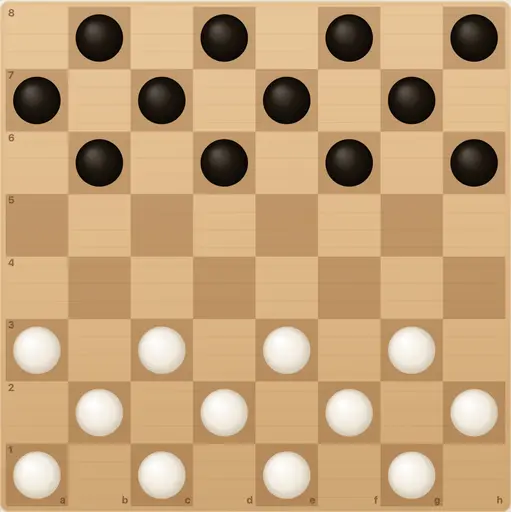
About Russian Draughts
Russian Draughts cannot be identified by board dimensions alone. It shares an 8×8 board with American checkers but differs in man-capture directions, king range, and promotion during a sequence. Capture is compulsory, yet route choice is not governed by the maximum-capture requirement used in international draughts. Analyze piece status, landing occupancy, delayed removal, and the completed route before comparing positions.
- Ruleset covered
- Ply Yard's 8×8 Russian Draughts: backward man captures, flying kings, and immediate promotion with capture continuation
- Updated
- · Editorial policy and corrections
Russian DraughtsRules and variant distinctions
An 8×8 dark-square board, twelve men each, and White to move
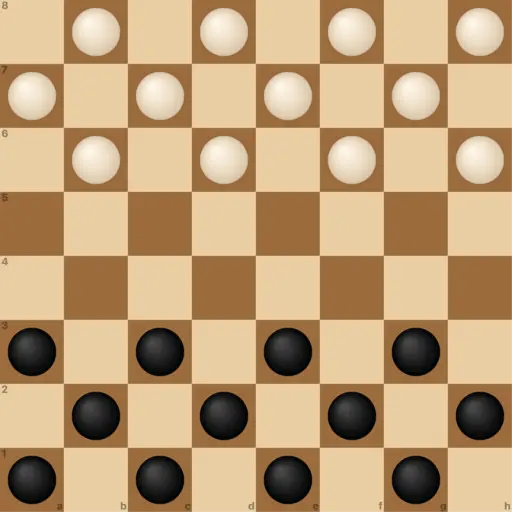
Russian Draughts, also known as shashki, uses an 8×8 board. Only the thirty-two dark squares are playable. Each side begins with twelve men on the dark squares of its nearest three ranks, and White moves first. Players alternate turns, but a multiple-capture sequence is one complete turn rather than several alternating moves. An 8×8 board does not establish the rules by itself. Russian Draughts differs from American checkers in backward captures by men, flying kings, and promotion during a capture sequence. It also differs from 10×10 international draughts in board size and capture-route selection. Identify the variant before applying a familiar combination. On the Ply Yard board, select a piece eligible to move and then a legal dark-square destination. If a quiet move is unavailable, inspect all your pieces for a compulsory capture before assuming a selection error. A piece with an ordinary step cannot use it while another friendly piece has a legal capture. Start position analysis in three passes: distinguish men from kings, establish whether any capture is available, and then calculate the legal routes for the eligible pieces. Move legality comes before comparisons of material gain or positional value.
Men move forward quietly but capture in all four diagonal directions
A man makes an ordinary move one square diagonally forward to an empty dark square. It cannot make a backward quiet step. To capture, it jumps an adjacent opposing piece and lands on the empty square immediately beyond it on the same diagonal. Captures may go forward or backward, so the quiet-movement restriction must not be copied onto capture analysis. An occupied landing makes that jump unavailable. A friendly piece is not a capture target, and a man does not acquire flying range merely because distant squares are empty. Each jump must satisfy its own adjacent-opponent and immediate-empty-landing conditions. If the same piece has another legal capture after landing, it must continue. The route may change diagonal direction between jumps, including switching between forward and backward captures. Assess the position at every landing rather than treat the whole sequence as movement along one fixed diagonal. The published rules remove captured pieces after the full sequence, not immediately after each jump. Keep track of pieces already jumped and do not treat their squares as cleared before the turn is complete or count the same opponent twice. This timing can affect whether a later diagonal route is open. Review both the route and the position left after the completed sequence.
Capture is compulsory; taking the maximum number of pieces is not
If any of your pieces has a legal capture, your turn must be a capturing move. You may not decline every capture and move another piece quietly. Check the entire board, including backward jumps by men and longer diagonal captures by kings. When several legal capture routes exist, Russian Draughts permits a choice among them. It does not require the route that captures the most pieces. This agrees with the platform's main rule text and differs from the maximum-capture requirement in its 10×10 draughts guide. A shorter legal route is not disqualified simply because another route takes more material. Route choice does not permit an arbitrary early stop. Once a piece begins a sequence, it must continue while it has a legal further capture. At a branch, choose a legal continuation; after a landing with no continuation, end the sequence and pass the turn. A shorter complete route and an unfinished route are different cases. Compare the final positions after complete routes. Consider the landing square, promotion, the opponent's compulsory reply, and material that may be lost immediately afterward. Captured-piece count is a strategic factor, not a move-selection priority imposed by these rules. Do not assume the largest immediate gain produces the strongest position.
Flying kings and immediate promotion during a capture sequence
A man reaching the opposing back rank becomes a king. A king may move any unobstructed distance diagonally to an empty dark square, in either forward or backward directions. It does not move orthogonally and cannot pass through a friendly piece. For a king capture, inspect an opposing piece along an unobstructed diagonal and the empty landing squares beyond it on that diagonal. Each individual capture crosses one opponent; flying range does not allow a leap over several occupied pieces at once. If a legal further capture remains after the chosen landing, continue with the same king. Landing selection can change which continuations are available. Russian Draughts promotes a man immediately when it lands on the opposing back rank during a capture sequence. If another capture is available, it continues in the same turn as a flying king. Do not end the turn merely because promotion occurred, and do not keep applying a man's adjacent-jump range to the promoted piece. Recalculate the legal king continuations from that landing. Promotion timing can determine the entire combination. Analyze the route before promotion with man rules and the route afterward with king rules, while preserving the sequence's captured-piece record. In computer play, the human defaults to White and the computer to Black; same-device and online modes use the same published movement and capture rules.
Win by elimination or immobilization; do not invent a draw counter
You win when the opponent has no pieces remaining, or when it is their turn and they have no legal move. To establish immobilization, exclude ordinary moves and captures for every opposing piece under its current status. A man unable to advance may still capture backward, and a distant king capture may defeat an apparent blockade. Players may agree to a draw. The platform also describes an automatic draw after a prolonged period without a capture or promotion, but the published rule text does not specify an exact numerical threshold. Follow the current board's result handling rather than insert a move count from international draughts, American checkers, or a tournament regulation not identified here. For early training, focus on forward quiet moves, backward man captures, and promotion recognition. Next, practice compulsory continuation and route choice without a maximum rule. Finally, construct combinations in which a man reaches the back rank and must continue as a flying king. In review, record the piece's status at each landing, pieces already jumped, the promotion point, and the final position after removal. Classify the first error as a direction mistake, blocked landing, missed compulsory continuation, incorrect promotion timing, or an imported maximum-capture rule. These instructions describe the current Ply Yard variant and are not a substitute for a separate event's complete regulations.
Practical strategy
Compare the same backward man-capture position under Russian Draughts and American checkers.
Identify the direction rule that changes legality. In Russian Draughts a man may capture backward even though its quiet move must go forward.
Construct a capture sequence that reaches the opposing back rank and leaves a legal flying-king continuation.
Promote on landing and continue in the same turn under king rules. Do not pass the turn at promotion or continue using a man's short jump range.
Compare two complete legal capture routes with different captured-piece totals.
Calculate each final position and the opponent's reply. Do not impose a maximum-capture requirement, and do not confuse choosing a shorter complete route with stopping early.
A common misconception
Every game on an 8×8 draughts board gives kings only a one-square diagonal move.
Russian Draughts uses flying kings, while American checkers uses short-range kings. Board size alone does not establish movement, capture selection, or promotion timing.
Position study: A backward capture remains legal for a Russian man
Your man is on e5, an opposing man is on d4, and c3 is empty. For this example, your man's ordinary forward direction increases rank numbers. The remaining conditions permit the jump.
May the man capture backward from e5 to c3?
Show the answer and analysis
Yes. A Russian man can capture backward over d4 to c3. Its forward-only quiet movement does not restrict its capture directions. Do not apply the forward-only man-capture rule of American checkers.
Check ordinary movement and capture separately. After landing, inspect compulsory continuations and any change of status at promotion. The 8×8 board does not determine those rules. This local example establishes one legal jump, not that the turn necessarily ends at c3 or that the route is strategically best.
This position was constructed for instruction. It is not a tournament record or an engine-verified proof of an optimal move. Evaluate it under the stated conditions; do not assume unlisted features of the complete position.
Structured practice
Understand the rules
Test the same backward man-capture pattern in Russian Draughts and American checkers.
Assessment: Name the capture-direction condition that changes legality, rather than rely on the shared 8×8 dimensions.
Compare candidate moves
Create a multiple capture that lands on the opposing back rank before a further king capture.
Assessment: Promote immediately on that landing and continue as a flying king in the same turn. Retain the captured-piece record until the sequence ends.
Review and verify
Calculate two legal complete capture routes that take different numbers of pieces.
Assessment: Compare their resulting positions and replies without imposing maximum capture. Complete every mandatory continuation on the route you choose.
Frequently asked questions
Is Russian Draughts the same game as Chinese checkers?
No. Chinese checkers is a race on a star-shaped board; jumping over a neighboring piece does not capture it. Russian Draughts uses the dark squares of an 8×8 board, with backward captures by men and flying kings. Its objective is to eliminate the opponent's pieces or leave them without a legal move.
May I decline a capture, or must I choose the longest route?
You may not decline all captures in favor of a quiet move. However, Russian Draughts lets you choose among legal capture routes without requiring the maximum captured-piece count. Once the chosen piece starts jumping, continue while it has a legal capture. A shorter complete sequence can be legal; stopping before an available continuation is not.
Can a king move several squares diagonally, and what happens during promotion?
Yes. Russian Draughts uses flying kings, unlike the short-range kings of American checkers. A king can travel along an unobstructed diagonal and make legal diagonal captures with landing choices beyond the captured opponent. A man that reaches the opposing back rank during a capture sequence promotes immediately and continues as a king if another capture is available.
Who moves first, and may pieces use the light squares?
White moves first. Pieces occupy dark squares only. An unpromoted man makes quiet moves one square diagonally forward, but its captures may go in any of the four diagonal directions. Light squares are not playable destinations.
May my man capture backward from e5 to c3?
Yes, if an opposing piece is on d4, c3 is empty, and the remaining capture conditions are satisfied. Assuming the man's forward direction increases rank numbers, e5 to c3 is backward, but Russian Draughts permits backward man captures. Do not import American checkers' forward-only man-capture restriction. Ordinary movement, capture direction, continuation, and promotion are separate checks.
Does an 8×8 board mean kings can move only one diagonal square?
No. Board dimensions do not determine king range. Russian Draughts has flying kings; American checkers has short-range kings. Identify the ruleset, then inspect diagonal obstructions, capture targets, and legal landing squares. A shared board size does not make the two variants interchangeable.
Put your understanding into practice.
Choose one skill to work on in your next game. A clear reason for each move is more useful than an immediate win.
Play Russian DraughtsRules sources and editorial notes
- Current rules for this game on Ply Yard
Identifies the board variant and interface described here. Platform instructions are not a complete statement of every tournament ruleset.
This guide combines the relevant board's rules with independently constructed examples and exercises. It distinguishes basic rules, variant-specific provisions, and strategic advice. Rules sections draw on the sources listed above. Instructional positions have not been presented as exhaustively engine-verified or certified by professional players.
Written by Ply Yard. Independent review by a named professional player has not been completed. To report an issue, send the game, ruleset, position, and relevant source provision to contact@plyyard.com.