 Ply Yard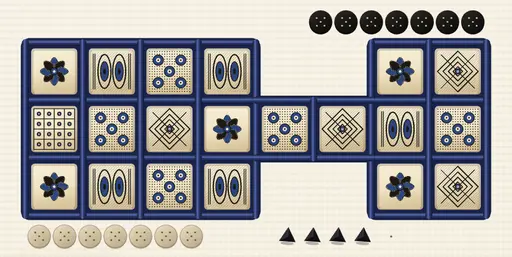
About Royal Game of Ur
The ancient board and a modern playable reconstruction must be treated separately. Ply Yard uses seven-piece racing, four binary sticks totaling 0–4, rosette bonus rolls, and exact exits. The strategic focus is the shared lane's capture risk and maintaining useful movement choices. Probability analysis requires an explicit fair, independent-stick assumption and must not be presented as an audit of the platform's random implementation.
- Ruleset covered
- Modern Royal Game of Ur reconstruction associated with Irving Finkel; not a complete surviving ancient ruleset
- Updated
- · Editorial policy and corrections
Royal Game of UrRules and variant distinctions
A reconstructed race on a twenty-square board
The Royal Game of Ur is an ancient board game played here through a modern reconstruction. Ply Yard describes its version as the popular reconstruction associated with Irving Finkel and the British Museum. That attribution identifies the reconstruction tradition; it is not a claim that the site's rules are a complete surviving ancient rulebook or have been independently certified by the museum. The physical board has twenty squares. In the default display, White uses the lower private track and Black the upper one, with a shared central lane where the two routes meet. Each player has seven pieces. A piece enters through its own private section, follows the shared lane, and returns to its own private exit section before leaving the board. White rolls first. Learn the route rather than measure distance across the board's outline. The twenty physical squares are not a twenty-step route available to every piece. Opposing pieces cannot enter your private sections, while the shared lane creates the capture contest. The central shared rosette is a protected square and also awards another roll. Leaving the board requires the exact remaining movement value. A result larger than that distance cannot remove the piece. Check another legal piece instead; if none can use the result, the turn passes.
Roll four binary sticks, then move one piece
The interface rolls four binary sticks and totals their marked outcomes, producing a value from 0 through 4. Select one of the highlighted pieces that can legally use that value. A waiting piece may enter with any positive result from 1 through 4, or you may advance an active piece instead. One result is used for one piece; it is not split among several pieces or reduced to a preferred smaller distance. A 0 supplies no movement and passes the turn. The same applies when a positive result offers no legal move. Having pieces already on the board does not let you reinterpret 0 as an advance or ignore an exact-exit restriction. Friendly pieces do not capture one another; check the board's highlights for occupancy-related restrictions rather than assuming another race game's stacking rules apply. Under the mathematical model of four independent fair binary sticks, the sixteen equally likely combinations produce totals 0, 1, 2, 3, and 4 in counts 1, 4, 6, 4, and 1. Thus 2 is more likely than 4 in that model. This calculation is not an audit of the website's random-number implementation. Plan options for several plausible results instead of predicting the next roll. Advancing only one piece can leave fewer usable choices; bringing additional pieces into play can improve flexibility, but their destinations and exposure still matter.
Captures on the shared lane and protection on the central rosette
A piece captures by landing exactly on an opposing piece in the shared lane, except on the protected central rosette. The captured piece returns to its waiting position and must enter again on a later positive roll. Merely passing an opposing piece does not capture it. The central shared rosette is safe: an opposing piece cannot capture the piece occupying it. The private track sections are safe from the opponent because the opponent's route does not enter them. These are different reasons for protection. Do not assume that every square with a rosette has the same shared-lane capture status simply because all rosettes award another roll. To evaluate a candidate landing, trace the opponent's active pieces along their actual routes and identify which results from 1 through 4 would land exactly on it. Exclude protected destinations and private sections. A nearby piece on a different track is not automatically a capture threat. A capture sets back the opponent, but the capturing piece may now be exposed to a reply. Compare that immediate gain with a protected rosette landing or progress out of the shared lane. The relevant question is not only whether a capture exists, but what position remains after it.
Rosettes award another roll; captures alone do not
Landing on any rosette awards another roll. This is a new chance to choose a piece using the new result, not permission to add a predetermined number of steps to the move already completed. You may continue the same piece if legal or use a different one. A capture alone does not award another roll on this board. Keep that distinction separate from the central rosette's combined benefits: it grants the usual rosette bonus and has a specific protection rule. A capture and a safe landing are not interchangeable ways of extending the turn. Every bonus roll is subject to the same movement restrictions. A 0 or the absence of a legal move ends the turn. When calculating a rosette continuation, inspect the new position and the range of possible values rather than assuming another favorable roll. An extra choice can be valuable without making every rosette move automatically best.
Exact exits and completing all seven pieces
The first player to move all seven pieces off the board wins. Captures do not contribute a separate victory score. Each exit must use exactly the distance remaining on that piece's route: if it needs two steps to leave, 2 removes it and a larger result does not. You may still use that larger result on another piece when legal. In the endgame, compare the usable result sets for your unfinished pieces. Two pieces at different exit distances may let you use more results than two pieces needing the same value. That flexibility must be weighed against the moves required to create it; the argument does not guarantee a faster finish in every position. For example, pieces needing 1 and 3 provide two distinct immediate exit values, whereas two pieces each needing 1 both depend on the same immediate exit value. Other positive rolls may still advance a piece without removing it, so distinguish an exit opportunity from every legal movement available. Online players may resign or agree to a draw; computer and same-device play also allow resignation or a new game. These interface choices are separate from the automatic seven-piece race result. In replay, compare the legal choices from the actual roll, not from a later roll you could not know in advance.
Practical strategy
List all sixteen binary outcomes of four sticks and group them by totals 0 through 4. State the assumptions before assigning probabilities.
Obtain counts 1, 4, 6, 4, and 1, totaling sixteen. Explain that equal likelihood belongs to the independent fair-stick model, not to five equally likely totals or a verified website randomness audit.
Compare an ordinary shared-lane destination with the protected central rosette. Trace the opposing pieces' possible one-through-four capture landings.
Separate the rosette's bonus roll from its specific capture protection. Exclude private-track threats and distinguish landing from passing. A capture alone does not grant another roll.
Place two unfinished pieces at different exit distances, then compare their immediate exit values and other legal advances with a position where both need the same value.
Require an exact exit for each piece. Do not remove a piece on an oversized result, and do not equate the set of exit values with the complete set of legal moves.
A common misconception
The modern game is an unchanged, fully excavated ancient rulebook.
Ancient evidence does not supply a complete modern operating rulebook. This guide describes an identified reconstruction, not proof that every rule survives unchanged from antiquity.
Position study: Five possible totals are not five equally likely outcomes
Assume four independent binary sticks, each with two equally likely outcomes. Count the marked outcomes to obtain the movement total from 0 through 4.
Are totals of 2 and 4 equally likely?
Show the answer and analysis
No. There are sixteen equally likely combinations. Six produce 2 and only one produces 4, so their probabilities are 6/16 and 1/16 respectively.
Count the underlying combinations rather than distribute probability equally across the five totals. The resulting model can inform which movement options are useful to preserve, but it does not guarantee the next roll or establish that the site's randomizer implements this model without bias.
This position was constructed for instruction. It is not a tournament record or an engine-verified proof of an optimal move. Evaluate it under the stated conditions; do not assume unlisted features of the complete position.
Structured practice
Understand the rules
Group all sixteen four-stick binary combinations by totals 0, 1, 2, 3, and 4.
Assessment: Give counts 1, 4, 6, 4, and 1, and state the fair, independent assumptions. Do not confuse possible totals with equally likely underlying outcomes.
Compare candidate moves
Compare capture risk at an ordinary shared-lane square and the central rosette.
Assessment: Identify legal opposing landing values and distinguish the bonus-roll mechanism from explicit capture protection.
Review and verify
Compare the usable values of two pieces at different exact-exit distances.
Assessment: Respect exact exits, include legal non-exiting advances separately, and never remove a piece merely because the result exceeds its distance.
Frequently asked questions
Why does a result of 0 pass the turn?
Four binary sticks produce a total from 0 to 4. A 0 provides no movement, so the turn passes even if pieces are already active. You cannot replace it with a smaller advance, enter a piece, or take an additional roll merely because you have no useful move.
Can a piece on the central shared rosette be captured?
No. That square has explicit capture protection and grants another roll on landing. Other rosettes also grant another roll, but the bonus symbol alone does not define every square's capture status. Private-section pieces are protected by their separate routes; distinguish that from the central shared square's special rule.
Why must the movement value match the exit distance exactly?
Exact exit is part of the reconstruction used here. A piece needing three steps leaves on 3, not on 4. Try another piece if the result is too large; if no legal move exists, pass. Do not import oversized bearing off from backgammon into this route.
Are these the unchanged rules from an excavated ancient rulebook?
No. The platform identifies a modern reconstruction associated with Irving Finkel and the British Museum. Ancient evidence and modern playable reconstructions must be distinguished. Other modern versions may differ in routes, randomizers, rosette bonuses, and protected squares. This guide explains the platform's published version rather than claiming a complete ancient text or museum endorsement.
Does White always roll first on Ply Yard?
Yes. White starts in every mode. Against the computer you may choose White or Black; if you choose Black, the computer rolls for White's first turn. Read the current side-to-move display rather than inferring ownership solely from screen position.
Who generates the stick result in an online room?
According to the platform's published instructions, the room generates and synchronizes the result so both players see the same total from 0 to 4. A player cannot choose a value or unilaterally replace the shared roll through the normal interface. This describes the documented operation, not an independent security or randomness audit.
Are totals of 2 and 4 equally likely?
No, under the independent fair-stick model. Among sixteen equally likely binary combinations, six give 2 and one gives 4, for probabilities 6/16 and 1/16. The assumptions matter: this arithmetic does not verify the site's random-number implementation or predict the next roll. Prepare useful choices for common values without treating any future result as guaranteed.
Does today's game exactly reproduce a complete surviving ancient ruleset?
That claim is too strong. Archaeological evidence is not the same as a complete rulebook specifying every modern operation. The version here is a labeled reconstruction with seven-piece racing, binary totals, rosette bonuses, protected central landing, and exact exit. Identify that version before comparing tactics or historical claims.
Put your understanding into practice.
Choose one skill to work on in your next game. A clear reason for each move is more useful than an immediate win.
Play Royal Game of UrRules sources and editorial notes
- Current rules for this game on Ply Yard
Identifies the board variant and interface described here. Platform instructions are not a complete statement of every tournament ruleset.
This guide combines the relevant board's rules with independently constructed examples and exercises. It distinguishes basic rules, variant-specific provisions, and strategic advice. Rules sections draw on the sources listed above. Instructional positions have not been presented as exhaustively engine-verified or certified by professional players.
Written by Ply Yard. Independent review by a named professional player has not been completed. To report an issue, send the game, ruleset, position, and relevant source provision to contact@plyyard.com.