 Ply Yard
About Army Chess
Army Chess turns are either information or movement. Railways, mines, and bombs punish careless flips and frontal pushes. Before you flip or step, check whether the opponent can reach your flag next turn and whether the square might be a mine. This guide ties those three checks to rank captures and railway runs.
- Ruleset covered
- 5×12 Chinese Army Chess: flip, rank, railways, flag capture
- Updated
- · Editorial policy and corrections
Army ChessRules and variant distinctions
Board, camps, and railways
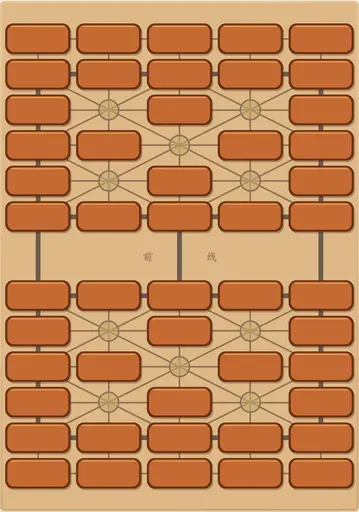
Chinese Army Chess — junqi or luzhanqi — uses a 5×12 grid with headquarters, camps, roads, and railways. Each side starts with 25 face-down pieces in Dark setup, or a mixed layout in Flip mode. The flag and mines never move on their own; other pieces move and capture by rank.
Flip or move
Each turn is either one flip or one move of a revealed piece of your color. Red moves first. A flipped piece is shown to both players. Face-down pieces cannot be captured.
Ranks, bombs, and mines
Higher rank captures lower; equal ranks remove both. Engineers remove mines and survive; any other piece hitting a mine is removed with it. Bombs trade with any movable piece they meet, removing both.
Railway lines
On roads, revealed pieces step one square. On railways they may run in a straight line until blocked. Only engineers may turn at railway junctions. Railway control often decides bomb trades and flag races.
Winning
Enter the square holding the enemy flag — face-up or still hidden — to win immediately. Online rooms support resign and draw offers; AI and same-device play add undo, hints, and replay.
Practical strategy
Mark your flag, nearby guards, and any revealed enemy piece on a railway. Ask whether a bomb trade this turn leaves the flag reachable next turn.
Tie railway distance, bomb removal, and flag defense together instead of comparing ranks alone.
List three possible identities for one face-down piece and the worst outcome of flipping it.
Keep the analysis probabilistic; do not assert hidden types.
Replay one flip that exposed a commander on a railway.
Explain the new bomb or flag threat using only information available before the flip.
A common misconception
The highest rank should always lead the advance.
Mines, bombs, and railways turn big pieces into exchange targets. Keeping engineers and flag guards often matters more than winning one commander trade.
Position study: A bomb trade on the railway
The enemy commander is revealed on a railway line. Your bomb can reach it next turn, and one guard still sits beside your flag.
Is trading the bomb for the commander sound?
Show the answer and analysis
Only if the flag stays guarded afterward and the opponent cannot enter the flag square on the following turn. Removing a known commander does not win by itself when the railway opens a faster flag route.
Treat bombs as clearance moves, not rank advantage. Railway speed makes defensive gaps expensive.
This position was constructed for instruction. It is not a tournament record or an engine-verified proof of an optimal move. Evaluate it under the stated conditions; do not assume unlisted features of the complete position.
Structured practice
Understand the rules
Mark railways, camps, and the squares beside your flag.
Assessment: Explain how one revealed piece changes its reach when it leaves a road for a railway.
Compare candidate moves
For one hidden piece, list three possible types and the worst flip outcome.
Assessment: Use uncertainty language instead of guessing the hidden rank.
Review and verify
Replay a loss where the flag fell one or two turns after a flip.
Assessment: Show the opponent's flag route, not only which piece was revealed.
Frequently asked questions
Is this the four-player Army Chess game?
No. This guide covers two-player luzhanqi on 5×12. Four-player Si Guo Jun Qi uses a different board.
Does the AI see hidden pieces?
No. The engine searches revealed moves only and uses heuristics for flips.
Can I play online with a friend?
Yes. Open a room, send the link, and both clients sync revealed information and moves.
How is Army Chess different from xiangqi or Banqi?
Same cultural family, different board and win condition: rank captures, mines, railways, and carrying the flag — not palace checkmate.
Put your understanding into practice.
Choose one skill to work on in your next game. A clear reason for each move is more useful than an immediate win.
Play Army ChessRules sources and editorial notes
- Current rules for this game on Ply Yard
Identifies the board variant and interface described here. Platform instructions are not a complete statement of every tournament ruleset.
This guide combines the relevant board's rules with independently constructed examples and exercises. It distinguishes basic rules, variant-specific provisions, and strategic advice. Rules sections draw on the sources listed above. Instructional positions have not been presented as exhaustively engine-verified or certified by professional players.
Written by Ply Yard. Independent review by a named professional player has not been completed. To report an issue, send the game, ruleset, position, and relevant source provision to contact@plyyard.com.