 Ply Yard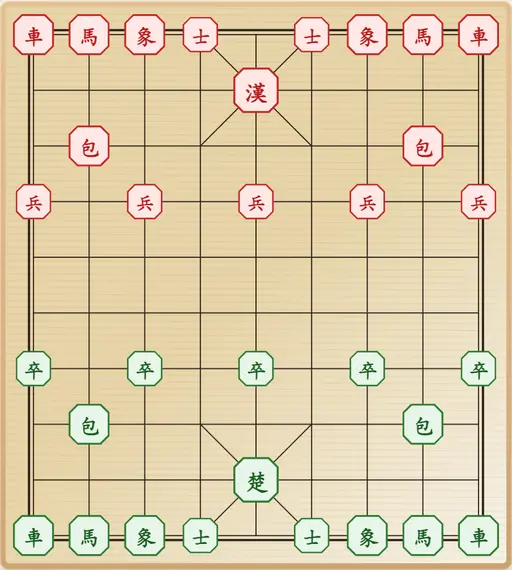
About Janggi
Janggi is not xiangqi with different piece labels. A cannon needs a valid screen to move as well as to capture; an elephant has two blocking points; and a soldier may move sideways from the start. Palace lines and bikjang change how attacks must be assessed. Good analysis distinguishes a piece's geometric reach from its legal route, then checks the general's safety under the current implementation's rules.
- Ruleset covered
- 9×10 Janggi on Ply Yard: no river, marked palace diagonals, and non-cannon screens
- Updated
- · Editorial policy and corrections
JanggiRules and variant distinctions
Board, sides, and the platform's starting arrangement
Janggi, or Korean chess, is played on the intersections of a board with nine files and ten ranks. There is no river. On the platform's default display, Cho starts at the bottom and Han at the top. Cho moves first. Each side begins with a general, two guards, two chariots, two horses, two elephants, two cannons, and five soldiers. Ply Yard uses a fixed starting arrangement. Reading each home rank across the displayed board, the pieces are chariot, horse, elephant, guard, an empty intersection, guard, elephant, horse, and chariot. The general starts at the center of its own palace, rather than on the home rank. Cannons occupy the third rank from their side, in front of the horses; soldiers occupy alternating files on the fourth rank. Other Janggi settings may permit different horse-and-elephant arrangements before play. Do not assume that setup option exists on this board. Each palace is a marked three-by-three network. The general and guards remain in their own palace. Its diagonal markings are movement lines, not decorative lines or permission to move diagonally anywhere on the board. Unlike a xiangqi elephant, a Janggi elephant is not confined by a river, but its route can be blocked.
Movement, blocking points, and palace lines
A chariot moves along a clear rank or file and cannot jump intervening pieces. A horse moves one step orthogonally and then one step diagonally away from its starting point, reaching the familiar two-by-one displacement. A piece on that first orthogonal intersection blocks the move; it does not matter which side owns the blocking piece. An elephant follows one orthogonal step and then two diagonal steps in the same outward direction. Its destination is three ranks and two files away, or two ranks and three files away. Both intermediate intersections must be empty. Check the complete route, not just the destination. A general or guard moves one step along an orthogonal palace line or a marked palace diagonal, without leaving its own palace. Palace diagonals require special attention when calculating chariot lines. Do not extend a marked diagonal beyond the palace or infer that every diagonal between palace intersections is connected. Use the board's legal-move highlights to confirm the exact implementation: the platform's published text does not fully specify every chariot, cannon, and soldier palace-diagonal case. A friendly piece cannot occupy the destination. A legal move onto an enemy-occupied intersection captures that piece. There is no castling and no soldier promotion. Every move must also leave your general safe from ordinary check.
Cannons require a screen; soldiers move laterally from the start
A Janggi cannon must jump exactly one intervening piece, called a screen, for both a noncapturing move and a capture. The screen may belong to either side, but it must not be a cannon. A cannon also cannot capture another cannon. An unobstructed line is therefore not a route for a noncapturing cannon move, and two intervening pieces do not constitute a legal screen. Before calculating a cannon move, identify the line, count the intervening pieces, inspect the screen's type, and inspect the target's type. Only then check whether the move leaves your general safe. Moving or exchanging a screen can create or remove cannon access even when the cannon itself remains stationary. The platform's published rules describe a soldier as moving one intersection forward or sideways, never backward, with captures made by the same movement. Sideways movement is available from the start; there is no river-crossing requirement and no promotion on reaching the far side. This description should not be read as a complete tournament definition of palace movement. In particular, do not import every soldier palace-diagonal rule from another Janggi implementation without checking the current board.
Checkmate, bikjang, and the platform's draw conditions
Checkmate wins: the opposing general is attacked and has no legal response that removes the attack. According to the platform's published rules, a side with no legal move loses. Treat that as a rule of this implementation, not as a universal Janggi convention; passing and tournament adjudication procedures must be established from the ruleset actually in use. When the generals face each other along an otherwise empty file, the situation is called bikjang. On this platform, that facing position is legal and is not automatically treated as exposing your own general to ordinary check. This differs from xiangqi. The platform's FAQ instructs the responding side to break the facing line by moving the general, interposing a piece, or capturing the piece that opened the file, where a legal move permits it. Its published text does not fully explain acceptance or draw-claim procedures, so do not infer an unlisted automatic draw or pass option. The platform also describes a draw after approximately sixty rounds without a capture, and online players may agree to a draw. The published wording does not define the counter precisely enough to convert it into a verified number of individual moves. Follow the current board's result display rather than substituting a chess move-count rule.
Select and complete a legal move
Check the status display to see whether Cho or Han is to move. Select one of that side's pieces; the board highlights its legal destinations, including legal captures. Select a highlighted intersection to complete the move. If no destinations appear, choose another piece or inspect why the selected piece is restricted. Use the highlights as a verification tool, not as a substitute for analysis. Predict the available destinations before selecting a horse or elephant, then compare the prediction with the displayed moves. For a cannon, identify its screen first. After any capture or screen relocation, reassess both sides' cannon lines and the safety of your general before planning the next turn.
Illegal moves and a practical safety check
You may not move an opposing piece, place a general on an attacked intersection, or leave ordinary check unresolved. A cannon move without a screen, over a cannon screen, or onto an opposing cannon is illegal. A blocked elephant route and a backward soldier move are also illegal. A legal-looking destination does not override a restriction on the route. Before committing a move, ask three questions: Does the piece have the required movement line? Are every blocking point and any screen valid? Does the resulting position leave my general safe? On a palace line, verify the marked connections rather than treating the palace as an unrestricted diagonal grid. Keep a legal bikjang facing position distinct from an ordinary attack on the general.
Practical strategy
Compare a xiangqi cannon and a Janggi cannon in three situations: a noncapturing move, a capture, and a potential screen that is itself a cannon.
Explain that a Janggi cannon needs a non-cannon screen even when it does not capture, and that an opposing cannon cannot be its capture target. Correctly reject the empty-line move rather than relying on xiangqi habits.
Place a general and then a chariot in a palace position. Trace the marked diagonals and predict the destinations before checking the board's highlights.
Separate one-step general movement from chariot line movement. Identify the marked connections and avoid extending palace diagonals across the rest of the board. Record any implementation-specific restriction rather than assuming another ruleset applies.
Review a move that changes a cannon's screen. Compare the position immediately before and after the move, including both sides' cannon lines.
Explain which line becomes available or unavailable, and why. Identify the screen's type as well as the number of intervening pieces, then check the target and your general's safety.
A common misconception
If the generals face each other on an empty file, the position must be illegal just as it is in xiangqi.
Janggi's bikjang must be distinguished from xiangqi's facing-generals restriction and from ordinary check. Apply the current board's response and result procedures. The platform's published instructions do not fully specify every bikjang acceptance or draw-claim case; that omission is not evidence for an automatic result.
Position study: A cannon cannot serve as another cannon's screen
Your cannon, another cannon, and an opposing soldier lie on the same straight line. The intervening cannon is the only piece between your cannon and the soldier; there are no other obstructions on that segment.
Can your cannon jump the intervening cannon and capture the soldier?
Show the answer and analysis
No. A Janggi cannon cannot use another cannon as its screen, even when the destination contains a soldier rather than a cannon. The screen restriction alone makes this move illegal.
Counting one intervening piece is necessary but not sufficient. Identify its type before calculating the capture. Replacing that screen with a non-cannon piece would remove this particular restriction, but you would still need to verify the movement line, target, and resulting general safety. Removing the screen entirely would not create a legal noncapturing cannon move either.
This position was constructed for instruction. It is not a tournament record or an engine-verified proof of an optimal move. Evaluate it under the stated conditions; do not assume unlisted features of the complete position.
Structured practice
Understand the rules
Compare xiangqi and Janggi cannon movement, captures, and screen eligibility.
Assessment: State that a Janggi cannon requires a non-cannon screen even for a noncapture, and cannot capture another cannon. Explain the restrictions separately rather than describing it merely as a jumping piece.
Compare candidate moves
Trace palace-diagonal destinations for a general and a chariot, then compare your prediction with the legal-move highlights.
Assessment: Respect the marked palace connections, distinguish one-step movement from line movement, and never extend those diagonals across the entire board.
Review and verify
Review a move that changes a cannon's screen and compare the available lines before and after it.
Assessment: Track the screen's type and ownership, the number of intervening pieces, the target, and general safety. Explain the line change without assuming that removing a screen always improves a cannon.
Frequently asked questions
Does a Janggi cannon move like a xiangqi cannon?
No. Both use an intervening screen to capture, but a Janggi cannon also needs a screen for a noncapturing move. It cannot use a cannon as its screen and cannot capture a cannon. A xiangqi-style move along a completely empty line is therefore not a legal Janggi cannon move.
May the two generals face each other on an empty file?
Yes. That facing position is called bikjang, and the platform does not automatically classify it as ordinary self-check. Its FAQ instructs the responding player to break the line with a legal general move, an interposition, or an appropriate capture. The published instructions do not fully specify acceptance and draw-claim procedures. Do not treat bikjang as xiangqi's prohibition on facing generals, or assume a draw option not documented by the current board.
Do soldiers promote on the far side of the board?
No. A soldier remains a soldier. The platform describes forward and sideways one-step movement, available from the start, with no backward move or promotion to a chariot or cannon. There is no river-crossing threshold for sideways movement. Check the board for palace-diagonal cases rather than treating this short movement description as a full tournament rulebook.
Does Cho always move first on Ply Yard?
Yes. The platform's published instructions give Cho the first move in every mode. Against the computer, you may choose Cho or Han; if you choose Han, the computer takes Cho and makes the opening move. The bottom-of-screen orientation and the side to move are separate interface facts, so read the status display rather than relying only on where a piece appears.
Can my cannon jump another cannon to capture a soldier?
No. A cannon is an invalid screen regardless of its owner. The fact that the target is a soldier does not make the move legal. First inspect the screen's type; if it is a non-cannon piece, continue by checking the line, the number of intervening pieces, the destination, and your general's safety.
Is an open file between the generals always illegal, as in xiangqi?
No. Applying xiangqi's facing-generals restriction to Janggi is a ruleset error. Identify the position as bikjang and use the current implementation's response and adjudication procedures. Also check for an independent attack on either general: a legal facing position does not permit a player to ignore ordinary check from another piece.
Put your understanding into practice.
Choose one skill to work on in your next game. A clear reason for each move is more useful than an immediate win.
Play JanggiRules sources and editorial notes
- Current rules for this game on Ply Yard
Identifies the board variant and interface described here. Platform instructions are not a complete statement of every tournament ruleset.
This guide combines the relevant board's rules with independently constructed examples and exercises. It distinguishes basic rules, variant-specific provisions, and strategic advice. Rules sections draw on the sources listed above. Instructional positions have not been presented as exhaustively engine-verified or certified by professional players.
Written by Ply Yard. Independent review by a named professional player has not been completed. To report an issue, send the game, ruleset, position, and relevant source provision to contact@plyyard.com.