 Ply Yard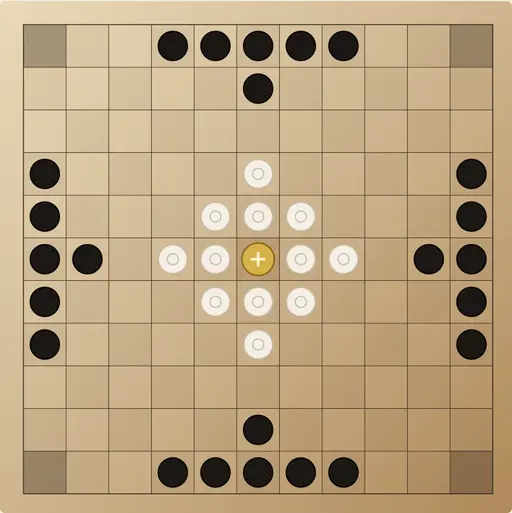
About Hnefatafl
Hnefatafl is an asymmetric contest between escape and containment. The defenders seek a viable route for their king to a corner; the attackers seek to close those routes and complete the required encirclement. Only the king may occupy the throne and corners. Ordinary custodial captures and the king's special capture condition must be calculated separately, so material gains should always be evaluated against the escape routes they open or close.
- Ruleset covered
- 11×11 Fetlar Hnefatafl: corner escape, four-sided king capture, and no shieldwall capture
- Updated
- · Editorial policy and corrections
HnefataflRules and variant distinctions
Two sides with different objectives
Ply Yard uses an 11×11 Fetlar version of Hnefatafl. Black has 24 attackers arranged around the four sides of the board and moves first. White has 12 defenders surrounding a king on the central throne. The defenders win by moving the king onto any of the four corner squares; the attackers win by capturing the king under the special encirclement rule. The unequal starting forces do not make this a contest to collect the most captures. As Black, monitor every open rank and file that could give the king access to a corner. As White, evaluate whether an exchange creates a usable escape route, not simply whether it preserves all twelve defenders. A defender may be expendable if its removal opens the decisive route, but an open line is useful only if the king can reach and use it before Black closes it. Start each calculation by stating whose turn it is and which side you are evaluating. A move that improves the attackers' containment may be poor for the defenders, even if it wins material. The two sides require different measures of progress.
Orthogonal movement and restricted squares
Every piece, including the king, moves any number of vacant squares along a rank or file. No piece moves diagonally or jumps another piece. The destination must be empty: captures are resolved after a move, not by moving onto an occupied square. A blocked line is unavailable regardless of how close the desired destination appears. Only the king may stop on the central throne or a corner square. An ordinary attacker or defender may pass through the throne when it is empty, but may not end its move there. Ordinary pieces may not enter the corners. An occupied throne remains an obstruction because no piece may jump the king. When planning a route, check both segments of any proposed turn in direction. A king cannot move along a rank and then a file in the same move. Reaching a useful intermediate square may require giving the attackers another turn, which can be enough to close the route. Distinguish a clear one-move escape from a route that still needs preparation.
Custodial capture of ordinary pieces
An ordinary enemy piece is captured when your move completes a sandwich on two opposite, orthogonally adjacent sides of that piece. This is custodial capture. Usually your moved piece supplies one side and another friendly piece supplies the other. An empty throne or a corner can supply a hostile side under the platform's published rules. A diagonal pair does not form a sandwich, and merely ending beside an enemy piece does not capture it. The capture is created by the move that closes the sandwich. An ordinary piece may move into a gap between two enemies without being removed automatically. Nevertheless, that destination may allow the opponent to create a different sandwich on the next turn. Check the perpendicular direction as well as the two pieces already beside it. The king may help the defenders capture ordinary attackers. Capturing the king is different: two attackers on opposite sides do not capture it in this implementation. Keep ordinary-piece captures and the king's encirclement rule separate throughout your calculation. For a practical capture check, inspect the four adjacent directions from the moved piece. Where an adjacent enemy piece is present, inspect the square immediately beyond it for a valid opposing side of the sandwich. Do not treat a row of enemy pieces as automatically captured by surrounding its ends; this board does not use shieldwall capture.
Corner escape, king capture, and draws
The defenders win immediately when the king actually lands on a corner square. An ordinary edge square is not an escape square. A king on the edge may be closer to a corner, but the game continues until the required destination is reached or another result is recorded. To capture the king, the attackers must occupy its four orthogonally adjacent squares: above, below, left, and right. When the king is directly beside the empty throne, the throne supplies one hostile side and attackers must occupy the other three. Diagonally adjacent attackers do not contribute to this encirclement. Do not replace this rule with a two-sided king capture from another tafl variant. For the attackers, containment should come before a local capture that opens a decisive escape line. For the defenders, count the turns needed to reach a corner and compare them with Black's available blocking moves. A route that looks clear in the current position is not necessarily forced if Black can intervene before the king completes it. The platform describes a draw after approximately one hundred half-moves without a capture. A half-move is one player's move, not a pair of turns; the published threshold is approximate, so follow the current board's result display rather than claim an independently verified exact counter. Players in an online room may also agree to a draw.
Common errors and the limits of this ruleset
Reject diagonal moves, jumps over occupied squares, and moves that leave an ordinary piece on the throne or a corner. Remember that ordinary captures require a newly completed sandwich on opposite orthogonal sides. Adjacency alone is insufficient, and a piece is not automatically captured merely because it moves between two enemies. Do not count diagonal attackers toward the king's capture, declare an ordinary edge square an escape, or assume two attackers can sandwich the king. This board does not use shieldwall capture or an exit-fort victory condition. Those features belong to other rulesets and must not be imported simply because the boards look similar. After each move, reassess the nearest corner routes and the pieces that can close them. Review the first move that opens or blocks a route, rather than judging the position only by the latest capture. When comparing another Hnefatafl board, establish its escape squares, king-capture requirements, restricted-square rules, and special victory conditions before applying this guide.
Practical strategy
Build two local positions: an ordinary piece captured between opposite sides, and a king surrounded on all four orthogonal sides. Then move the king beside the empty throne and reassess the capture requirement.
Explain why the ordinary-piece sandwich does not capture the king. Identify the empty throne's contribution in the adjacent-king position, and exclude diagonal attackers from the count.
With the king near an edge, trace routes to the two corners on that edge. Identify the empty squares required for each route and the attacker's available blocking points.
Verify an actual corner destination and the number of moves required. Distinguish a present one-move escape from a route that Black can interrupt; do not declare victory merely because the king has reached the edge.
Play one game as the attackers and one as the defenders. In each replay, locate the first move that opens or closes a significant corner route.
Assess Black's moves by containment and White's moves by viable escape access. Explain how a capture or exchange changes a route instead of comparing only the number of remaining pieces.
A common misconception
In every Hnefatafl version, the king wins as soon as it reaches the board edge.
Escape conditions depend on the ruleset. The platform's Fetlar version requires a corner destination; other tafl versions may use edge escape. Establish the escape and king-capture rules before interpreting a position or borrowing a tactic.
Position study: Reaching the edge is not yet an escape
White's king has safely reached a non-corner edge square. It is Black's turn, and the king has not entered any of the four corners.
Have the defenders already won?
Show the answer and analysis
No. This Fetlar implementation requires the king to land on a corner. The edge position may shorten a route, but it does not satisfy the winning condition.
Black must now assess the routes along that edge to the corners and whether a legal blocking move closes the immediate threat. White must compare the king's remaining moves with Black's available replies. Central encirclement alone is not a sufficient defensive plan against an edge-positioned king. Do not import edge-escape or shieldwall adjudication from another tafl ruleset.
This position was constructed for instruction. It is not a tournament record or an engine-verified proof of an optimal move. Evaluate it under the stated conditions; do not assume unlisted features of the complete position.
Structured practice
Understand the rules
Construct an ordinary-piece sandwich and a four-sided king encirclement, then test the empty-throne exception.
Assessment: Describe the two capture conditions separately. Count only orthogonal neighbors for the king and identify when the empty throne supplies a hostile side.
Compare candidate moves
Trace two corner routes from a king near the edge and mark the attacker's potential blocking squares.
Assessment: Verify actual corner access, count the required moves, and include the attacker's reply. Reaching an ordinary edge square is not itself a win.
Review and verify
Play both sides and review the first significant change in corner access.
Assessment: Explain the attackers' containment and the defenders' escape prospects rather than using capture totals as the sole measure of progress.
Frequently asked questions
Which side moves first in Hnefatafl on Ply Yard?
Black, the attacking side, moves first. Black begins with 24 attackers; White has 12 defenders and the king. The numerical advantage does not remove Black's containment problem: all four corners are potential exits, while White needs the king to reach only one of them.
Can two attackers capture the king by sandwiching it?
No. In the platform's Fetlar version, the king requires four-sided orthogonal encirclement. If it is directly beside the empty throne, the throne supplies one side and attackers must occupy the other three. Do not apply the ordinary-piece sandwich rule or a different tafl variant's two-sided king capture.
May ordinary pieces stop on the throne or a corner?
No. Only the king may occupy those restricted squares. Ordinary pieces may pass through an empty throne but may not stop on it; they may not enter the corners. If the king occupies the throne, that square blocks passage like any other occupied square.
Is a piece captured if it moves between two enemies?
Not automatically. Ordinary capture occurs when the opponent's move completes the sandwich. Moving into a gap between two enemies is therefore permitted, but it may still expose the piece to a newly completed capture in another direction on the next turn. Check the opponent's legal replies rather than treating the gap as unconditionally safe.
Does the king win by reaching the edge of the board?
No. This board requires corner escape: the king must land on one of the four corner squares. Reaching a non-corner edge square may create a threat, but it does not end the game. Examine the remaining path and the attackers' blocking opportunities.
The king is safely on a non-corner edge square. Have the defenders already won?
No. Under the corner-escape condition used here, the king has not yet reached a winning square. Black must inspect the routes along the edge toward the corners, not focus exclusively on the central area. White must still complete an escape before Black can prevent it. Neither an edge-escape rule nor an exit-fort victory from another implementation applies.
Do all Hnefatafl versions use the same escape and capture rules?
No. Hnefatafl encompasses multiple tafl rulesets. This guide describes the platform's 11×11 Fetlar board with corner escape, four-sided king capture, and the empty-throne exception; it does not use shieldwall capture or exit-fort victories. Other versions may use edge escape or different king-capture conditions. Identify the ruleset before transferring a tactic or declaring a result.
Put your understanding into practice.
Choose one skill to work on in your next game. A clear reason for each move is more useful than an immediate win.
Play HnefataflRules sources and editorial notes
- Current rules for this game on Ply Yard
Identifies the board variant and interface described here. Platform instructions are not a complete statement of every tournament ruleset.
This guide combines the relevant board's rules with independently constructed examples and exercises. It distinguishes basic rules, variant-specific provisions, and strategic advice. Rules sections draw on the sources listed above. Instructional positions have not been presented as exhaustively engine-verified or certified by professional players.
Written by Ply Yard. Independent review by a named professional player has not been completed. To report an issue, send the game, ruleset, position, and relevant source provision to contact@plyyard.com.