 Ply Yard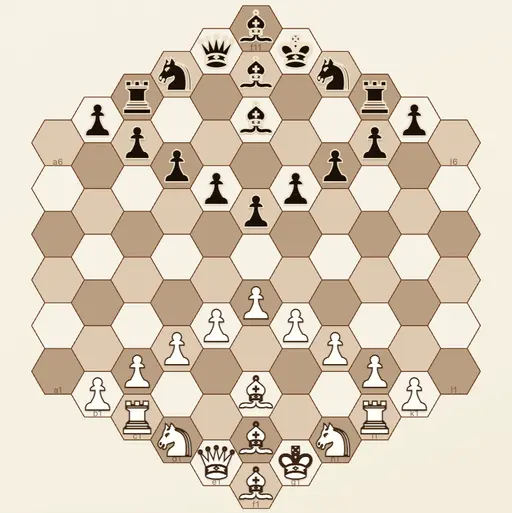
About Hexagonal Chess
Familiar chess pieces operate on unfamiliar geometry. Rook, bishop, queen, and knight attacks must be reconstructed from the hexagonal board's connections rather than copied from square-board patterns. Three cell colors divide bishop coverage into three complexes. Accurate analysis identifies the direction and any obstruction before checking king safety, with separate attention to directional pawn movement and the platform's promotion and stalemate handling.
- Ruleset covered
- 91-cell Gliński hexagonal geometry: six orthogonal directions, six diagonal directions, and three cell colors; platform-specific promotion and result handling
- Updated
- · Editorial policy and corrections
Hexagonal ChessRules and variant distinctions
The 91-cell board and starting forces
This board uses Gliński's hexagonal geometry: 91 hexagonal cells in a large hexagon, colored in three shades. White moves first. In the default display, White starts on the near side and Black on the far side. Each player begins with one king, one queen, two rooks, two knights, three bishops, and nine pawns. Each bishop starts on a different cell color and remains on that color throughout its movement. Three bishops therefore cover three separate color complexes, not the two familiar from square-board chess. Losing one bishop changes which colored cells your remaining bishops can reach; it does not simply remove another interchangeable long-range piece. Learn the board's connections before transferring a familiar chess pattern. A hexagonal cell has six edge-sharing neighbors. The bishop's directions use a different set of lines, so a piece's name alone does not identify every square it controls.
Rook, bishop, queen, king, and knight movement
A rook slides along any of six orthogonal directions through edge-sharing cells. A bishop slides along any of six diagonal directions and stays on its cell color. The queen combines those rook and bishop lines. Sliding pieces cannot jump occupied cells: a friendly piece blocks further movement, while an opposing piece can be captured at its cell but prevents movement beyond it. The king moves one step in a rook or bishop direction, giving up to twelve geometrically available destinations in an unobstructed interior position. These are not twelve edge-sharing neighbors: six are orthogonal steps and six are diagonal steps. Board boundaries, friendly occupancy, and enemy attacks reduce the legal choices. The king may not move into check or remain in check after your move. A knight has up to twelve geometrically available jumping destinations. Unlike a rook or bishop, it may jump intervening pieces, but it cannot land on a friendly piece. Use the board's legal-move highlights to learn the exact destination pattern rather than importing the square-board knight's eight destinations. A capture normally replaces an opposing piece on its cell. Before accepting a candidate move, identify its direction, check any intervening obstruction, inspect the destination, and verify king safety. A piece's geometric reach is not the same as a legal move when moving it exposes its own king.
Pawn advances, en passant, and automatic promotion
A pawn advances one vacant cell straight forward. It captures on the two forward lines at 60 degrees to its advance direction, not by advancing straight into an enemy piece. A noncapturing diagonal pawn advance is not legal. Pawns on their own starting cells may instead advance two cells along the same straight line, provided both cells are vacant. An opposing pawn's immediately preceding two-cell advance can create an en passant capture. The capturing pawn moves to the passed-over cell and removes the pawn that advanced, rather than landing on its occupied destination. The platform gives this example: after Black plays c7–c5, a White pawn on b5 can capture en passant on c6. Check the actual coordinates and the immediately preceding move; an adjacent enemy pawn alone does not establish eligibility. A pawn promotes when it reaches the end of its forward line. Because the board is hexagonal, identify the terminal cell of that pawn's line rather than applying a single square-board promotion rank. Ply Yard automatically promotes to a queen; do not assume an underpromotion selector is available. There is no castling on this board. For each pawn, distinguish the forward advance cell, the capture cells, and the promotion boundary. A geometrically nearby cell may belong to none of these legal options. Pawn control matters when evaluating king moves even when the pawn cannot advance into the king's cell.
Checkmate, stalemate, and platform results
Checkmate wins: the opposing king is in check and the opposing side has no legal response. Examine king moves, captures of the checking piece, and possible interpositions against a sliding attack. Every proposed response must leave the king safe from all attacks. Visual encirclement is not proof of mate, and a jumping knight attack cannot be stopped by placing a piece between the knight and king. Stalemate is different: the side to move has no legal move, but its king is not in check. According to the platform's published instructions, the player who made the preceding move wins in that situation. This describes the site's result handling; it must not be presented as a complete statement of scoring in every Gliński competition. In particular, do not import square-board chess's automatic stalemate draw into this implementation. Players may agree to a draw. The platform also describes a possible draw after an extended period without a capture or pawn advance, but the cited page does not state an exact counter. Do not assume the square-board fifty-move or seventy-five-move thresholds apply. Use the current board's result display and published instructions for implementation-specific adjudication.
Use the board to verify your calculation
Read the status display, select a piece belonging to the side to move, and inspect its highlighted legal destinations. Selecting a highlighted cell completes the move. If no destinations appear, inspect its blockers or king-safety restriction, or select another piece. Against the computer you may choose White or Black; choosing Black lets the computer make White's opening move. For a first training game, predict a rook's six directions and a bishop's six directions before selecting them. Compare your prediction with the highlights and explain any missing destination. Then practice the knight pattern and pawn captures. This is more useful than memorizing a square-board rule and assuming it survives the change in geometry. In review, record the actual cells involved in a check or blocked line. Classify the error as direction, obstruction, pawn eligibility, or king safety. Hints reflect the selected computer level, so a displayed suggestion is not an independent certification that a move is optimal. The goal is to understand why a move is legal and what the opponent can do in reply.
Practical strategy
From an interior cell, list the unobstructed cells controlled by a rook and then by a bishop. Record the board coordinates and cell colors, then add a friendly blocker to one line.
Identify six orthogonal directions and six diagonal directions without substituting the square board's four of each. Show that the bishop stays on its color and that a sliding piece cannot pass the blocker.
For one pawn, mark its forward advance, both capture cells, any starting double advance, and the terminal cell where promotion occurs.
Separate geometric proximity from forward-oriented pawn movement. Check empty advance cells and occupied capture targets, then explain the platform's automatic queen promotion and the timing requirement for en passant.
Review a checked position and enumerate king moves, captures of the checking piece, and any legal interpositions.
Test every candidate for the resulting king safety. Declare checkmate only when the king is checked and all legal responses fail; keep stalemate separate and do not use visual encirclement as the test.
A common misconception
Bishops on a hexagonal chessboard still divide their coverage into the square board's two colors.
Gliński's board has three cell colors. Each bishop remains within its own color complex along the defined hexagonal diagonals. Reconstruct the actual control cells rather than applying the square board's two-color model.
Position study: Identify the line before checking the blocker
Choose an interior hexagonal cell and mark its six edge-sharing neighbors. Trace a straight rook-direction line through one of those neighbors. A friendly piece occupies a cell on that line.
Does experience with ordinary chess justify treating this as a rook line that can pass the friendly piece?
Show the answer and analysis
No. Verify the hexagonal direction first. Even on a valid rook line, the friendly piece blocks movement beyond its cell. More movement directions do not give a sliding piece permission to jump.
Work in order: board connections, movement direction, obstruction, and king safety. A familiar symbol identifies the piece, not the complete set of legal cells on a different geometry. Remove or relocate the blocker only as a separate legal move; do not disregard it when calculating a distant attack.
This position was constructed for instruction. It is not a tournament record or an engine-verified proof of an optimal move. Evaluate it under the stated conditions; do not assume unlisted features of the complete position.
Structured practice
Understand the rules
List the unobstructed control cells of an interior rook and bishop using actual coordinates and cell colors.
Assessment: Distinguish six orthogonal directions from six diagonal directions and verify the bishop's unchanged color. Do not substitute the square board's direction counts.
Compare candidate moves
Mark a pawn's advance and capture cells, then locate its promotion boundary.
Assessment: Explain direction-dependent movement rather than proximity alone. Check the starting double advance and distinguish automatic queen promotion from an assumed choice of promotion piece.
Review and verify
Review a check and enumerate king moves, captures of the attacker, and possible interpositions.
Assessment: Test the resulting king safety for each candidate. Checkmate requires check and no legal response, not merely an apparent ring of attacks around the king.
Frequently asked questions
Which side moves first in hexagonal chess on Ply Yard?
White always moves first. Against the computer you may choose either side; if you choose Black, the computer plays White's first move. Read the side-to-move display rather than relying only on the board's orientation.
Why does each player start with three bishops?
The board has three cell colors, and a bishop remains on the color where it starts. The three starting bishops occupy different colors, allowing their combined movement to reach all three color complexes. One bishop cannot change color to replace the coverage of another.
Can a pawn advance diagonally without capturing?
No. A pawn's ordinary advance is straight forward into an empty cell; its forward 60-degree directions are for captures. The starting two-cell advance follows the same straight line and requires both cells to be empty. En passant is a special capture with its own immediate timing condition, not a general diagonal advance.
Is stalemate a draw on this board?
Not according to the platform's published instructions. If the side to move has no legal move and is not in check, the player who made the preceding move is awarded the win. This is a statement about the site's result handling, not a universal account of Gliński tournament scoring. Checkmate requires check; stalemate does not.
Can I play before memorizing every hexagonal movement pattern?
Yes. Selecting a piece shows its legal destinations. Use those highlights to test a prediction, starting with rook and bishop lines before learning the knight's twelve potential destinations. If a cell is missing, inspect the line, occupancy, and king safety. The highlights help you learn legality; they do not explain every tactical consequence of a move.
Can a rook jump a friendly blocker because the board is hexagonal?
No. Changing the geometry does not remove a sliding piece's obstruction rule. First identify whether the route is a legal rook direction; then stop at the first occupied cell. A friendly piece blocks it, while an enemy piece can be captured there but not passed. Knights jump; rooks, bishops, and queens do not.
Do bishops still operate on only two square-board colors?
No. Gliński's board uses three cell colors. Each bishop follows its six diagonal directions within one color complex, so evaluate the actual hexagonal lines and colors rather than a square board's light-square and dark-square division. Verify the coordinates of an attack before assuming a familiar bishop pattern applies.
Put your understanding into practice.
Choose one skill to work on in your next game. A clear reason for each move is more useful than an immediate win.
Play Hexagonal ChessRules sources and editorial notes
- Current rules for this game on Ply Yard
Identifies the board variant and interface described here. Platform instructions are not a complete statement of every tournament ruleset.
This guide combines the relevant board's rules with independently constructed examples and exercises. It distinguishes basic rules, variant-specific provisions, and strategic advice. Rules sections draw on the sources listed above. Instructional positions have not been presented as exhaustively engine-verified or certified by professional players.
Written by Ply Yard. Independent review by a named professional player has not been completed. To report an issue, send the game, ruleset, position, and relevant source provision to contact@plyyard.com.