 Ply Yard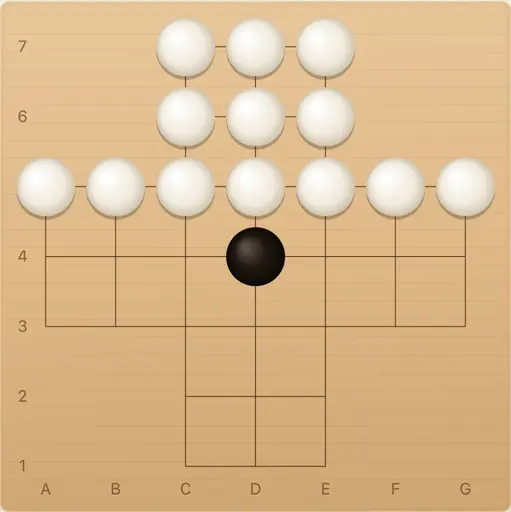
About Fox and Geese
Evaluate the two sides through their asymmetric tasks: capture and mobility for the fox, coordinated immobilization for the geese. An empty point beyond an adjacent goose can provide a single-jump escape despite a visually complete enclosure. The jump ends the fox's turn, and the geese respond before any later capture. Movement directions, capture sequencing, and winning thresholds here follow the current platform rules rather than every Fox and Geese variant.
- Ruleset covered
- Ply Yard's thirty-three-point Fox and Geese: one fox against thirteen geese; orthogonal movement, optional single jumps, and a nine-capture target
- Updated
- · Editorial policy and corrections
Fox and GeeseRules and variant distinctions
A thirty-three-point cross, one fox, and thirteen geese
Ply Yard uses a cross-shaped board with thirty-three playable intersections. The upper and lower arms each contain two rows of three points; the three central rows each contain seven. Pieces stand on these intersections, not inside squares. Movement follows the horizontal and vertical connections only. Do not import diagonal routes from an Alquerque-style board or another Fox and Geese variant. The fox starts at the center, and thirteen geese occupy the northern starting area shown on the board. The geese move first, after which the sides alternate one turn at a time. All pieces are already in play: there is no reserve-piece placement phase as in Bagh-Chal. The fox has greater directional freedom and can capture. The geese have a numerical advantage but cannot capture or retreat northward. Assess the sides by different measures: the fox needs useful escape routes and opportunities to reach the capture threshold, while the geese need coordinated restrictions that remain intact after the fox's reply. A cross-shaped boundary changes which neighboring points exist. Before calculating a move near an arm or corner, confirm that both the destination and its connecting line are actually on the playable network. An apparently adjacent position outside the cross is not a legal destination.
Geese step south or sideways; they never retreat, jump, or capture
On a goose turn, move one goose along an orthogonal connection to a neighboring empty point. A goose may move south, east, or west, but not north toward its starting side. It cannot jump over another piece or capture the fox. The direction restriction is fixed by the board, not by where the fox happens to stand. Think of the geese as a coordinated barrier rather than thirteen independent pursuers. A goose beside the fox may obstruct an ordinary step, yet offer a capture if the point immediately beyond it is empty. Adding more adjacent geese does not by itself make the fox immobile. Every goose move occupies a destination and vacates its origin. Inspect both changes: a move that closes one neighboring exit may create a landing point behind another goose. Southward advancement is especially consequential because the moving goose cannot reverse that step on its next turn. Sideways movement remains available where connected empty points exist. Before advancing a barrier, list the fox's ordinary steps and single captures in the resulting position. Preserve the geese's own legal mobility as well. A densely occupied group can still fail if it leaves a capture landing or eventually has no legal move. Formation quality depends on the actual action network, not the number of pieces near the fox.
The fox may step in four directions or make one optional capture
The fox may move to a neighboring empty point north, south, east, or west along a printed connection. To capture, it jumps over one adjacent goose and lands on the immediately following empty point along that same straight orthogonal line. Both segments must be playable connections. Remove the jumped goose immediately. A capture is optional: even when a legal jump exists, the fox may choose an ordinary step. Each fox turn permits only one jump. After a capture, the geese take their turn; the fox cannot continue jumping in the same turn, even if a second capture appears available from its new point. An occupied landing prevents a jump. A diagonal alignment, two intervening geese, or a missing point beyond the boundary also prevents it. The fox cannot turn midway over a goose or leap over a line of several pieces in one action. These are capture conditions, not exceptions that a visually enclosed fox may ignore. Compare the position after a capture with the position after a quiet step. Capturing reduces the goose count, but the landing point may leave the fox with fewer useful routes. A quiet move may instead reposition the fox to threaten a later jump. Any plan involving successive captures must include an intervening goose reply between them; do not calculate it as an uninterrupted capture sequence.
Nine captures win for the fox; the geese must remove every legal action
The fox wins when its cumulative capture count reaches nine geese. Eight captures are not enough under the published threshold. The geese win by leaving the fox without any legal action when it must move: both ordinary steps and single jumps must be excluded. The platform also states that whichever side has no legal move loses, so the geese cannot disregard their own mobility. To verify a fox blockade, first check the connected neighboring empty points in all four orthogonal directions. Then check each adjacent goose for a playable empty point immediately beyond it. One legal step or jump disproves complete immobilization, even if the fox looks surrounded. A position at an arm's end is not automatically a win for either side. For the fox, track the capture total and the routes left after each removal. For the geese, track occupied barrier points, potential jump landings, and origins that a proposed move would vacate. Material count and visual enclosure are useful observations, but neither replaces a legal-action calculation. Train in stages: identify each side's movement directions, construct and invalidate single-jump patterns, and finally review a coordinated enclosure. In a replay, locate the first move that opened an escape or capture landing, then test a legal alternative against every fox reply. This guide describes the current Ply Yard implementation; other boards and regional versions may use different directions, capture sequences, or winning thresholds.
Practical strategy
List every legal one-turn action for the fox and for a selected goose in a small position.
Give the fox four orthogonal movement directions and optional single captures. Give the goose only southward or sideways neighboring steps, with no jumping or capture.
Build a position that appears to surround the fox, then inspect every possible capture landing.
Distinguish an occupied neighboring point from a blocked jump. For each adjacent goose, check whether a connected empty point exists directly beyond it.
Review one move that tightens the goose formation and identify any capture route it opens.
Evaluate the fox's complete set of steps and single jumps after the move, including the goose's vacated point. Include a goose reply before any later fox capture.
A common misconception
A fox with geese on all neighboring points has no legal move.
It may still jump over an adjacent goose to a connected empty landing. Verify both ordinary steps and single captures before declaring immobilization.
Position study: A surrounded fox can still have a capture landing
A goose stands at an orthogonally adjacent point to the fox. The next point on that same straight printed line is empty, and both connections are playable. The remaining conditions permit that single capture.
Has the goose formation completely immobilized the fox?
Show the answer and analysis
No. The fox has a legal jump over that goose to the empty landing point. It removes one goose and ends its turn. The geese respond next; any further fox capture belongs to a later turn.
A blockade must exclude the fox's entire legal-action set, not merely its ordinary neighboring steps. Controlling potential landing points can matter more than increasing the number of adjacent geese. The geese cannot use the fox's jumping ability themselves, and a plan involving successive fox captures must account for intervening goose replies.
This position was constructed for instruction. It is not a tournament record or an engine-verified proof of an optimal move. Evaluate it under the stated conditions; do not assume unlisted features of the complete position.
Structured practice
Understand the rules
List the fox's and a goose's legal actions in a small test position.
Assessment: Use orthogonal connections only. Distinguish the fox's four-direction steps and optional single captures from the goose's southward or sideways steps without capture.
Compare candidate moves
Construct a visually enclosed fox position and inspect every empty point beyond an adjacent goose.
Assessment: Check both segments of each straight jump and its landing occupancy. An occupied neighboring point can prevent a step while still permitting a capture.
Review and verify
Review a tightening goose move and identify any newly available fox capture route.
Assessment: Include the moving goose's vacated point and every fox action. If planning a later jump, insert the intervening goose reply rather than calculate a continuous capture sequence.
Frequently asked questions
Is Fox and Geese the same game as Hnefatafl?
No. Hnefatafl centers on a king's escape and custodial capture. This Fox and Geese board instead has one fox against thirteen geese, with orthogonal jump captures available only to the fox. Geese cannot retreat northward, and the fox's nine-capture target differs from a king's escape objective.
Can a goose move backward?
Not northward toward its starting side. A goose may step south, east, or west to a connected neighboring empty point. It cannot move diagonally, jump, or capture. Before advancing south, inspect the point it will leave empty, because that goose cannot simply retreat north to repair the formation.
Must the fox capture, and can it keep jumping in the same turn?
Capturing is optional, and each turn permits only one jump. The fox may choose an ordinary legal step even when a capture is available. After a jump removes one goose, the turn passes to the geese. A later capture must be evaluated after their intervening reply, not as part of a multiple-capture sequence.
Why has the fox not won after capturing several geese?
The published winning threshold is nine captured geese. Eight captures do not meet it. Before the ninth capture, continue checking the side-to-move immobilization condition as well: the geese must exclude every fox step and jump to win by blockade, and a goose side with no legal move loses.
Does a ring of geese prove that the fox is trapped?
No. Inspect the legal actions rather than the shape of the formation. If an adjacent goose has a connected empty landing immediately beyond it, the fox can make a single capture and escape. The geese then reply before the fox's next turn. Complete immobilization requires the absence of every neighboring step and every legal single jump.
Is the fox immobile whenever all its neighboring points contain geese?
Not necessarily. Those geese may block ordinary steps but allow captures if the points directly beyond them are empty and connected. Check each orthogonal jump separately, including whether its landing lies inside the thirty-three-point board. Surrounding the fox's immediate neighbors is not the same as eliminating its legal actions.
Put your understanding into practice.
Choose one skill to work on in your next game. A clear reason for each move is more useful than an immediate win.
Play Fox and GeeseRules sources and editorial notes
- Current rules for this game on Ply Yard
Identifies the board variant and interface described here. Platform instructions are not a complete statement of every tournament ruleset.
This guide combines the relevant board's rules with independently constructed examples and exercises. It distinguishes basic rules, variant-specific provisions, and strategic advice. Rules sections draw on the sources listed above. Instructional positions have not been presented as exhaustively engine-verified or certified by professional players.
Written by Ply Yard. Independent review by a named professional player has not been completed. To report an issue, send the game, ruleset, position, and relevant source provision to contact@plyyard.com.