 Ply Yard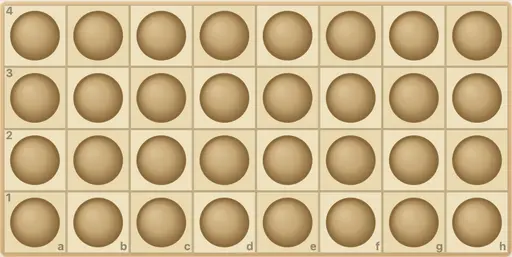
About Banqi
Banqi combines a visible arrangement with identities that remain hidden. Legal move analysis starts with revealed ownership, the capture hierarchy, the soldier–general exception, and cannon-screen geometry. Evaluating a reveal then requires reasoning from the remaining possibilities, not assuming that an unknown piece will be favorable. This guide separates known occupancy from concealed identity and uses a face-down cannon screen to show why hidden pieces already have tactical significance.
- Ruleset covered
- 8×4 Banqi: the first reveal assigns colors; cannons capture revealed targets across one screen
- Updated
- · Editorial policy and corrections
BanqiRules and variant distinctions
The 8×4 board and face-down starting position
Banqi, also called Chinese dark chess, uses an 8-column, 4-row board with 32 squares. Each color has 16 xiangqi pieces: one general, two advisors, two elephants, two chariots, two horses, two cannons, and five soldiers. All 32 pieces start face down in randomly assigned squares. There is no river or palace. The piece names identify capture ranks, not their movement from xiangqi. A revealed horse does not make a knight-like move, and a general is not confined to a palace. Most movement is a single orthogonal step; the cannon's capture has its own rule. Face-down pieces conceal identity, not occupancy. They block ordinary movement and can serve as cannon screens. Plan from the visible arrangement and the identities still possible among the hidden pieces rather than treating those squares as empty.
The first reveal assigns the players' colors
Choose whether to play first or second, not whether to play Red or Black. The first player reveals one face-down piece. Its color belongs to that player, and the opponent takes the other color. Revealing the first piece is the first player's complete turn; it does not also permit moving that piece immediately. On subsequent turns, either reveal one remaining face-down piece or move one of your own revealed pieces. You may reveal a piece without knowing which color it will belong to. A reveal changes the information available to both players and may create a new threat near an already exposed piece. Distinguish choice of move order from ownership. Red is not automatically the first player in this game: the first reveal determines whether the player who started owns Red or Black.
Ordinary capture ranks and the soldier–general exception
The hierarchy from highest to lowest is general, advisor, elephant, chariot, horse, cannon, soldier. For pieces using ordinary rank-based capture, equal ranks can capture one another, and a higher rank can capture a lower rank. The special reversal is that a soldier can capture a general, while a general cannot capture a soldier. A revealed piece makes an ordinary non-capturing move one square horizontally or vertically onto an empty square. An ordinary capture also targets an adjacent orthogonal square, which must contain a revealed opposing piece eligible under the rank rule. There are no diagonal moves. The cannon does not use ordinary adjacent rank-based captures: its screen capture is described separately below. A face-down piece cannot be captured or entered by an ordinary move, and no piece can land on one of its own color. Banqi has no check rule, so general safety does not restrict legal moves as it does in xiangqi.
A cannon captures across exactly one screen
When not capturing, a cannon moves one orthogonal square to an empty destination. To capture, it must target a revealed opposing piece along the same row or column, with exactly one occupied square between the cannon and the target. That intervening piece is the screen. Other intervening squares must be empty. The screen may be face down or revealed and may belong to either player. Its identity need not be revealed first. The target, however, must already be revealed. A cannon can capture that target regardless of rank, including a general. With no screen or two or more screens, the capture is illegal. An adjacent target has no intervening screen and therefore cannot be captured by the cannon. Separate the three tests: alignment, exactly one intervening piece, and a revealed opposing target. A high target rank does not invalidate a capture that satisfies the cannon rule.
Elimination, inability to act, and the no-progress draw
Capturing all of the opponent's pieces wins the game. A player also loses when their turn begins and they can neither reveal a piece nor make a legal move. The absence of a movement option alone does not establish defeat while a legal reveal remains available. There is no checkmate procedure and no final score obtained by counting piece values. A general is an important ranked piece, not a royal piece whose capture alone necessarily ends the game. Winning requires the stated elimination or inability-to-act condition. This platform declares a draw after 120 consecutive half-moves without either a capture or a reveal. A half-move is one action by one player, not a pair of turns. An ordinary move advances this no-progress count; a capture or reveal breaks the sequence. Online players may also offer and agree to a draw before that limit.
Revealing and moving on Ply Yard
Select a face-down piece once to reveal it. To move a revealed piece, select one of your own pieces, inspect the highlighted legal destinations, then select a destination. Changing the selected piece before committing a move does not use a turn. Before colors are assigned, the status display distinguishes the first and second players. After the initial reveal, it identifies Red or Black. Check that display rather than assuming the familiar xiangqi move order. When deciding whether to reveal, assess the surrounding exposed pieces and the remaining possible identities. An adjacent hidden piece may reveal as an opposing soldier beside your general, but it is not known to be one. Review the decision using the information available at that moment, not by treating the eventual identity as something you should already have known.
Illegal actions and a public-information checklist
You cannot move diagonally, move an ordinary piece more than one square, move an opponent's revealed piece, or capture a face-down target. A general cannot capture a soldier. An ordinary lower-ranked piece cannot capture a higher-ranked one except for a soldier capturing a general; the cannon follows its separate screen rule. A cannon cannot capture without a screen or across two or more intervening pieces. Its ability to capture at a distance does not permit a long non-capturing move. A hidden piece can be a screen, but that does not make it a legal capture target. For every candidate action, verify the public facts first: ownership of revealed pieces, destination occupancy, ordinary rank or cannon eligibility, and the exact number of screens. Then evaluate the uncertainty of a reveal. Track possible identities without asserting that a particular hidden square must contain a favorable piece unless the remaining inventory actually establishes that fact.
Practical strategy
Test a cannon line with zero, one, and two intervening pieces. For the one-screen case, use a face-down piece, then a revealed piece of each color.
Allow a capture only with exactly one screen and a revealed opposing target. Explain why screen color and hidden identity do not change that test.
Record the revealed pieces by color and rank, keeping captured revealed pieces in the record. List the identities still possible among the face-down pieces.
Deduct each known piece from the original inventory once. Express uncertain identities as possibilities instead of declaring an unseen square to be a general or soldier without evidence.
Review a reveal by comparing the publicly known position before it with the new threats after it.
Evaluate the original choice using the information available when it was made. Separate a foreseeable risk from an unfavorable identity learned only afterward.
A common misconception
A hidden piece cannot obstruct movement or serve as a cannon screen, so it has no tactical value until revealed.
Its identity is concealed, but its occupancy is public. A face-down piece blocks ordinary movement and can be the single screen required for a cannon capture.
Position study: A cannon screen need not be a revealed friendly piece
Your cannon and a revealed opposing piece lie on the same straight line. Exactly one face-down piece stands between them; all other intervening squares are empty. Assume the revealed target is otherwise eligible for a cannon capture.
Can the face-down piece serve as the cannon's screen?
Show the answer and analysis
Yes. The capture crosses exactly one intervening piece. The screen may be face down or may be a revealed piece of either color; its identity need not be revealed first. The cannon lands on the revealed opposing target, not on the screen.
Do not reject the capture because the target has a higher rank, and do not treat the hidden screen as a capturable target. Alignment, intervening occupancy, and the target's revealed status are separate parts of the legality test.
This position was constructed for instruction. It is not a tournament record or an engine-verified proof of an optimal move. Evaluate it under the stated conditions; do not assume unlisted features of the complete position.
Structured practice
Understand the rules
Build cannon lines with zero, one, and two screens. Test face-down pieces and revealed pieces of both colors as the single screen.
Assessment: A legal cannon capture requires exactly one intervening piece and a revealed opposing target.
Compare candidate moves
Count the known pieces of each color and rank, including captured revealed pieces, and list the possible remaining hidden identities.
Assessment: Use the original inventory without deducting a piece twice, and express unresolved identities as possibilities rather than unsupported certainties.
Review and verify
Review one reveal, comparing the publicly known risks before the action with the threats created after the identity became visible.
Assessment: Judge the decision using information available at the time, not by assuming that the eventual identity was already known.
Frequently asked questions
How does Banqi differ from xiangqi?
It uses the same piece types, but on an 8×4 board with all pieces initially face down. There is no river, palace, check, or checkmate. Revealed pieces mostly move one orthogonal square, and captures use a rank hierarchy with exceptions. You win by eliminating the opponent's pieces or leaving the opponent unable to reveal or move, not by trapping a general in a palace.
Do I choose Red or Black before the game?
No. You choose to play first or second. The first piece revealed determines ownership: its color belongs to the first player, and the other color belongs to the opponent. Red therefore need not be the first player's color. The reveal uses the turn; moving a revealed piece is a separate action on a later turn.
Can a soldier really capture a general?
Yes. A revealed soldier may capture an adjacent revealed opposing general with a legal orthogonal move. A general cannot capture a soldier in return. This reversal makes an exposed general vulnerable near hidden squares that could contain an opposing soldier, but a possible hidden identity is not a known one.
How does a cannon capture?
It captures a revealed opposing piece in the same row or column across exactly one intervening piece. That screen may be face down or revealed and may be either color. Target rank does not matter. A hidden target, an adjacent target with no screen, or a line with more than one screen is not a legal cannon capture.
Does the computer see face-down piece identities?
According to the platform's published rules, it does not. The described search evaluates revealed pieces, while reveal selection uses positional heuristics rather than concealed identities unavailable to the player. This guide reports that documented behavior; it is not an independent audit of the engine or a promise about every other Banqi implementation.
Can play continue indefinitely without a capture?
The platform draws the game after 120 consecutive half-moves with neither a capture nor a reveal. That means 120 individual player actions, not 120 pairs of turns. A reveal interrupts the count even if no piece is captured. Online players may also agree to a draw before the limit is reached.
Can a face-down piece serve as a cannon screen?
Yes. A cannon capture requires exactly one intervening piece, not a screen of a particular color or rank. A face-down screen does not need to be revealed first. The target must still be a revealed opposing piece. Keep screen occupancy separate from target eligibility: being usable as a screen does not make a hidden piece capturable.
Does a face-down piece have no tactical significance until it is revealed?
No. Its square is occupied, so it obstructs ordinary movement and can serve as a cannon screen even while its identity remains unknown. Revealing it can change ownership-specific movement and capture threats. Analyze the known occupancy separately from the uncertain identity rather than treating the square as empty or assuming a favorable reveal.
Put your understanding into practice.
Choose one skill to work on in your next game. A clear reason for each move is more useful than an immediate win.
Play BanqiRules sources and editorial notes
- Current rules for this game on Ply Yard
Identifies the board variant and interface described here. Platform instructions are not a complete statement of every tournament ruleset.
This guide combines the relevant board's rules with independently constructed examples and exercises. It distinguishes basic rules, variant-specific provisions, and strategic advice. Rules sections draw on the sources listed above. Instructional positions have not been presented as exhaustively engine-verified or certified by professional players.
Written by Ply Yard. Independent review by a named professional player has not been completed. To report an issue, send the game, ruleset, position, and relevant source provision to contact@plyyard.com.