 Ply Yard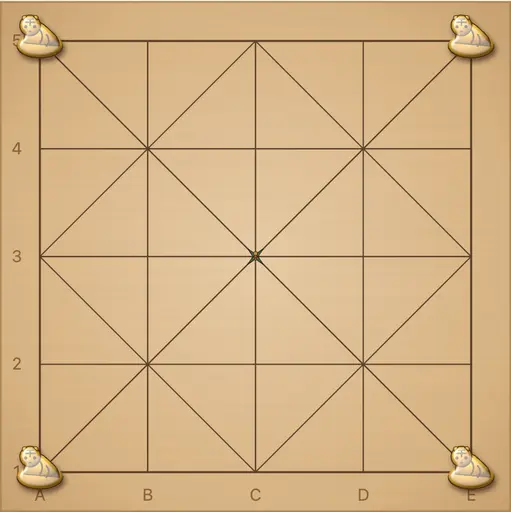
About Bagh-Chal
Bagh-Chal separates the two sides' tasks. The goats build a coordinated restriction of tiger routes, while the tigers use mobility and captures to create openings. Goat placement and goat movement require different calculations: a placement occupies a new point, whereas a move also vacates an old one. Analyze the printed connections, capture landings, remaining reserve, and cumulative tiger capture count before judging a position.
- Ruleset covered
- Ply Yard's 5×5 Bagh-Chal: four tigers against twenty goats; placement before goat movement; optional single captures
- Updated
- · Editorial policy and corrections
Bagh-ChalRules and variant distinctions
Four tigers, twenty goats, and a network of twenty-five points
Bagh-Chal is an asymmetric hunting game. Four black tigers begin at the corners of a 5×5 intersection board. Twenty white goats begin off the board, in reserve. The goats make the first placement, and the sides then alternate one turn at a time. Pieces occupy intersections, not the centers of squares. Horizontal and vertical connections join neighboring intersections. Diagonal movement is available only where the board has a printed diagonal connection. With rows and columns numbered consistently from a corner, points whose row and column numbers have an even sum belong to the diagonal network; odd-sum points have only orthogonal connections. Corners and the center allow diagonal movement, but a nearby point is not automatically adjacent. Use the drawn lines to determine both ordinary moves and capture routes. Counting the goats around a tiger is not enough to establish a blockade: you must inspect its connected empty destinations and the landing points beyond adjacent goats. The two sides differ in numbers, actions, and winning conditions, not merely in piece color.
Placement phase: introduce one goat, then allow a tiger response
While goats remain in reserve, each goat turn places one new goat on an empty intersection. An existing goat cannot move instead. The tiger side does not have a matching placement phase: on its turn, it moves one tiger to a connected neighboring empty point or makes a legal single capture. Tiger captures are optional on this board. Having a jump available does not prohibit an ordinary move. Each capture takes exactly one goat and ends the turn; there are no multiple-capture sequences. That distinction matters when comparing Bagh-Chal with draughts or Alquerque. Before choosing a placement, examine every tiger's reply. A goat beside a tiger is exposed only if the point directly beyond it is empty and both segments of the jump follow the same straight printed line. Occupying a prospective landing point can remove one jump, but may expose the newly placed goat to another tiger. Recalculate the entire position rather than assume one defensive placement closes every route. Aim to build mutually supporting restrictions without offering an immediate capture. Captured goats leave the game; they do not return to reserve. The placement phase ends when all twenty goats have been introduced, not when twenty surviving goats stand on the board simultaneously.
Movement phase: goats make neighboring steps, never captures
After the reserve is exhausted, each goat turn moves one surviving goat along a printed connection to a neighboring empty intersection. Goats cannot jump, capture, or move through another piece. The tiger side retains its choice between an ordinary neighboring step and an optional single capture. A goat move changes two important points: its destination becomes occupied, and its former point becomes empty. A move that closes one escape route may therefore open a capture landing or release another tiger elsewhere. Check the vacated point as carefully as the destination. Coordinate the surviving goats to reduce the tigers' legal actions while retaining a legal action for the goat side. Do not equate dense occupation with a secure position. Empty points can be needed for goat mobility, yet can also serve as tiger capture landings. The strategic task is to manage those vacancies, not simply to fill the largest possible area. The side to move must have a legal action; the published rules do not provide a voluntary pass. If the goats have no legal neighboring step during this phase, the goats lose. A position that blocks one tiger is not a victory if another tiger can still move or capture.
A tiger capture follows one straight, connected two-segment route
To capture, a tiger jumps over one adjacent goat and lands on the immediately following empty intersection on the same straight line. Both the approach to the goat and the segment beyond it must be marked connections. Remove the jumped goat immediately. The tiger's turn then ends, even if another capture is available from its new point. An occupied landing point prevents that jump. A missing diagonal segment also prevents it, regardless of how natural the diagonal appears on screen. A tiger cannot jump a tiger, skip two adjacent goats in one leap, turn midway over a goat, or continue into a second capture during the same turn. Goats have no jumping action at all. Evaluate the position after removal as well as the immediate material gain. A capture may open another tiger's route or move the capturing tiger into a restricted area. Because capture is optional, compare its resulting mobility with the positions produced by ordinary moves; do not import a compulsory-capture priority from another game. On the interface, select a piece and then its legal destination during the movement phase. During goat placement, select an empty point for the new goat. An unavailable destination usually reflects the current phase, a missing connection, an occupied point, or an action that the selected piece cannot perform. An invalid selection does not consume the turn.
Five captured goats win for the tigers; complete immobilization wins for the goats
The tigers win immediately when their cumulative capture count reaches five goats. They do not need to capture every goat. The goat side normally wins by leaving all four tigers without any legal neighboring step or capture when the tiger side must act. Conversely, the published implementation makes the side with no legal action lose, so goat immobilization also matters. Verify a claimed tiger blockade one piece at a time. List each tiger's connected neighboring empty points, then every adjacent goat with a connected empty landing beyond it. Only when all four lists contain no legal action has the goat side established the required immobilization. Visual enclosure, a corner position, or the immobility of a single tiger is insufficient. For a first complete game, prioritize phase recognition, optional single captures, and the five-goat threshold. Then practice how placement changes capture landings, followed by how movement changes both the occupied destination and the vacated point. These are different calculation tasks and should be trained separately. In review, record the phase, the tiger capture total, the newly occupied or vacated points, and the first legal route missed in your analysis. Judge a sacrifice by the resulting routes and the remaining capture margin, not by an unsupported promise of a forced blockade. These instructions describe the current Ply Yard board rather than every regional Bagh-Chal ruleset.
Practical strategy
Alternate goat placements and tiger replies for several turns, identifying the legal action before selecting a point.
The goats introduce one reserve piece per turn; the tigers may step or make one optional capture. Existing goats cannot move during placement.
List one tiger's neighboring moves and capture landings, then place a goat to remove one route.
Recheck every tiger afterward. Identify the exact printed segments, intervening goat, and empty landing for each remaining capture.
After all twenty goats have been introduced, reduce tiger mobility through coordinated goat moves and review the first escape you overlooked.
Examine every tiger's legal actions, the point vacated by each goat move, and the goat side's own remaining mobility. Do not claim victory from blocking only one tiger.
A common misconception
Both sides move pieces already on the board from the first turn.
The goats must introduce all twenty reserve pieces before moving survivors. The tigers begin on the board and can move or capture throughout. Their legal actions and winning objectives are asymmetric.
Position study: A promising blockade does not override the placement phase
It is the goat side's turn, and some goats remain in reserve. Moving a goat already on the board appears to close a tiger route. This guide uses the placement-before-movement rules of the current Ply Yard board.
May the goats move that existing piece instead of introducing a new goat?
Show the answer and analysis
No. Place one reserve goat on a legal empty intersection. Existing goats may move only after all twenty have been introduced. The tigers still take their normal movement or capture turns while the goats are placing.
First establish which actions the phase allows; only then compare their positional value. Examine whether the new placement leaves a connected empty landing beyond an adjacent goat, and check the other tigers as well. A visually compact group is not necessarily safe, and an attractive but illegal move cannot complete a blockade.
This position was constructed for instruction. It is not a tournament record or an engine-verified proof of an optimal move. Evaluate it under the stated conditions; do not assume unlisted features of the complete position.
Structured practice
Understand the rules
Play a short sequence of alternating goat placements and tiger replies, stating each side's legal options.
Assessment: Introduce a reserve goat on every goat turn, and distinguish a tiger's neighboring step from its optional single capture. Do not move an existing goat during placement.
Compare candidate moves
Enumerate one tiger's moves and jumps, then place a goat to close a selected route.
Assessment: Identify each printed connection and landing point. Recalculate the other routes and other tigers rather than assume the placement establishes complete control.
Review and verify
In the movement phase, narrow tiger routes and review the first reopened escape or capture landing.
Assessment: Check all four tigers after each move, including the point the goat vacated. Confirm that the goats retain a legal action and that any claimed tiger immobilization excludes both steps and captures.
Frequently asked questions
Is Bagh-Chal a form of Chinese checkers or Turkish Draughts?
No. Chinese checkers is a race across a star-shaped board. Turkish Draughts and English draughts use 8×8 boards but differ in movement and capture directions. Bagh-Chal instead pits four tigers against twenty goats on a 5×5 intersection network. The tigers seek captures, while the goats seek complete tiger immobilization; neither side is racing its pieces to an opposite home area.
Must a tiger capture whenever a jump is available?
No. Capturing is optional in the Ply Yard implementation. The tiger side may choose a legal ordinary neighboring step even when a capture exists. A chosen capture removes one adjacent goat and ends the turn. Goats cannot capture.
Why are diagonal moves available at some points but not others?
The printed Alquerque-style network determines adjacency. Orthogonal connections join neighboring points throughout the board, while diagonals occur at even row-plus-column points when numbered consistently from a corner. An odd-sum point has no diagonal connection. Always inspect the actual line, rather than infer a diagonal move from visual proximity.
Which side starts, and where do the pieces stand?
The goats start by placing one white piece on an empty intersection. Four black tigers already occupy the corners. All pieces stand on the twenty-five intersections, not inside squares. The remaining goats enter one at a time on subsequent goat turns.
Can one tiger capture two goats in the same turn?
No. This implementation permits only a single jump per tiger turn. Jump one adjacent goat along a straight connected route, land on the empty point immediately beyond it, remove that goat, and end the turn. A further jump from the new position must wait for a later tiger turn.
May I move an existing goat instead of placing a new one?
Not while any goats remain in reserve. Place one new goat on a legal empty point. Existing goats become movable only after all twenty have been introduced, even if earlier captures mean fewer than twenty survive. During placement, the tigers continue to move and capture under their own rules. Calculate the next tiger reply before choosing the placement.
Do both sides move existing pieces from the beginning?
No. The goats first have a placement phase, followed by a movement phase. The four tigers are already on the board at the start and can move or capture on their turns throughout both phases. Confusing these roles can produce an illegal goat move or an incomplete blockade analysis.
Put your understanding into practice.
Choose one skill to work on in your next game. A clear reason for each move is more useful than an immediate win.
Play Bagh-ChalRules sources and editorial notes
- Current rules for this game on Ply Yard
Identifies the board variant and interface described here. Platform instructions are not a complete statement of every tournament ruleset.
This guide combines the relevant board's rules with independently constructed examples and exercises. It distinguishes basic rules, variant-specific provisions, and strategic advice. Rules sections draw on the sources listed above. Instructional positions have not been presented as exhaustively engine-verified or certified by professional players.
Written by Ply Yard. Independent review by a named professional player has not been completed. To report an issue, send the game, ruleset, position, and relevant source provision to contact@plyyard.com.