 Ply Yard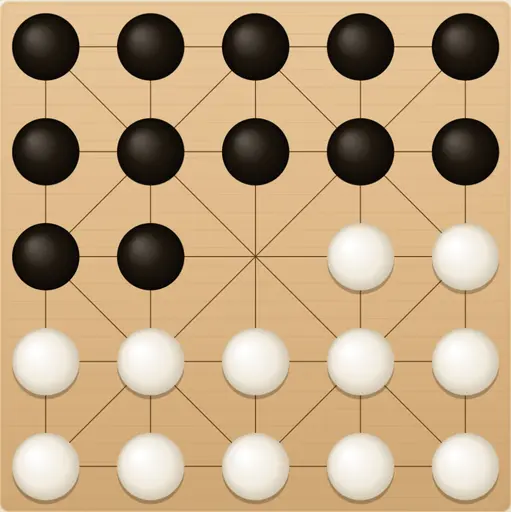
About Alquerque
Alquerque is played on a marked intersection network, not a grid in which every neighboring point is connected. Establish the printed edges before checking steps and capture routes; visual proximity is not legality. This platform requires capture and continued jumps but not the longest available sequence, and reaching the opposing back line locks quiet movement without promotion. Those distinctions shape both route choice and blockade analysis.
- Ruleset covered
- 5×5 Alquerque on Ply Yard: drawn-line movement and compulsory capture without a maximum-count rule
- Updated
- · Editorial policy and corrections
AlquerqueRules and variant distinctions
Twenty-five intersections and a drawn movement network
Ply Yard's Alquerque board has 5×5 intersections, not 5×5 playable squares. Each side begins with twelve pieces, leaving only the central intersection empty. Each color occupies two full rows and two of the four occupied middle-row points. Read the displayed arrangement rather than place both colors on the same pair of middle-row points. Black moves first. Horizontal and vertical lines are supplemented by the drawn main diagonals and central diamond connections. The movement network is defined by those markings. Two points that look close on the screen are not automatically connected, and different points may have different sets of legal directions. Think of the board as vertices and edges: pieces occupy intersections, and printed lines define connections. This model avoids importing a square-grid rule that permits every diagonal. At a boundary or row intersection, verify the actual line before evaluating a move or jump. Select a piece eligible to move and a legal destination on its connected route. If an apparently available ordinary step is rejected, first check for a compulsory capture elsewhere. Empty destination, geometric proximity, and legal action are three different conditions.
Quiet steps and captures use the marked lines
When no capture is available, a piece may move along a drawn connection to a neighboring empty intersection. The platform prohibits a quiet retreat toward the piece's own back line. An empty point farther along a line is not a one-step destination, and an unmarked diagonal cannot be used simply because the target is nearby. A capture jumps an adjacent opposing piece and lands on the empty intersection immediately beyond it on the same line. Verify both segments of that jump: from the starting point to the opponent, and from the opponent to the landing point. A friendly piece is not a capture target, and an occupied landing makes the jump unavailable. The jumped piece is removed immediately. If the capturing piece then has a legal continuation, it must keep jumping. The sequence may change direction between jumps, but each individual jump still follows its own straight, connected two-segment route. Turning during the sequence does not mean turning midway over one enemy. Keep the quiet-move retreat restriction distinct from capture eligibility. Calculate the board's permitted jumps on the marked network rather than automatically copy an ordinary-step restriction onto every capture, or import a different draughts variant's direction rules. Reassess occupancy and accepted continuations after each removal.
A capture is required, but the longest sequence is not
If any of your pieces has a legal capture, you must make a capturing move. You may not choose an ordinary step with another piece instead. Check the whole board before deciding a quiet move is available. A visually nearby enemy on an unconnected diagonal does not create a compulsory capture. When several capturing routes are available, this implementation permits a choice among them; it does not impose a maximum-capture rule. That differs from the platform's Turkish Draughts and 10×10 draughts rules. Do not reject a legal route merely because another takes more pieces. Choosing a route does not allow you to stop it arbitrarily. Once a jump is made, continue with that same piece while a legal further jump exists. Route choice at a branch and completion of a chosen sequence are separate questions. A shorter complete route can be legal; an unfinished route with an available continuation is not. Compare the positions after the full sequences, not just their first jumps or capture counts. Removing more material can be useful, but it may leave your piece exposed, immobilized near the far line, or poorly placed for the opponent's reply. The absence of a maximum rule creates a genuine strategic choice rather than permission to avoid capture entirely.
The opposing back line locks quiet movement; it does not crown a king
Alquerque has no promotion on this board. A piece reaching the opposing back line loses its ordinary neighboring-step movement and may move only through legal captures. It does not become a king, gain backward quiet movement, or acquire flying range. That restriction changes how advancement should be judged. Getting closer to the far edge is not automatically an improvement. Before advancing there, inspect whether the resulting piece will have a capture, whether it supports a blockade, and whether its loss of quiet mobility leaves your other pieces with useful moves. A capture sequence must still be assessed from the new position under the current board's legal continuation rules. Do not substitute a draughts crowning procedure when a jump reaches the far line. Material status and movement eligibility can change differently here. The computer mode defaults to the human as Black and the computer as White. Same-device and online play use the same published rules with alternating players. A familiar piece symbol or opponent mode does not change the no-promotion rule.
Win by capture or immobilization; verify the actual routes
You win when the opponent has no pieces remaining, or when it is their turn and they have no legal move. A blockade must therefore be proved against every available step and capture, using the real drawn connections. Visual enclosure alone is not enough, and a far-line piece may still have a legal jump despite lacking quiet moves. The platform describes a draw after forty consecutive moves without a capture. That is the wording of its published instruction; do not silently convert it into forty pairs of turns or a counter from another game. Follow the current board's result handling. Players may also agree to a draw. For a first training game, apply three habits: identify the drawn line, check for compulsory capture before a quiet move, and remember the far-line lock without promotion. For a blockade exercise, list each opposing piece's connected empty destinations and jump patterns, then explain why each is available or excluded. In replay, track the position after every removal and the final point of each sequence. Classify errors as missing connection, occupied landing, overlooked compulsory continuation, or a mistaken assumption about promotion. Only after the legal routes are established should you compare material and positional gains.
Practical strategy
For a central point and a boundary point, list every intersection directly connected by a printed line. Mark occupied and empty neighbors separately.
Explain why the points can have different direction counts. Do not substitute a universal eight-neighbor grid or infer a connection from visual proximity.
Place the same start–enemy–landing pattern on a drawn two-segment route and on a visually similar route with a missing line.
Admit only the line-supported jump with an adjacent enemy and empty landing. Verify both segments, then inspect compulsory continuations after removal.
Replay a blockade and enumerate the opposing pieces' ordinary destinations and captures before declaring them immobilized.
Exclude moves using actual connection, occupancy, and far-line restrictions. Check capture options even for quiet-locked pieces; do not rely on the appearance of a surrounding formation.
A common misconception
Any two points that look diagonally adjacent permit a move between them.
Only the board's printed connections define adjacency. An empty destination and a short visual distance cannot replace a missing line.
Position study: A nearby point can lack a legal connection
Two intersections appear diagonally adjacent, but no printed line joins them. The proposed destination is empty, and your side has no compulsory capture.
May you step directly to that empty point?
Show the answer and analysis
No. A quiet move requires a drawn connection to an adjacent empty intersection. An absent diagonal cannot be treated as a legal route merely because the points are close.
Read the board as points and connecting edges. A jump likewise needs the connected route through an adjacent opponent and on to an empty landing. Establish the network before comparing the move's tactical value.
This position was constructed for instruction. It is not a tournament record or an engine-verified proof of an optimal move. Evaluate it under the stated conditions; do not assume unlisted features of the complete position.
Structured practice
Understand the rules
List the actual connected neighbors of central and boundary points.
Assessment: Explain differing direction counts through the printed network, not a universal geometric-neighbor rule.
Compare candidate moves
Compare identical-looking capture patterns with and without the required printed lines.
Assessment: Admit only routes whose two jump segments are supported, with an adjacent enemy and empty landing.
Review and verify
Review a blockade by eliminating every opposing step and capture candidate.
Assessment: Prove immobilization from actual routes and occupancy, including the far-line lock, rather than visual enclosure alone.
Frequently asked questions
Is Alquerque the same game as Chinese checkers?
No. Chinese checkers is a star-board race in which jumps do not remove the jumped pieces. This Alquerque board uses twenty-five intersections, compulsory captures, and a capture-or-immobilization objective. Shared ideas about jumping do not make the routes or victory conditions identical.
May I decline a jump and move another piece?
No. Any available legal capture makes a capturing move compulsory. You may choose among available routes because this platform does not require the longest one, but you must finish the selected piece's legal continuation. Choosing a shorter complete route is not the same as stopping midway or making a quiet move.
Does reaching the opposing back line create a king?
No. There is no crowning. The piece becomes unavailable for ordinary neighboring steps and can move only through legal captures. It gains neither flying movement nor a king's quiet retreat. Check whether it still has a jump before calling it entirely immobile.
Who starts, and do pieces occupy squares?
Black starts. Pieces occupy intersections, not the centers of the drawn squares. Ordinary movement follows the printed connection to an adjacent empty point, subject to capture priority and the platform's direction restrictions.
May I step to a nearby empty point when no diagonal line connects it?
No. In the worked position, no capture is compulsory, but the proposed quiet step still lacks a required connection. The empty destination alone is insufficient. Captures also need the marked route through the adjacent enemy to a legal empty landing; they are not unrestricted jumps across the board.
Are all visually diagonal neighbors connected?
No. Only printed lines define adjacency. Some diagonal pairs are connected and others are not. Treat the board as a movement graph, verify the actual edge, and then check occupancy and the remaining move restrictions.
Put your understanding into practice.
Choose one skill to work on in your next game. A clear reason for each move is more useful than an immediate win.
Play AlquerqueRules sources and editorial notes
- Current rules for this game on Ply Yard
Identifies the board variant and interface described here. Platform instructions are not a complete statement of every tournament ruleset.
This guide combines the relevant board's rules with independently constructed examples and exercises. It distinguishes basic rules, variant-specific provisions, and strategic advice. Rules sections draw on the sources listed above. Instructional positions have not been presented as exhaustively engine-verified or certified by professional players.
Written by Ply Yard. Independent review by a named professional player has not been completed. To report an issue, send the game, ruleset, position, and relevant source provision to contact@plyyard.com.