 Ply Yard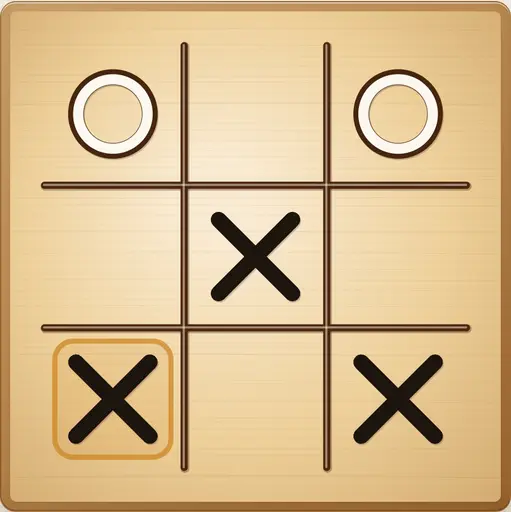
About Tic-Tac-Toe
Tic-tac-toe teaches the difference between a forcing move and an opening preference. Accurate analysis starts with a possible win on the current turn, then addresses the opponent's next winning placement and the creation or prevention of forks. Correct defense from an empty board produces a draw, but choosing the center does not excuse a missed threat. This guide uses explicit winning lines and revised practice positions to make each conclusion verifiable.
- Ruleset covered
- Standard 3×3 tic-tac-toe: X moves first; three in a row wins immediately
- Updated
- · Editorial policy and corrections
Tic-Tac-ToeRules and variant distinctions
Placement is permanent; a completed line ends the game
On each turn, place your mark in one empty cell of the 3×3 grid. A mark already on the board cannot move, be replaced, or be captured. X moves first, and O follows. Three of the same mark in a row, column, or either main diagonal win immediately. You do not continue filling the board after a winning line appears. If the board becomes full without a winning line, the game is a draw. The order of these checks matters on the ninth move: completing a winning line on the last empty cell is a win, not a draw. Board fullness does not override a completed line.
Evaluate each move in the correct order
First place X or O in an empty cell. Next check whether that placement completes a winning line. Only if no player has won should you check whether all nine cells are occupied and declare a draw. If neither condition applies, the other player takes the next turn. Use the same order when choosing a move: look for your own immediate win before defending against an opponent's possible win on the following turn. A legal winning move ends the game, so a threat that the opponent would otherwise execute no longer matters. If you cannot win now, identify and address the opponent's immediate winning cells.
Nine cells and eight winning lines
There are eight winning lines: three rows, three columns, and two main diagonals. The center belongs to four lines, each corner to three, and each non-corner edge cell to two. These differences help explain the strategic value of the center and corners, but they do not restrict legal placement. X may begin in any empty cell. A potential line with two of your marks and one empty cell is an immediate winning threat. A line containing an opposing mark cannot become your winning line because marks remain fixed. Scan all eight lines rather than judging a move by the total number of marks nearby. In the coordinate examples below, columns are a–c and rows are 1–3. Coordinates name cells, not intersections. The game itself requires only selecting an empty cell; the notation makes positions and explanations unambiguous.
Immediate wins and forks
A move wins as soon as it fills one of the eight lines with your mark. Completing two lines at once still ends one game with one win; it does not count as two separate results. The same rule applies to a winning ninth move. A fork is different from an already completed line. It creates two distinct cells where you could win on the following turn. If the opponent cannot win immediately or otherwise neutralize both threats, blocking only one leaves the other available. Identify the actual winning cells rather than calling every pair of unfinished lines a fork. When defending, first check whether you can end the game with your own winning move. If not, examine the opponent's threats and possible fork-creating moves. A single placement may be insufficient once two independent winning threats already exist; the decisive defensive error may have occurred earlier.
A legal win on the fifth move
A game can finish before the board is full. To reconstruct a five-move diagonal win, use columns a–c from left to right and rows 1–3 from bottom to top: 1. X places on c3; 2. O places on a3; 3. X places on b2; 4. O places on b3; 5. X places on a1. The fifth placement completes a1–b2–c3: the lower-left corner, center, and upper-right corner. X wins immediately, with four cells still empty. O's unfinished top-row threat does not get another turn. This is an illustration of legal move order, not a forced opening win against correct defense. O could have prevented the diagonal threat earlier. In a review, identify the specific line that was left open instead of assuming that an early win proves the opening is unbeatable.
Draws, correct defense, and resignation
Standard tic-tac-toe is a solved game: from an empty board, optimal play by both players produces a draw. That result describes correct play, not every legal sequence. A player who misses a winning threat or permits a fork can lose before the ninth move. In an online room, one player may offer a draw. If the opponent accepts, the game ends; if the opponent declines, play continues. Resignation is different: it awards the win to the opponent. Treat a draw against accurate defense as a successful exercise in calculation. For improvement, review the first move that allowed a decisive threat, even when the visible loss occurred several turns later. Occupying the center is a useful strategic choice, but it is not a substitute for checking immediate wins and replies.
Practical strategy
List the three rows, three columns, and two main diagonals. Write the three coordinates belonging to each line.
Identify all eight lines without duplication. Explain why an empty cell leaves a line unfinished and an opposing mark prevents that line from becoming yours.
Modify the worked position by setting X on c3 instead of b1. This is a new setup, not a legal movement of an existing mark. Recalculate both players' immediate wins.
Check all eight lines again. Do not reuse the original answer: determine whether X still has a winning placement and whether O's threat on c2 must now be blocked.
Play a defensive game without hints. Before every placement, check your own immediate wins and then the opponent's immediate winning cells.
Explain any mistake using a named winning line or two distinct fork threats. Do not attribute the loss solely to failing to occupy the center.
A common misconception
Because optimal tic-tac-toe is a draw, every game must continue until all nine cells are occupied.
Optimal play from the starting position avoids defeat. Inaccurate defense can lose earlier, and arbitrary legal moves are not guaranteed to draw.
Position study: Take the immediate win before defending
Use columns a–c and rows 1–3. X occupies a1 and b1; O occupies a2 and b2. Cells c1 and c2 are empty, and it is X's turn.
Should X block c2 or place on c1?
Show the answer and analysis
Place on c1. X completes a1–b1–c1 and wins immediately. O's threat on c2 never becomes a move because the game has ended. A legal winning placement takes precedence over defending against the opponent's next-turn threat.
List your immediate winning cells first, then the opponent's immediate winning cells. If you cannot win now and the opponent has two distinct winning cells, a single defensive placement may not cover both. Analyze the actual lines rather than following an automatic rule to block every visible threat.
This position was constructed for instruction. It is not a tournament record or an engine-verified proof of an optimal move. Evaluate it under the stated conditions; do not assume unlisted features of the complete position.
Structured practice
Understand the rules
List all eight winning lines: three rows, three columns, and two main diagonals. Give the three cells in each line.
Assessment: Distinguish a completed line from an unfinished one, and recognize that an opposing mark prevents the line from becoming yours.
Compare candidate moves
Create a revised version of the worked position with X on c3 instead of b1. Recalculate the immediate winning cells for both players; this is a setup change, not a move in play.
Assessment: Check all eight lines again instead of carrying over the previous answer. Explain which immediate threat now determines X's choice.
Review and verify
Complete a defensive game without hints. At every turn, check both players' immediate winning cells before choosing a placement.
Assessment: Explain an error by identifying the specific winning line or fork it allowed, rather than blaming the absence of an early center placement.
Frequently asked questions
Is a winning line on the ninth move a win or a draw?
It is a win. After every placement, check for a completed winning line before checking whether the board is full. If the ninth move completes a row, column, or main diagonal, that player wins. A full-board draw applies only when no winning line has been completed.
What happens if one move completes two winning lines?
The player wins one game. Both lines are valid, but the same placement does not end the game twice or produce two wins. This differs from a fork, which creates two future winning threats without necessarily completing a line immediately.
Must X open in the center?
No. X may place the first mark in any empty cell. The center participates in four winning lines and is often strategically valuable, but occupying it is not a rule and does not guarantee victory. Immediate wins, necessary defenses, and fork prevention take precedence over an opening preference.
Can I move or capture a mark already on the board?
No. Each turn adds one mark to an empty cell. Existing X and O marks remain where they were placed, and there is no movement or capture phase. When an exercise asks you to change a mark's location, it describes a separate position to analyze, not a legal action during a game.
Does X move first in every play mode?
Yes. X moves first and O moves second in the modes described by this guide. Against the computer, you may choose X or O. If you choose O, the computer makes the first placement as X. Choosing a mark changes your side, not the move order.
Why does optimal play result in a draw?
From the empty board, neither player can force a win against a correctly defending opponent. Both can maintain a strategy that avoids defeat, so optimal play by both ends in a draw. This does not mean that every move is equally good: a missed block or an allowed fork can create a forced loss. The claim concerns the standard starting position, not every position reached after an error.
Should X block c2 or play c1 in the worked position?
Play c1. With X on a1 and b1 and O on a2 and b2, placing X on c1 completes a1–b1–c1 and ends the game immediately. O never gets to carry out the threat on c2. Check for your own immediate win first; only when none exists should you decide which opposing threat must be blocked.
Does the theoretical draw mean every game must last nine moves?
No. Correct play from the empty board leads to a draw, but a mistake can permit a win much earlier. An agreed draw or resignation can also end an online game before the board is full. A non-losing strategy is not a promise that arbitrary moves will draw: review the actual threats and legal replies in each position.
Put your understanding into practice.
Choose one skill to work on in your next game. A clear reason for each move is more useful than an immediate win.
Play Tic-Tac-ToeRules sources and editorial notes
- Current rules for this game on Ply Yard
Identifies the board variant and interface described here. Platform instructions are not a complete statement of every tournament ruleset.
This guide combines the relevant board's rules with independently constructed examples and exercises. It distinguishes basic rules, variant-specific provisions, and strategic advice. Rules sections draw on the sources listed above. Instructional positions have not been presented as exhaustively engine-verified or certified by professional players.
Written by Ply Yard. Independent review by a named professional player has not been completed. To report an issue, send the game, ruleset, position, and relevant source provision to contact@plyyard.com.