 Ply Yard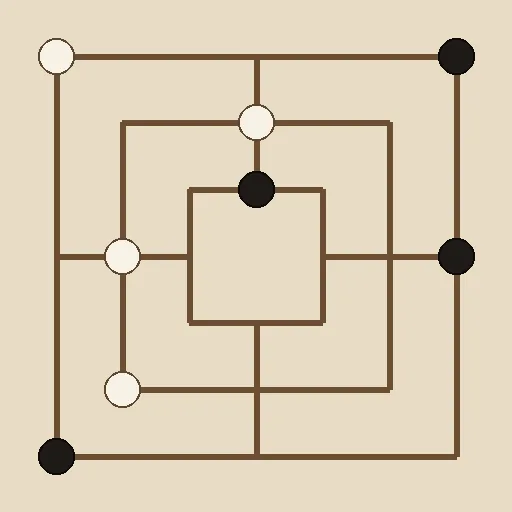
About Nine Men's Morris
Nine Men's Morris is a game of line formation, capture, and mobility. Placement, adjacent movement, and flying permit different actions, so accurate analysis begins by identifying the phase and the rules available to each player. Completing a mill creates a capture within the same turn; it does not immediately pass play to the opponent. This guide connects those procedures to practical decisions about shared mill points, recurring threats, and blockades rather than treating every three-piece alignment as equivalent.
- Ruleset covered
- Nine Men's Morris: 24-point board; flying allowed with three pieces after placement
- Updated
- · Editorial policy and corrections
Nine Men's MorrisRules and variant distinctions
Three phases, three different sets of legal moves
Nine Men's Morris begins with placement, proceeds to movement, and allows flying when a player has exactly three pieces remaining on the board after placement is complete. These phases determine what a player may do; they are not merely labels for the opening, middlegame, and endgame. During placement, put one unplaced piece on an empty point. You cannot move a piece already on the board. During ordinary movement, move one of your pieces along a board line to a directly adjacent empty point. When eligible to fly, move one of your pieces to any empty point, regardless of adjacency. Check your phase before comparing candidate moves. A destination that would be legal while flying may be inaccessible during ordinary movement, and having three pieces left to place does not make you eligible to fly.
A turn includes any required capture
A mill is a row of three of your pieces on one of the board's designated lines. If your placement or movement completes a mill, you must remove one eligible opposing piece before the turn passes to your opponent. If no mill is completed, your turn ends after the placement or move. Treat the capture as part of the same turn, not as a separate move. Before completing a mill, identify which opposing pieces you will be allowed to remove and how the resulting position changes. Counting the mill without evaluating its capture leaves the analysis incomplete.
The 24 points and 16 mill lines
The board consists of three concentric squares joined at their side midpoints. Its 24 marked points—not the spaces inside the squares—are the playing locations. Two points are adjacent only when a board segment connects them directly, with no intervening point. Pieces cannot pass through an intermediate point during ordinary movement, even if it is empty. There are 16 possible mill lines: the four sides of each of the three squares account for 12, and the four lines connecting corresponding side midpoints account for another four. All three points of one of these lines must contain your pieces to form a mill. Three pieces that appear diagonally aligned do not form a mill. On Ply Yard, select an empty point during placement. During movement, select your piece and then one of the displayed legal destinations. Use the board's connections, rather than visual proximity alone, to judge adjacency.
Placement: develop threats while all nine pieces enter play
The game starts with an empty board. Each player has nine pieces to place, and the players alternate placing one piece on an empty point until both have made nine placements. A piece already on the board cannot move during this phase, even if it is blocked. Captures do not create additional pieces to place. For example, with your pieces on the upper-left corner and upper midpoint of the outer square, placing on its upper-right corner completes that side's mill. You must then remove an eligible opposing piece before your opponent acts. In the Ply Yard variant described here, a placement that completes two mills still permits only one capture. Evaluate threats in terms of the next placement. A line with two of your pieces is not a guaranteed future mill: your opponent may occupy its empty point first. Compare an immediate mill with a placement that creates more than one threat, and include the opponent's available blocking placement in the calculation.
Capture eligibility and protection inside a mill
Whenever a placement or move newly completes a mill, remove one opposing piece. If any opposing piece is outside a mill, you must choose a piece outside a mill. A piece inside an opposing mill is eligible only when every opposing piece on the board belongs to a mill. This protection is conditional, not permanent. Before choosing a capture, classify the opposing pieces by whether each belongs to a completed mill. You cannot remove a protected piece merely because it would be the most useful target. Ply Yard highlights the eligible targets for the current capture. Among legal targets, consider what the removal changes: it may interrupt an unfinished line, reduce access to a connecting point, or contribute to a later blockade. Legality comes first; strategic preference applies only to the pieces the rules allow you to remove.
Movement, reopening mills, and flying with three pieces
Once both players have finished placing, an ordinary move takes one piece along a board line to an adjacent empty point. You cannot cross an intervening point or occupied location. If a move newly completes a mill, make the required capture before ending your turn. You may move a piece out of a completed mill and restore that mill on a later turn. Each new completion permits a capture under the usual eligibility rule. Two mills that can be opened and closed in succession can generate repeated threats, but the intervening moves and the opponent's replies must still be legal. After placement, a player with exactly three pieces on the board may fly: any one of those pieces can move to any empty point. Adjacency and intervening pieces no longer restrict that player's destination. The opponent does not gain the same privilege unless also reduced to exactly three pieces. Do not assume both players are using the same movement rules in a three-versus-four-piece position.
Winning by reducing material or eliminating legal moves
After the placement phase, a player loses when reduced to fewer than three pieces, since a mill can no longer be formed. A player also loses if it is their turn and no legal move is available. Material advantage alone does not decide the game: a player with several pieces can still lose to a complete blockade. When testing a blockade, list the opponent's legal destinations under the movement rules that apply to that opponent. If the opponent has exactly three pieces and may fly, closing adjacent exits is not enough while empty points remain elsewhere. In online play, a draw offer accepted by the opponent can also end the game. This guide describes the stated platform variant; do not assume that a repetition or move-count provision from another Morris ruleset applies without checking its rules.
Practical strategy
Use one board to identify legal actions during placement, ordinary movement, and flying. State which phase applies to each player.
Allow flying only after placement is complete and only for the player with exactly three pieces on the board. Distinguish board pieces from unplaced pieces.
Construct two potential mill lines that share one empty point, with two of your pieces on each line. Analyze a placement on the shared point.
Determine which mills that placement completes, then check whether your opponent can occupy the shared point first. Remember that this variant allows one capture even when two mills are completed at once.
Review a blockade from a game and list every opposing piece that could move on the next turn.
Account for both losing conditions: too few pieces after placement and no legal move. Check flying eligibility before declaring the opponent immobilized.
A common misconception
Completing a mill allows you to remove any opposing piece, including one protected inside a mill.
Choose a piece outside a mill whenever such a piece exists. A piece inside a mill becomes eligible only when every opposing piece belongs to a mill.
Position study: Complete the capture before ending the turn
During placement, your pieces occupy a1 and d1, and g1 is empty. An opposing piece on d2 is outside every mill. Other pieces do not affect the outer-edge line in this example.
Can you pass the turn immediately after placing on g1?
Show the answer and analysis
No. The placement completes the mill a1–d1–g1, so you must remove an eligible opposing piece. The piece on d2 is outside a mill and is a legal capture target. This example completes one mill; it does not depend on a variant's treatment of simultaneous mills.
Identify the phase, the newly completed line, and the required capture before evaluating the resulting position. Later, mills that can be opened and closed in alternation may create recurring threats, but every movement and capture must satisfy the current rules. A favorable piece count does not compensate for an unfinished turn or an illegal target.
This position was constructed for instruction. It is not a tournament record or an engine-verified proof of an optimal move. Evaluate it under the stated conditions; do not assume unlisted features of the complete position.
Structured practice
Understand the rules
On one board, distinguish legal placements, adjacent moves, and flying moves. Identify which rules apply to each player.
Assessment: Use the flying rule only after placement is complete and only for a player with exactly three pieces remaining on the board.
Compare candidate moves
Set up two potential mills sharing one empty point, with two of your pieces already on each line. Compare the consequences of occupying the shared point.
Assessment: Include the opponent's opportunity to occupy that point during placement. Separate the number of mills completed from the number of captures allowed.
Review and verify
Review a position you believe is a blockade. List every opposing piece and all of its legal destinations on the next turn.
Assessment: Evaluate both immobilization and insufficient material. Do not count mills alone, and do not overlook an opponent's right to fly.
Frequently asked questions
How do I make a move on Ply Yard?
During placement, select an empty point to place one of your remaining pieces. During ordinary movement, select a piece of your own, then a directly connected adjacent empty point. When your player is eligible to fly, select your piece and any empty point. The displayed destinations identify legal actions in the current phase; if you have just completed a mill, finish the required capture before attempting another move.
Why is it still my turn after I form a mill?
The capture belongs to the turn that formed the mill. Select and remove one eligible opposing piece; only then does play pass to your opponent. Forming the mill is not the end of the turn. If a target cannot be selected, check whether it is protected inside a mill while another opposing piece remains outside all mills.
Can I remove a piece that belongs to an opposing mill?
Only if every opposing piece on the board belongs to a mill. If even one opposing piece is outside all mills, you must choose an eligible piece outside a mill instead. A strategically important target is not an exception to the protection rule. Check the full opposing position, not just the mill nearest your newly completed line.
Does flying begin when I have three pieces left to place?
No. Flying requires that placement be complete and that you have exactly three pieces remaining on the board. Three unplaced pieces do not qualify. Once eligible, you may move one board piece to any empty point. This privilege applies separately to each player: an opponent with four or more board pieces must still move along adjacent connections.
Can I pass the turn immediately after placing on g1?
Not in the example here. Your pieces on a1 and d1, followed by a placement on g1, complete the outer-edge mill a1–d1–g1. You must remove an eligible opposing piece before ending your turn. The opposing piece on d2 is outside a mill and is therefore a legal target. For later play, analyze whether mills can be reopened and completed again, but verify movement and capture eligibility at every step.
Does forming a mill let me capture any opposing piece?
No. A mill permits one capture, but it does not cancel mill protection. When the opponent has any piece outside a mill, choose from those pieces. Only when all opposing pieces belong to mills may you remove one from a mill. In this platform variant, completing two mills with one placement still produces one capture, not two.
Put your understanding into practice.
Choose one skill to work on in your next game. A clear reason for each move is more useful than an immediate win.
Play Nine Men's MorrisRules sources and editorial notes
- Current rules for this game on Ply Yard
Identifies the board variant and interface described here. Platform instructions are not a complete statement of every tournament ruleset.
This guide combines the relevant board's rules with independently constructed examples and exercises. It distinguishes basic rules, variant-specific provisions, and strategic advice. Rules sections draw on the sources listed above. Instructional positions have not been presented as exhaustively engine-verified or certified by professional players.
Written by Ply Yard. Independent review by a named professional player has not been completed. To report an issue, send the game, ruleset, position, and relevant source provision to contact@plyyard.com.