 Ply Yard
About Sudoku
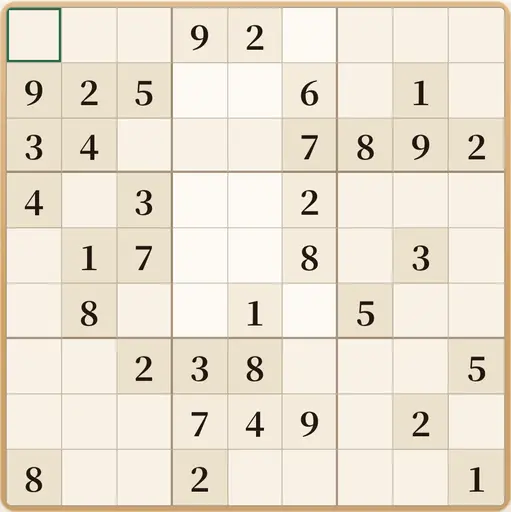
Sudoku is a logic placement puzzle. Instruction should emphasize uniqueness in rows, columns, and boxes, plus candidate notes—not guessing digits. Check only flags conflicts.
- Ruleset covered
- Standard 9×9 sudoku with pencil, check, and explained hints
- Updated
- · Editorial policy and corrections
SudokuRules and variant distinctions
Fill 1–9 in each row, column, and 3×3 box
Standard sudoku on a 9×9 grid. Each row, column, and outlined 3×3 box must contain digits 1 through 9 exactly once. Given clues cannot be changed; you enter answers only in empty cells. Pencil mode records small candidate digits without committing an answer. Check highlights conflicts with existing entries but does not clear them for you. Hints explain a logical next step; undo restores earlier states.
Daily puzzle and local progress
The daily puzzle is fixed for the date. Progress and timing stay in your browser on this device.
Practical strategy
List which digits are missing in one 3×3 box.
Every candidate must still be allowed in its row and column.
Turn on pencil notes for three cells in one row, then run Check.
Pencil marks should not trigger conflict highlighting by themselves.
A common misconception
Check automatically corrects wrong digits.
Check highlights conflicts; you still edit or undo entries yourself.
Position study: One empty cell in a box
A 3×3 box already shows digits 1–8.
What belongs in the remaining cell?
Show the answer and analysis
9, the only missing digit in that box.
Scan boxes, then rows and columns; a forced single is different from trial and error.
This position was constructed for instruction. It is not a tournament record or an engine-verified proof of an optimal move. Evaluate it under the stated conditions; do not assume unlisted features of the complete position.
Structured practice
Understand the rules
List missing digits for one row.
Assessment: Each candidate must avoid row and column clashes.
Compare candidate moves
Use pencil on two cells, then run Check.
Assessment: Pencil marks do not count as committed answers.
Frequently asked questions
Do I have to guess?
Well-formed puzzles should solve by logic. Use pencil notes or hints if you are stuck.
What does Check do?
It marks cells that conflict with another filled digit in the same row, column, or box.
Does Check fix mistakes?
No. You change or undo entries yourself.
Is progress synced across devices?
No. It remains local to this browser.
Do I need an account?
No. Open the sudoku host and start playing.
How is the daily puzzle chosen?
It is tied to the calendar date on this site.
Put your understanding into practice.
Choose one skill to work on in your next game. A clear reason for each move is more useful than an immediate win.
Play SudokuRules sources and editorial notes
- Current rules for this game on Ply Yard
Identifies the board variant and interface described here. Platform instructions are not a complete statement of every tournament ruleset.
This guide combines the relevant board's rules with independently constructed examples and exercises. It distinguishes basic rules, variant-specific provisions, and strategic advice. Rules sections draw on the sources listed above. Instructional positions have not been presented as exhaustively engine-verified or certified by professional players.
Written by Ply Yard. Independent review by a named professional player has not been completed. To report an issue, send the game, ruleset, position, and relevant source provision to contact@plyyard.com.