 Ply Yard
About Schulte Table
Schulte table training is ordered visual search, not a win-or-lose board game. Teach the ascending target, how errors are counted, and when the timer starts and stops—without treating one session as a clinical test.
- Ruleset covered
- Ply Yard Schulte grids 3×3–7×7 with timing and error stats
- Updated
- · Editorial policy and corrections
Schulte TableRules and variant distinctions
Tap digits 1 through N in order
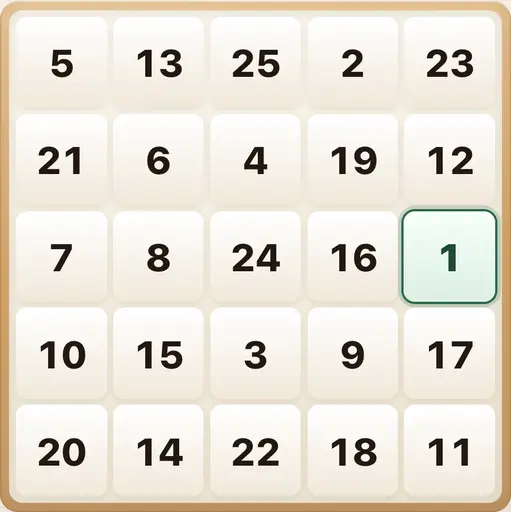
A Schulte grid shuffles the numbers 1 through N across a square board (for example 1–25 on 5×5). Start at 1 and tap each next digit in ascending order until N is reached. A wrong tap counts as an error and gives feedback; the timer typically starts on your first correct tap and stops when the last digit is hit. Choose 3×3 through 7×7 sizes; New shuffles the layout.
Timing, analysis, and local history
The board shows elapsed time, error count, and pace changes for the run. Session analysis summarizes average gaps so you can see where you slowed. Scores stay in this browser on this device.
Practical strategy
Finish one 5×5 run and note time plus errors.
Repeat the same size and compare mistakes.
Miss one tap on purpose and continue.
Confirm the target number does not advance until the correct cell is hit.
A common misconception
A faster finish always means better vision.
Times shift with practice, grid size, and fatigue—track trends on the same settings.
Position study: Target is 7
You reached 6 on a 5×5 grid; 7 sits off center.
Which cell should you tap?
Show the answer and analysis
7—the next number in sequence, not the largest digit on the board.
The drill is scan-by-target; flashy numbers are distractions.
This position was constructed for instruction. It is not a tournament record or an engine-verified proof of an optimal move. Evaluate it under the stated conditions; do not assume unlisted features of the complete position.
Structured practice
Understand the rules
Run 5×5 twice and compare error counts.
Assessment: State whether the second run had fewer mis-taps.
Compare candidate moves
Note total seconds and the slowest segment on one run.
Assessment: Tie the comment to pace, not only a single headline time.
Frequently asked questions
Must I start at 1?
Yes. The active target counts up from 1 in order.
What happens on a wrong tap?
An error is recorded; keep searching for the current target without resetting the whole run.
Does progress carry across grid sizes?
Changing size or starting a new run reshuffles; partial runs do not carry over.
Is progress synced to an account?
No. It remains local to this browser.
Does a fast time prove eyesight or IQ?
No. Results depend on practice, grid size, and conditions—compare your own runs, not strangers.
Do I need an app?
No. Open the Schulte host in your browser.
Put your understanding into practice.
Choose one skill to work on in your next game. A clear reason for each move is more useful than an immediate win.
Play Schulte TableRules sources and editorial notes
- Current rules for this game on Ply Yard
Identifies the board variant and interface described here. Platform instructions are not a complete statement of every tournament ruleset.
This guide combines the relevant board's rules with independently constructed examples and exercises. It distinguishes basic rules, variant-specific provisions, and strategic advice. Rules sections draw on the sources listed above. Instructional positions have not been presented as exhaustively engine-verified or certified by professional players.
Written by Ply Yard. Independent review by a named professional player has not been completed. To report an issue, send the game, ruleset, position, and relevant source provision to contact@plyyard.com.