 Ply Yard
About Maze
Browser mazes are solo path puzzles: fixed entrance to exit, about memory and junction choices—not a two-player contest. Teach movement rules, wall constraints, and what hints mean without treating one finish time as a clinical spatial test.
- Ruleset covered
- Ply Yard mazes 9×9–35×35 with timing, steps, path hints, and a daily seed
- Updated
- · Editorial policy and corrections
MazeRules and variant distinctions
Walk from start to exit
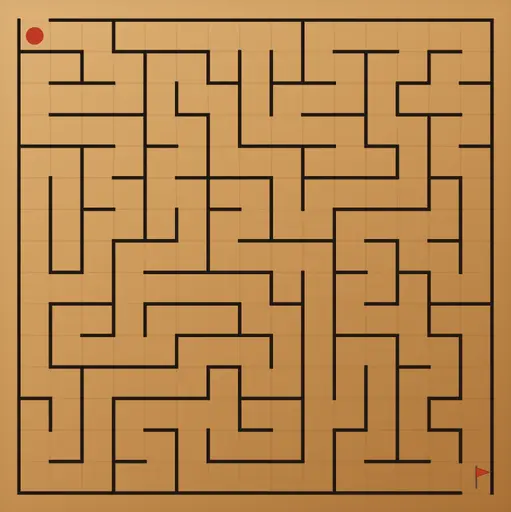
Walls form corridors on a square grid. Start at the top-left entrance and reach the bottom-right exit. Move with arrow keys or swipes—one step at a time, no cutting through walls or diagonal corner slips. This host generates perfect mazes: exactly one route between any two points, with no loops. Grid sizes run from 9×9 to 35×35; New deals a fresh layout.
Timer, hints, and local bests
The panel shows time and step count; each size keeps its own best time on this device. Path hints can reveal a shortest legal route when you are stuck. The daily seed reproduces the same walls for a calendar day so you can compare runs. Nothing syncs to an account.
Practical strategy
Finish 15×15 without hints and note steps.
Replay the same size and compare detours.
Use a path hint once, then replay without it.
Say whether you remembered turns or only followed the line.
A common misconception
Fewer steps always means smarter play.
Steps depend on exploration style, hints, grid size, and screen—compare your own runs on the same settings.
Position study: Three-way junction
Mid-maze on 15×15; two branches are dead ends.
How reduce backtracking without hints?
Show the answer and analysis
Use a wall-following habit or mark turns you already tried—not random probing.
Perfect mazes have one solution path; practice is marking and backtracking, not guessing through walls.
This position was constructed for instruction. It is not a tournament record or an engine-verified proof of an optimal move. Evaluate it under the stated conditions; do not assume unlisted features of the complete position.
Structured practice
Understand the rules
Two runs at the same size; compare steps and time.
Assessment: Note whether the second run had fewer detours.
Compare candidate moves
Hinted run, then daily seed without hints.
Assessment: Separate memorizing the route from reading the hint overlay.
Frequently asked questions
Must I start top-left?
Yes. Entrance and exit stay fixed at opposite corners.
Can I cut diagonally through corners?
No. Only orthogonal steps along open corridors.
Does progress carry across sizes?
Changing size or starting New reshuffles; partial runs do not carry over.
Is progress synced?
No. Best times stay in this browser.
Does the hint show the only route?
In a perfect maze there is one path; the hint traces that shortest route.
Do I need an app?
No. Open the maze host in your browser.
Put your understanding into practice.
Choose one skill to work on in your next game. A clear reason for each move is more useful than an immediate win.
Play MazeRules sources and editorial notes
- Current rules for this game on Ply Yard
Identifies the board variant and interface described here. Platform instructions are not a complete statement of every tournament ruleset.
This guide combines the relevant board's rules with independently constructed examples and exercises. It distinguishes basic rules, variant-specific provisions, and strategic advice. Rules sections draw on the sources listed above. Instructional positions have not been presented as exhaustively engine-verified or certified by professional players.
Written by Ply Yard. Independent review by a named professional player has not been completed. To report an issue, send the game, ruleset, position, and relevant source provision to contact@plyyard.com.