 Ply Yard
About Snake
Browser snake is a solo reflex and routing drill, not a two-player contest. Teach turning rules, ignored reversals, growth, and crash conditions without treating one score as a clinical reaction-time test.
- Ruleset covered
- Ply Yard grid snake with four speed presets, pause, and a local high score
- Updated
- · Editorial policy and corrections
SnakeRules and variant distinctions
Eat food, grow, and do not crash
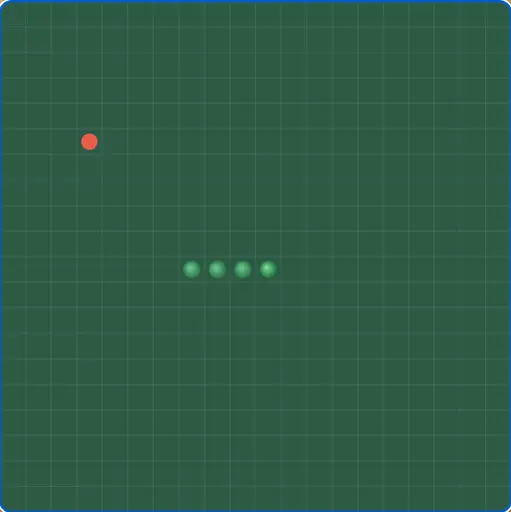
On a square grid the snake head starts moving right. Turn with arrow keys on desktop or swipes on the board on mobile. Eating the red food adds one point and one segment; the run ends immediately if the next cell is outside the border or already occupied by the body. You cannot reverse in one step: while moving right, a left command is ignored. Each step the head enters a new cell and the tail vacates the last segment unless food was just eaten. Only one food pellet is on the board at a time.
Four speed presets and pause
Slow is 12×12 at about 0.22 s per step; Standard is 20×20 at about 0.16 s (default); Fast keeps 20×20 at about 0.11 s; Extreme is 28×28 at about 0.075 s. Changing speed discards the current run and restarts that preset. Pause freezes the board while score and length stay; Continue resumes.
Local high score
When a run ends, if the score beats the number saved in this browser, the side panel best updates. All four presets share one high score; nothing syncs to an account or another device. Clearing site data resets the record.
Practical strategy
Reach 5 points on Slow 12×12 and note how you crashed.
On a second run, track the tail cells before chasing food.
On Standard, try an instant 180° reverse input.
Confirm the snake keeps its heading because reverse is ignored.
Pause on Extreme for ten seconds, then continue.
Confirm score and length did not reset.
A common misconception
A higher score always means faster reflexes or smarter play.
Scores shift with preset, grid size, practice, and device—track trends on the same settings.
Position study: Press left while heading right
The head faces right and the player taps left.
Does the snake reverse?
Show the answer and analysis
No. The reverse input is ignored; turn up or down first, then loop back.
Classic rules prevent instant self-collision; instruction should cover legal turn order, not faster tapping.
This position was constructed for instruction. It is not a tournament record or an engine-verified proof of an optimal move. Evaluate it under the stated conditions; do not assume unlisted features of the complete position.
Structured practice
Understand the rules
Reach 8 on Slow and name the body cell that blocked you.
Assessment: Point to the tail segment, not only the wall.
Compare candidate moves
Play Standard and Fast once each; compare crash causes.
Assessment: Separate tight grids from late turns.
Review and verify
Beat your best, refresh, and read the side panel.
Assessment: Confirm the number persists in this browser.
Frequently asked questions
How do I control the snake?
Arrow keys or swipe on the board; eat red food to score and grow. Hit a wall or your body to end.
Can I turn around instantly?
No. Opposite directions are ignored until you turn to a side first.
Does changing speed keep my run?
No. A new preset starts a fresh layout for that speed.
Is high score per speed?
No. One local high score covers all presets.
Do I need an account?
No. Open the snake host in your browser.
Does pause lose progress?
No. Pause only stops movement.
Is sound on by default?
Off until you enable it on the status card.
Is there a daily fixed board?
No. Food placement is random each run.
Put your understanding into practice.
Choose one skill to work on in your next game. A clear reason for each move is more useful than an immediate win.
Play SnakeRules sources and editorial notes
- Current rules for this game on Ply Yard
Identifies the board variant and interface described here. Platform instructions are not a complete statement of every tournament ruleset.
This guide combines the relevant board's rules with independently constructed examples and exercises. It distinguishes basic rules, variant-specific provisions, and strategic advice. Rules sections draw on the sources listed above. Instructional positions have not been presented as exhaustively engine-verified or certified by professional players.
Written by Ply Yard. Independent review by a named professional player has not been completed. To report an issue, send the game, ruleset, position, and relevant source provision to contact@plyyard.com.