 Ply Yard
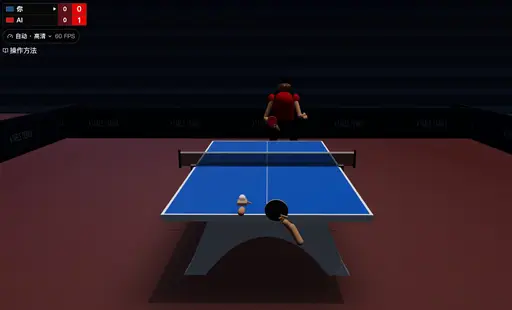
About 3D table tennis
Browser table tennis is a 3D rally on a regulation-sized table: read spin, place the ball, and time your serve. A legal serve must bounce on your side before crossing the net. Play to 11 and win by at least 2; from 10–10, service changes every point. A let only replays that serve—it is not a match-wide tactic.
- Ruleset covered
- Table tennis to 11, with multiple AI levels and online rooms
- Updated
- · Editorial policy and corrections
3D table tennisRules and variant distinctions
Games to 11, and you must lead by 2
A legal serve bounces on your side, crosses the net, and bounces on the other side. If it clips the net and is otherwise legal, it is a let and you serve again. Service changes every 2 points, then after every point from 10–10. The first player to 11 with a lead of at least 2 wins the game. Choose one game or a best of three, five, or seven.
AI rallies can show a read; online rooms sync the point
The homepage opens against multiple AI levels. During a rally the sidebar can mark placement, spin, and a suggested return—block, push, loop, or drive. Hints do not swing the paddle, and you can turn them off. A public lobby or private room syncs the score, the ball, and the seats for that match. Physics stays in this browser. The table is modeled at 2.74 by 1.525 meters.
Practical strategy
Serve ten balls: long, short backspin, and sidespin.
Say which one bounced on your side first, and which one was a let.
Play through 10–10 and note the server for the next three points.
Explain why service now changes after every point.
A common misconception
Faster is always better, so spin does not matter.
A flat block against topspin can sail long, and a flat block against backspin can drop into the net. Read the spin, then choose a block, push, loop, or drive.
Rally study:Who serves after 10–10
The score is 10–10. Service had been changing every two points, and you won the last point.
Who serves next?
Show the answer and analysis
Your opponent. From 10–10, service changes after every point.
The changeover is different before and after deuce. Know who serves before you talk about sidespin.
This position was constructed for instruction. It is not a tournament record or an engine-verified proof of an optimal move. Evaluate it under the stated conditions; do not assume unlisted features of the complete position.
Structured practice
Understand the rules
Serve ten balls: long, short backspin, and sidespin.
Assessment: Point to one that bounced on your side first and one that was a let.
Compare candidate moves
Reach 10–10 and note the server for the next three points.
Assessment: Say whether service changed after each point.
Frequently asked questions
What opens on the homepage?
A match against AI. Open an online room from the side panel.
How do I serve?
Tap to serve. Swipe up for a long ball, down for a short backspin serve, or sideways for sidespin. On a keyboard, Space serves, and the arrow keys pick long, short, or sidespin.
What happens at 10–10?
Play continues until one player leads by 2. From 10–10, service changes after every point.
Do I need an account?
No. Open pingpong.plyyard.com in your browser.
Does an AI rally upload every shot?
No. AI physics stays on this device. Only an online room syncs that match’s score, ball, and seats with the people in the room.
Will the hint swing for me?
No. It marks direction, placement, and a suggested return. You still control the paddle, and you can turn hints off.
Put your understanding into practice.
Start with one small goal. You do not need to score right away. Use each shot to read spin, placement, and when the serve changes.
Play 3D table tennisRules sources and editorial notes
- Current rules for this game on Ply Yard
Identifies the board variant and interface described here. Platform instructions are not a complete statement of every tournament ruleset.
This guide places the site's rules next to teaching examples and drills. It separates basic rules, version differences, and technique notes. Rule paragraphs follow the sources above. The examples are not match records and are not endorsed by a professional coach.
Written by Ply Yard. Independent review by a named coach or official has not been completed. To report an issue, send the game, ruleset, rally, and relevant source provision to contact@plyyard.com.