 Ply Yard
About Pool
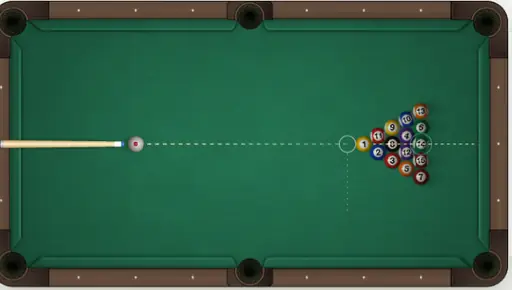
Browser pool is aiming and cue-ball position, not piece placement. Teach how groups are assigned after the break, when the 8-ball is legal, and where the cue goes after a foul. Do not treat one pot as a whole-rack tactic.
- Ruleset covered
- Chinese eight-ball default; American eight-ball, nine-ball, and ten-ball on the same table
- Updated
- · Editorial policy and corrections
PoolRules and variant distinctions
Chinese eight-ball: assign a group, then the 8-ball
Default is Chinese eight-ball: fifteen object balls plus the cue. Pots on the break do not assign a group; the table stays open. A later legal pot of one group assigns solids or stripes. Each shot must hit your group first. Pocketing your ball continues the visit; a miss, a wrong first contact, or a cue in a pocket turns the table over. Clear your group before the 8-ball; pocketing the 8 early loses. A legal 8-ball pot without a foul wins.
Switch rules on the same table; hints follow the AI level
The side panel can switch to American eight-ball, nine-ball, or ten-ball and starts a new rack. Nine-ball and ten-ball must first hit the lowest-numbered ball still on the table; a legal pot of the 9 or 10 wins. Hints use the same search as the current AI level. Undo works versus AI and pass-and-play; online rooms do not allow one-sided undo. Collision and cue choice run off the main thread.
Practical strategy
After the break, decide whether the table is still open before choosing a group.
Explain why a ball pocketed on the break does not assign stripes or solids.
Clear your group before shooting the 8-ball, then compare a combo 8-ball under Chinese versus American rules.
Name which version treats that combo as a win.
A common misconception
Any ball you can pocket should be taken first.
A legal pot continues the visit; the real gap comes from leaving the cue on an easy next shot.
Position study: A solid falls on the break
The break is legal, one solid is down, and all stripes remain.
Is a group assigned yet?
Show the answer and analysis
No. Chinese eight-ball does not assign groups on the break; the table stays open.
Assignment happens on a later legal pot of one group. Teach the open table first; a break pot is not choosing sides.
This position was constructed for instruction. It is not a tournament record or an engine-verified proof of an optimal move. Evaluate it under the stated conditions; do not assume unlisted features of the complete position.
Structured practice
Understand the rules
Finish a Chinese eight-ball rack and note when groups were assigned.
Assessment: Name which group the assigning shot hit first.
Compare candidate moves
Play one nine-ball rack and compare first-contact rules.
Assessment: State that you must hit the lowest-numbered ball first.
Frequently asked questions
What is the homepage default?
Chinese eight-ball. Switch to American eight-ball, nine-ball, or ten-ball in the side panel.
What if the cue ball is pocketed?
That is a foul. Ordinary fouls give ball-in-hand anywhere; a Chinese break foul places the cue behind the head string.
When can I shoot the 8-ball?
After your solids or stripes are gone. Pocketing the 8 earlier loses the rack.
Do I need an account?
No. Open pool.plyyard.com in your browser.
Is progress synced?
No. AI and pass-and-play leftovers stay in this browser.
Do hints always use the strongest level?
No. Hints follow the AI level selected in the side panel.
Put your understanding into practice.
Choose one skill to work on in your next game. A clear reason for each move is more useful than an immediate win.
Play PoolRules sources and editorial notes
- Current rules for this game on Ply Yard
Identifies the board variant and interface described here. Platform instructions are not a complete statement of every tournament ruleset.
This guide combines the relevant board's rules with independently constructed examples and exercises. It distinguishes basic rules, variant-specific provisions, and strategic advice. Rules sections draw on the sources listed above. Instructional positions have not been presented as exhaustively engine-verified or certified by professional players.
Written by Ply Yard. Independent review by a named professional player has not been completed. To report an issue, send the game, ruleset, position, and relevant source provision to contact@plyyard.com.