 Ply Yard
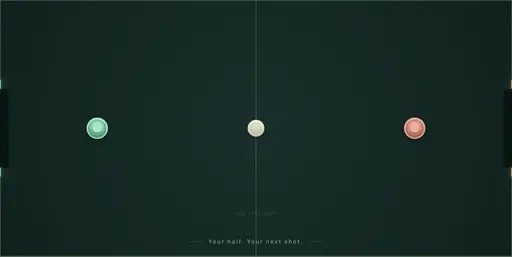
About Air hockey
Browser air hockey is reflex and lane control, not piece placement. Teach how goals count, who serves after a score, and how to guard the goal mouth without treating one lucky bounce as a full-match plan.
- Ruleset covered
- Standard two-player air hockey; race to a target score
- Updated
- · Editorial policy and corrections
Air hockeyRules and variant distinctions
Race to the target score
Standard two-player table: you guard one end, the opponent the other. Play opens with a serve; after each goal the scored player serves again. Mallets strike or block the puck; the puck must fully cross your goal line into the scoring zone to count. First to the chosen target (often 5, 7, or 9) wins the match.
Same rules in pass-and-play, vs AI, and online
Pass-and-play uses keyboard or touch on each half. Vs AI shares the same physics and serve rotation. Online private or public rooms sync paddles and puck after both seats connect; spectators can watch live. Start a rematch or replay from the side panel; vs AI undo cancels in-flight search.
Practical strategy
Block the straight shot with the mallet hugging your goal line, then try a angled clear.
Name when you blocked versus when you attacked.
Finish one match and use replay on the last goal.
State who served after that goal and why.
A common misconception
Slamming harder always wins.
Speed matters with goal-line position; an open net beats a wild hit.
Position study: Who serves after a goal
You score to make it 3–2; the puck rests on your half.
Who serves next?
Show the answer and analysis
The player who was scored on serves from their half.
Serve rotation after goals is the rhythm of casual air hockey; defense starts with knowing who restarts play.
This position was constructed for instruction. It is not a tournament record or an engine-verified proof of an optimal move. Evaluate it under the stated conditions; do not assume unlisted features of the complete position.
Structured practice
Understand the rules
Play one match and log the server after every goal.
Assessment: Match serves to the scored player, not the scorer.
Compare candidate moves
Pass-and-play: each player blocks one straight shot at the line.
Assessment: Say whether the mallet blocked or counter-attacked.
Frequently asked questions
What opens on the homepage?
Vs AI. Switch to pass-and-play or online rooms from the nav.
How do two players share one screen?
WASD and arrow keys split left and right; touch drag works on each half.
Do I need an account?
No. Open airhockey.plyyard.com in your browser.
Is progress synced?
No. Vs AI and pass-and-play state stay in this browser.
How do I join online?
Pick a public table in the lobby or enter a room code for a private room.
Is there a hint button?
No separate hint; pick the AI level in the side panel.
Put your understanding into practice.
Choose one skill to work on in your next game. A clear reason for each move is more useful than an immediate win.
Play Air hockeyRules sources and editorial notes
- Current rules for this game on Ply Yard
Identifies the board variant and interface described here. Platform instructions are not a complete statement of every tournament ruleset.
This guide combines the relevant board's rules with independently constructed examples and exercises. It distinguishes basic rules, variant-specific provisions, and strategic advice. Rules sections draw on the sources listed above. Instructional positions have not been presented as exhaustively engine-verified or certified by professional players.
Written by Ply Yard. Independent review by a named professional player has not been completed. To report an issue, send the game, ruleset, position, and relevant source provision to contact@plyyard.com.