 Ply Yard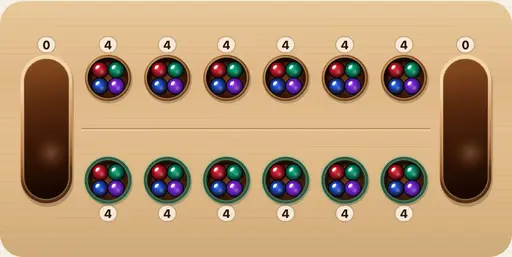
About Oware
Oware calculates a capture backward from the final opposing landing, not through Kalah's store or empty-home-pit mechanisms. Feeding obligations and the grand-slam exception can overturn an apparently high-scoring plan: a feeding violation makes a choice unavailable, while a grand slam cancels capture without undoing the sowing. Trace every deposit and test the complete capture set before evaluating the resulting score and position.
- Ruleset covered
- Abapa Oware on Ply Yard: twelve pits, forty-eight seeds, and backward two-or-three capture
- Updated
- · Editorial policy and corrections
OwareRules and variant distinctions
Twelve pits, forty-eight seeds, and off-board scoring
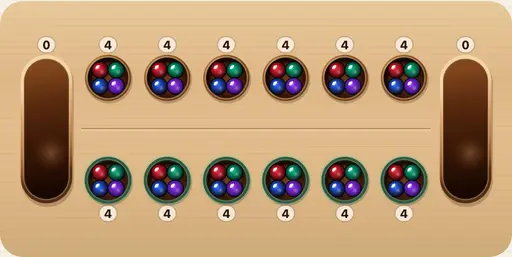
Ply Yard uses the Abapa version of Oware. The board has two rows of six pits, forming a twelve-pit circuit. Every pit begins with four seeds, for a total of 48. South occupies the near row in the default display and moves first; North occupies the opposite row. Captured seeds are recorded as off-board scores. The bowls beside the board display those scores; they are not sowing destinations. This differs from Kalah, where the mover's store participates in the sowing route. Identify your own six pits before selecting a move, and do not include either scoring bowl in a count. The platform labels South's pits a–f and North's pits A–F in its move records. Those labels help reconstruct a sequence, but the displayed sowing direction determines the route. A familiar two-row mancala board is not enough to identify the capture or feeding rules: establish Abapa before importing a tactic from another variant.
Sow counterclockwise and skip the origin on every circuit
Select one nonempty pit on your own side and lift all its seeds. Sow them one at a time into successive pits counterclockwise. You may not lift only part of the contents, choose a different distribution, or switch to another pit before finishing the move. Seeds go only into the twelve pits, never into the scoring bowls. The selected pit is emptied before sowing. If enough seeds remain to travel around the board, skip that original pit when the route returns to it. Continue skipping the origin on further circuits within the same move. Do not apply Kalah's treatment of returning to the selected pit. For example, thirteen seeds from one pit are deposited in the other eleven pits on the first circuit, then in the first two eligible pits again. The origin receives none. Recalculate the contents of every visited pit, especially the final destination, before checking capture. There are no extra turns for reaching a particular pit or making a capture. After the sowing and any permitted capture are resolved, the opponent moves unless the game has ended. The absence of a sowing store means there is no Kalah-style final-store bonus to calculate.
Backward two-or-three capture and the grand-slam exception
Capture can begin only when the final seed lands in an opposing pit and leaves that pit with exactly two or three seeds. Count its contents after the final deposit, not before. If it qualifies, the potential capture includes all seeds in that pit and then works backward, opposite the sowing direction, through consecutive opposing pits that also contain two or three. Stop at the first pit whose count is not two or three, or on reaching your own side. Do not skip a nonqualifying pit to capture a later one. A final landing on your own side starts no capture, and a four-seed opposing destination does not qualify merely because adjacent pits contain two or three. For example, suppose the final opposing pit contains two seeds after sowing, and the preceding opposing pits in capture order contain three and four. The potential capture is two plus three, totaling five; the four-seed pit stops the chain and remains untouched. This example assumes seeds remain elsewhere on the opponent's side. If the entire proposed capture would remove every seed currently on the opponent's side, it is a grand slam. The platform cancels the whole capture: collect no seeds, not even from the first qualifying pit. The sowing move itself still stands. Assess the complete capture set before removing seeds so that a partial collection does not incorrectly evade the exception. This is not Kalah's empty-home-pit capture of an opposite pit. The landing side, resulting counts, backward chain, and grand-slam check all matter. A visually large capture may therefore produce no score.
Feed an empty opposing row and establish the result
When the opponent's six pits are empty at the start of your turn, inspect all your nonempty pits for a move that deposits at least one seed into the opposing row. If any such feeding move exists, you must choose a feeding move. You may not deliberately keep the opponent empty by selecting an alternative that sows only on your own side. The platform's published instructions permit own-side-only sowing when no feeding move exists. Treat that as the documented behavior of this implementation. The cited page does not fully specify every later no-move, repetition, or residual-seed adjudication; do not import a final collection procedure from another Oware ruleset without checking the current board. With 48 seeds in the game, a player who has captured more than 24 has secured the winning majority. The published threshold is strictly greater than 24: 24 alone is not a win, and 24–24 is a draw. Track off-board scores rather than count a temporary advantage in pit contents as captured points. Players may also agree to a draw, and an online player may resign. Those options are separate from the score threshold. Feeding legality must be checked before calculating the final score of a candidate; the grand-slam exception must then be applied to its capture, if any.
Calculate the whole move before judging its value
Read the side-to-move display and identify your nonempty pits. If the opponent's row is empty, filter the candidates for feeding first. For each remaining candidate, trace the deposits, skip the origin on a full circuit, locate the final seed, calculate the backward capture set, and test the grand-slam exception. Only then compare the resulting scores and seed distributions. A strong-looking capture can leave the opponent an effective reply; a noncapturing move can improve the distribution of future options. Compare the resulting counts on both rows, not just the immediate harvest. Check whether your own low-count pits become vulnerable to the opponent's final deposit and whether a planned chain depends on a count that the next move will change. Against the computer you may choose South or North; selecting North lets the computer make South's opening move. The platform offers hints, undo, and replay for computer practice. Same-device players alternate on one board, and an online host chooses a side. The interface rejects empty or opposing pits and choices unavailable on the current turn. In replay, isolate the first error in the calculation: a missed origin skip, a pre-deposit rather than post-deposit count, an incorrectly extended capture chain, an overlooked grand slam, or a feeding violation. Hints are training assistance, not independent certification of optimal play. Oware's short sowing instruction does not imply shallow strategy.
Practical strategy
Trace a sowing move from a pit holding thirteen seeds, recording every destination and the pit contents afterward.
Deposit into the eleven other pits before beginning another circuit, and skip the origin throughout. Do not insert a scoring bowl or copy Kalah's original-pit treatment.
Set the final opposing pit to two after sowing, with backward neighbors of three and four. Then change the four-seed pit to two and recalculate.
First identify a five-seed capture ending at the four-seed pit. In the altered position, extend the proposed chain only through qualifying pits and check whether it contains all opposing seeds. If so, cancel the whole capture while retaining the sowing.
Reconstruct a turn with the opposing row empty and enumerate every move that deposits seeds there.
Require a feeding move whenever one exists. Reject a tempting own-side-only move in that case and distinguish this legal-choice filter from the later grand-slam capture test.
A common misconception
A final landing in a store grants another move just as it does in Kalah.
Abapa Oware has no sowing store and no Kalah-style store-ending extra turn. Its sowing route, capture conditions, and feeding obligations are distinct.
Position study: A four-seed pit stops the capture chain
The final seed lands in an opposing pit and makes its total two. The preceding opposing pits in reverse sowing order contain three and four. The opponent has seeds in other pits, so collecting the proposed chain would not empty their row.
How many seeds are captured, and is the four-seed pit included?
Show the answer and analysis
Capture two plus three, for five seeds. Stop at the four-seed pit and leave its contents untouched. The capture is tested pit by pit in backward order, not applied indiscriminately to the whole row.
The two-or-three condition establishes the proposed chain, but feeding legality and the grand-slam exception still require separate checks. If an altered chain would contain every opposing seed, the capture is canceled entirely while the sowing stands. Determine the legal choice and final capture outcome before updating the score.
This position was constructed for instruction. It is not a tournament record or an engine-verified proof of an optimal move. Evaluate it under the stated conditions; do not assume unlisted features of the complete position.
Structured practice
Understand the rules
Trace a sowing move long enough to return to its origin.
Assessment: Skip the selected pit on every circuit, sow only into pits, and distinguish the route from Kalah's store-inclusive model.
Compare candidate moves
Change the example's four-seed pit to two and recompute the chain and grand-slam condition.
Assessment: Explain the added candidate capture and test whether it would remove all opposing seeds. Do not keep a partial harvest when the whole capture is canceled.
Review and verify
Enumerate feeding choices with the opposing row empty.
Assessment: Require a legal feeding move whenever one exists instead of deliberately leaving the opponent without seeds. Keep that obligation separate from the capture exception.
Frequently asked questions
Which side moves first in Oware on Ply Yard?
South starts. Against the computer you may choose South or North; if you choose North, the computer makes South's first sowing move. Identify your assigned row from the current board and status display rather than relying only on screen orientation.
Are seeds sown into the scoring bowls?
No. In this Abapa version, sowing uses the pits only. The bowls display seeds captured off the board and are not additional locations in the route. Counting them as Kalah stores changes the final landing and leads to an incorrect capture calculation.
When does a sowing move capture seeds?
The final seed must land in the opposing row and leave its pit with exactly two or three seeds. The proposed capture then proceeds backward through consecutive opposing pits with two or three, stopping at the first other count or your own side. If the proposed set contains every seed on the opposing row, the grand-slam exception cancels the entire capture. The completed sowing remains in place.
May I sow only on my own side when the opponent's row is empty?
Not if any available move feeds the opponent. You must choose a move that deposits at least one seed into their row. The platform permits own-side-only sowing only when feeding is impossible. Do not infer an unlisted end-of-game collection procedure from that short instruction; follow the current board's result handling.
Is Abapa Oware played like Kalah?
No. This board uses a twelve-pit circuit with no sowing stores or extra turns, skips the origin on a full circuit, captures backward from an opposing two-or-three destination, cancels grand-slam captures, and requires feeding when possible. Kalah's final-store bonus and empty-pit opposite capture do not apply.
How many seeds are captured from a backward sequence of two, three, and four?
Five: collect the two-seed final pit and the adjacent three-seed pit, then stop at the four-seed pit. Do not capture that pit or jump beyond it to continue harvesting. The example assumes other opposing seeds remain, so it is not a grand slam. Check feeding legality and the full capture set before assigning the score.
Does a final store landing grant another turn, as in Kalah?
No. There is no sowing store in this Abapa route, and the platform does not award extra turns. A capture changes the score, not the turn entitlement. Sow through the pits, resolve the capture and exceptions, then pass play to the opponent unless a result has ended the game.
Put your understanding into practice.
Choose one skill to work on in your next game. A clear reason for each move is more useful than an immediate win.
Play OwareRules sources and editorial notes
- Current rules for this game on Ply Yard
Identifies the board variant and interface described here. Platform instructions are not a complete statement of every tournament ruleset.
This guide combines the relevant board's rules with independently constructed examples and exercises. It distinguishes basic rules, variant-specific provisions, and strategic advice. Rules sections draw on the sources listed above. Instructional positions have not been presented as exhaustively engine-verified or certified by professional players.
Written by Ply Yard. Independent review by a named professional player has not been completed. To report an issue, send the game, ruleset, position, and relevant source provision to contact@plyyard.com.