 Ply Yard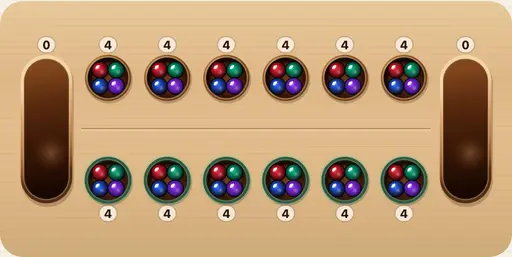
About Mancala (Kalah)
Mancala is a family of games, so the variant must be established before calculation begins. This Kalah board combines prescribed sowing, extra moves for direct store landings, and captures after a final seed reaches an empty home pit. Those mechanisms differ from Oware's capture conditions. Strong play counts the complete route, evaluates the resulting continuation, and includes the final sweep when a row becomes empty rather than judging only the current store totals.
- Ruleset covered
- Ply Yard Kalah: six pits per side, four starting seeds per pit, sow into your own store and skip the opponent's
- Updated
- · Editorial policy and corrections
Mancala (Kalah)Rules and variant distinctions
The Kalah board and starting position
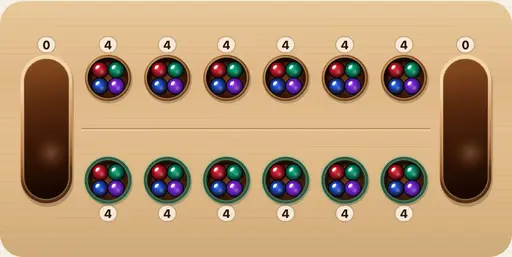
Mancala names a family of sowing games, not one universal ruleset. Ply Yard uses Kalah with six small pits per player and four seeds in every pit at the start. Each player also has a store, initially empty. The twelve pits therefore contain 48 seeds in total. South is the near row in the default display and moves first; North occupies the opposite row. Identify your own row and store before playing. You may select a nonempty pit on your own side, never an opponent's pit. Seeds collected in a store remain there; a store is not a pit you can select for another sowing move. The platform's move records label South's pits a–f, with internal indices 0–5, and South's store as 6. North's pits are A–F, with indices 7–12, and North's store is 13. You do not need to memorize those indices to play, but they help you reconstruct a move in replay. Use the actual sowing order rather than assuming the displayed letters alone identify the opposite pit.
Sow every seed along the prescribed route
Select one of your nonempty pits and lift all its seeds. Sow them one at a time into successive locations counterclockwise around the board. Deposit a seed in your own store whenever the route reaches it, but skip the opponent's store entirely. You cannot take only part of a pit, distribute the seeds freely, or switch to another pit midway through the move. The selected pit is emptied before sowing begins. The first seed goes into the next location, not back into the selected pit. If the seed count is large enough to complete a circuit, later seeds can return to that original pit. Count the route actually used on the current move, including your store and excluding the opponent's store. At the standard start, South can select c with four seeds. They land in d, e, f, and South's store, in that order. The last seed reaches the store, earning another move provided the game has not ended. This is a fixed sequence, not four placements chosen individually. Before committing, trace the final seed's destination and update every pit along the route. Those intermediate deposits can change capture opportunities and the opponent's next choices. Looking only at the selected pit's count misses the resulting position.
Extra moves and captures from an empty home pit
If the last seed lands directly in your store, you receive another move. Choose a new nonempty pit on your side and sow again. Several such moves can occur consecutively, but each is calculated from the updated position, and the end-of-game condition still takes priority. To capture seeds from an opposite pit, the final seed must land on your own side, its landing pit must have been empty immediately before that seed arrived, and the opposite pit must contain seeds. Move the final seed and the seeds from that opposite pit into your store. An earlier deposit into an empty pit is not enough: the capture test concerns the last seed. A final landing on the opponent's side does not trigger this capture. The platform additionally states that if the final seed lands in an empty pit on your own side while the opposite pit is empty, the lone landing seed is still collected into your store. Treat this as the site's documented handling, rather than assume every Kalah implementation uses the same empty-opposite convention. There are no opposing seeds to capture in that case. A capture does not itself grant another move. An extra move requires the final seed to land directly in the store; collecting seeds into the store after a pit landing is a different operation. To evaluate a capture, calculate the landing pit's contents at that moment, the opposite pit's contents, and the resulting options on both sides.
An empty row ends the game immediately
After a sowing move is resolved, the game ends if either player's six pits are all empty. The other player does not receive an additional reply. Sweep every remaining seed from the nonempty row into that row's owner's store, then compare the two store totals. More seeds wins; equal totals produce a draw. With the standard 48-seed start, a tied final position has 24 seeds in each store. Do not compare only the stores before the sweep. For example, if South's row is empty and the stores contain South 22 and North 18, with eight seeds still in North's pits, North finishes with 26 and wins. South's apparent store lead before collection is not the result. An apparent extra-move opportunity does not override the empty-row test. Resolve the sowing and any capture, check whether the game has ended, and only then determine who plays next. In a late position, compare a move that earns another turn with one that empties a row; include the full collection in both lines. Players may also agree to a draw, and an online player may resign. These interface options are separate from the automatic empty-row finish. No Oware feeding or starvation rule should be substituted for this Kalah end condition.
A calculation and review routine for the current board
Read whose turn it is, identify your nonempty pits, and count the final destination of each candidate. Classify the outcome as a direct store landing, an empty-home-pit landing, or an ordinary landing. Then calculate any capture and the empty-row test. The interface rejects empty pits, opposing pits, and selections unavailable on the current turn. Strategically, an extra move is valuable because you act again before the opponent, but it is not automatically the best choice. Inspect the next position: which pit can you use afterward, what capture becomes available, and could the sequence finish the game with an unfavorable sweep? Similarly, a large immediate capture must be compared with what it leaves for the opponent. Evaluate complete continuations rather than ranking moves solely by seeds deposited this instant. Against the computer you may take South or North; choosing North lets the computer open. The platform provides hints, undo, and replay in computer play. Same-device play alternates between the two players, and the online host chooses a side. Use replay to find the first counting or timing error: the wrong route, a missed skipped store, a mistaken final landing, or a premature assumption about the result. Hints support practice but do not certify an optimal move.
Practical strategy
For each nonempty pit on your side, trace every seed's destination and mark the choices whose final seed enters your store. Begin with South's opening c move.
List the actual sowing sequence, including your own store and skipping the opponent's. For c with four seeds, give d, e, f, then the store. Recalculate after every extra move rather than reuse the opening counts.
Construct a final landing in an empty pit on your own side. First give the opposite pit three seeds, then repeat with the opposite pit empty.
In the first case, collect the three opposing seeds and the final seed. In the second, apply the site's documented lone-seed collection. Explain why neither pit landing independently earns another move, and do not apply Oware's two-or-three-seed capture condition.
Compare a late move that earns another turn with a move that empties a row. Record the store totals and every seed remaining in the pits for both continuations.
Check the end condition before granting another move. Include the final sweep into the appropriate store before naming the winner; a current store lead alone is insufficient.
A common misconception
Every mancala game grants another move when the final seed enters a store.
Mancala includes distinct rulesets. This Kalah implementation uses direct store landings for extra moves; Oware and other variants have different mechanisms. Identify the version, and keep a capture transfer separate from a direct final store landing.
Position study: An opening sowing sequence earns another move
At the standard start, South's pits a–f each contain four seeds. South's store follows f in the sowing route. South selects c.
Where do the four seeds land, and does South move again?
Show the answer and analysis
The seeds land in d, e, f, and South's store, in that order. The final seed enters the store, so South earns another move. Neither row has become empty. This is a prescribed sowing sequence, not four freely chosen placements.
Establish the counterclockwise route and the skipped opposing store before counting the final seed. Evaluate the next move from the changed pit contents. Another move can support a useful sequence, but the extra-turn mechanism alone does not prove that a candidate is optimal.
This position was constructed for instruction. It is not a tournament record or an engine-verified proof of an optimal move. Evaluate it under the stated conditions; do not assume unlisted features of the complete position.
Structured practice
Understand the rules
Trace the final landing from each of your nonempty pits and identify direct store endings.
Assessment: List every deposit in order, include your store, and skip the opponent's store. Recalculate whenever a previous sowing has changed the counts.
Compare candidate moves
Calculate a final empty-home-pit landing with an occupied opposite pit, then with an empty opposite pit.
Assessment: Apply the platform's capture and lone-seed collection handling. Distinguish the landing seed from the opposite seeds and do not substitute Oware's capture conditions.
Review and verify
Compare an extra-move continuation with a row-emptying finish in a late position.
Assessment: Resolve the end condition and collect the remaining row before comparing final stores. Do not name the winner from the pre-sweep totals.
Frequently asked questions
Which side moves first in Kalah on Ply Yard?
South always starts. Against the computer you may choose South or North; if you choose North, the computer makes South's opening move. Identify your assigned side and store from the current board rather than relying solely on its visual orientation.
Do I sow seeds into the opponent's store?
No. Include your own store in the counterclockwise route and skip the opponent's store. Skipping it means no seed is deposited there; the next seed goes into the next eligible pit. This changes the final landing on long sowing moves, so count the route rather than treating both stores alike.
When does a last seed in an empty pit produce a capture?
To collect an occupied opposite pit, the last seed must land on your own side in a pit empty immediately before its arrival. Collect that seed and the opposite pit's seeds into your store. The platform also documents collecting the lone landing seed when the opposite pit is empty. A landing on the opposing row does not qualify, and collecting into the store after a pit landing is not a direct store landing that earns another move.
Can the other player reply after one row becomes empty?
No. Once a completed move leaves either row's six pits empty, the game ends. Collect the remaining seeds from the other row into its owner's store and compare the final totals. An extra-move opportunity does not continue a game whose end condition has already been reached.
Are Kalah and other mancala games governed by the same rules?
No. Mancala is a family of sowing games. This platform uses six pits per side, four starting seeds per pit, deposits in your own store, extra moves for direct store landings, and its documented empty-home-pit capture handling. Other games may use different pit counts, directions, capture conditions, or end procedures. Establish the variant before transferring a tactic.
Where do South's four seeds from the opening c pit land, and is there another move?
They land in d, e, f, and South's store. The final store landing earns another move, and neither row is empty in this starting example. You cannot distribute those four seeds among chosen pits. Evaluate the next move from the updated counts: an extra move is an opportunity, not proof that every store-ending sequence is best.
Does every mancala game award another move for a final store landing?
No. That mechanism belongs to particular rulesets, including the Kalah version described here. Oware and other mancala games cannot be treated as Kalah with different names. Even on this board, distinguish a seed landing directly in the store from seeds transferred there after a capture, and check for game end before taking another move.
Put your understanding into practice.
Choose one skill to work on in your next game. A clear reason for each move is more useful than an immediate win.
Play Mancala (Kalah)Rules sources and editorial notes
- Current rules for this game on Ply Yard
Identifies the board variant and interface described here. Platform instructions are not a complete statement of every tournament ruleset.
This guide combines the relevant board's rules with independently constructed examples and exercises. It distinguishes basic rules, variant-specific provisions, and strategic advice. Rules sections draw on the sources listed above. Instructional positions have not been presented as exhaustively engine-verified or certified by professional players.
Written by Ply Yard. Independent review by a named professional player has not been completed. To report an issue, send the game, ruleset, position, and relevant source provision to contact@plyyard.com.