 Ply Yard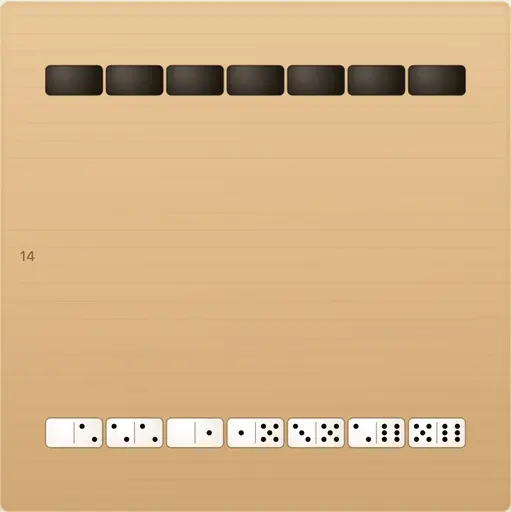
About Double-Six Dominoes
Dominoes decisions depend on more than removing the highest-pip tile. The two exposed values govern your remaining matching options and the opponent's legal plays. End selection, the same-turn draw procedure, the two-tile reserve, and blocked-hand pip comparison are central to this implementation. Do not import the exposed-end bonuses of All Fives or treat a displayed double as a wild card.
- Ruleset covered
- Ply Yard's double-six draw dominoes: twenty-eight tiles, seven per player, and two stock tiles reserved
- Updated
- · Editorial policy and corrections
Double-Six DominoesRules and variant distinctions
A double-six set, seven tiles each, and a free opening lead
Ply Yard uses a two-player draw-dominoes game with a double-six set of twenty-eight tiles. Each tile has two ends bearing zero through six pips; a blank end counts as zero. The set contains one of each unordered pair, from 0–0 through 6–6. Each player starts with seven tiles, and the other fourteen form the face-down stock, traditionally called the boneyard. The platform's Black player leads. With no tile yet on the table, the leader may play any tile: there is no requirement to lead the double-six or the highest double. White then takes a turn, and the players alternate. Black and White identify the two players in this interface, not different types of domino tile. After the lead, the chain has two open ends. Those exposed values determine which tiles can be played. A tile's total pip count does not establish whether it matches an end. Separate three questions: which plays are legal, what open values they leave, and how many pips remain in your hand afterward. To play on the interface, select a tile and then the left or right end. If the tile can fit both ends, choose the intended placement. A tile that matches neither open value cannot be played, and selecting a tile outside your turn does not create a legal action.
Match an open end; doubles are not wild cards or scoring spinners
A played tile must have an end equal to the exposed value at the chosen end of the chain. Attach that matching half; the other half becomes the new exposed value. The opposite end of the chain stays unchanged. For example, attaching 2–5 to an open 5 replaces that end with 2, not with the tile's combined pip total. A double has the same value on both halves. It may be attached to either end that matches that value, but not to an unrelated value. A 4–4 tile therefore requires an open 4; being a double does not let it fit an open 2. Its crosswise display, where used, does not change the matching rule or create extra playable branches. This is draw dominoes, not All Fives. The game does not award points during play for exposed-end totals divisible by five, and a double does not produce an automatic bonus. A double's pips still count normally if it remains in your hand at a blocked finish: 4–4 contributes eight pips. No bonus and no pip value are different claims. When a tile can fit either end, compare the resulting open values before choosing. Count the remaining tiles that would match each resulting position, and consider the distribution of values in your hand. A high-pip tile may reduce your exposure in a blocked finish, but playing it can also remove a useful connection. Immediate pip reduction is not a complete strategy.
Draw until you can play, but leave the last two stock tiles untouched
If no tile in your hand matches either open end, draw from the stock while more than two tiles remain. Continue until you obtain a playable tile or reach the two-tile reserve without a playable tile. Drawing is part of your current turn; it does not transfer the turn to the opponent. Once you can play, make the matching play rather than continue drawing unnecessarily. The last two stock tiles are not drawn in this implementation. When only those two remain and your hand still has no legal play, pass. You cannot choose an early pass while a required draw remains available, or pass merely because you dislike your playable tiles. The next player then applies the same play-or-draw procedure. Track the exposed values, your legal matches, and the number of drawable stock tiles separately. An unavailable tile does not prove that the entire hand is blocked. Before drawing, inspect every tile against both ends. Before treating a pass as a blocked finish, check whether the opponent can still play. An opponent's inability to match a value provides information about their hand at that moment, not permanent certainty about their holdings. Later draws can change what they possess. Use observed play and draw history to inform choices without claiming that one exposed number guarantees a forced pass. Computer play defaults to the human as Black and the computer as White; same-device and online play use the same published draw rules.
Empty your hand, or finish a blocked game with fewer pips
The first player to play every tile in their hand wins. If both players pass consecutively because neither can play under the stock rule, the game is blocked. Compare the total pips on each player's remaining tiles: the lower total wins, and equal totals produce a draw. A smaller tile count does not necessarily mean a lower pip total. Count both halves of each tile, with blanks worth zero. A remaining 6–6 contributes twelve pips, while 0–1 contributes one. Two low-pip tiles can therefore beat a single high-pip tile at a blocked finish. Do not import exposed-end scoring or a match-to-target-point system from a different dominoes variant. For a first game, identify both open ends before every play, follow the draw procedure without changing turns prematurely, and calculate remaining pips at a blocked finish. Then practice choosing the end for a tile that fits both sides. The choice changes future matching possibilities even though the same tile leaves your hand. In review, record the old open values, the played tile, the chosen end, and the new open values. Recount which remaining tiles match afterward, and note how draws changed the information available about the opponent. Evaluate a possible block using actual holdings where known and explicit uncertainty where they are hidden. These instructions describe the current Ply Yard board, not every double-six dominoes ruleset.
Practical strategy
Classify each tile in a sample hand as matching the left end, the right end, both, or neither.
Use matching pip values, not tile totals. A double needs a matching open end and produces no All Fives bonus.
With open ends 2 and 5, test playing 2–5 at each end and recount the remaining legal matches.
Playing at the 5 end leaves 2 and 2; playing at the 2 end leaves 5 and 5. Recalculate from the new values rather than keep the old-end count.
Review a draw turn and a blocked finish, recording stock size and each remaining tile's pips.
Drawing keeps the same player's turn. Leave two stock tiles undrawn, pass only when no legal play remains, and compare total pips after consecutive passes.
A common misconception
A double necessarily earns extra points.
This implementation uses draw dominoes, not All Fives. A double is a matching tile with an ordinary pip total, not an automatic bonus or a wild card.
Position study: The same tile can leave two different pairs of open values
The chain's open ends are 2 and 5. Your hand includes 2–5, 1–2, and 5–6. Other holdings and stock information are unknown.
What open values remain if you play 2–5 at either end?
Show the answer and analysis
At the 5 end, 2–5 leaves 2 and 2, so 1–2 remains playable and 5–6 does not currently match. At the 2 end, it leaves 5 and 5, so 5–6 remains playable and 1–2 does not currently match.
This is a comparison of immediate matching possibilities, not proof of an optimal move or a forced block. Consider the values in the rest of your hand, what the opponent could not match on earlier turns, and subsequent draws. The opponent acts before your next turn and may change the open values, so present availability is not a guaranteed future play.
This position was constructed for instruction. It is not a tournament record or an engine-verified proof of an optimal move. Evaluate it under the stated conditions; do not assume unlisted features of the complete position.
Structured practice
Understand the rules
Label every tile in a sample hand as matching the left end, the right end, both, or neither.
Assessment: Match actual exposed values. Doubles follow the same rule and do not generate All Fives bonuses.
Compare candidate moves
Apply both placements of 2–5 in the example and count the remaining matching tiles.
Assessment: Update the open values to 2 and 2 or 5 and 5 before recounting. Distinguish immediate availability from a guaranteed play after the opponent's turn.
Review and verify
Replay a draw turn and a blocked finish, checking the stock reserve and remaining pips.
Assessment: Keep the drawing player's turn, leave the last two stock tiles untouched, and compare both halves of every remaining tile only after the blocked-finish condition is met.
Frequently asked questions
Is this game the same as Chinese checkers?
No. Chinese checkers is a race on a star-shaped board, where jumps over neighboring pieces do not capture them. Double-six draw dominoes instead builds a chain by matching exposed pip values. Win by playing your entire hand, or by having fewer remaining pips when the game is blocked.
May I pass instead of drawing?
Only when the stock is down to its two reserved tiles and your hand has no legal play. If more than two stock tiles remain and you cannot match either open end, you must draw until you can play or reach that reserve. Drawing does not end your turn. A playable hand cannot pass simply to avoid a preferred tile choice.
Do doubles score extra points?
No. This draw-dominoes game does not award All Fives bonuses or accumulate points from exposed-end totals. A double is an ordinary matching tile, not a wild card or an extra branch. Its two halves still count toward remaining pips at a blocked finish: 6–6 contributes twelve, not zero.
Who leads, and must the opening tile be a double?
The platform's Black player leads and may play any tile on an empty table. A double is not required. After that lead, each played tile must match the left or right open end. This opening rule is specific to the implementation described here.
With open ends 2 and 5, what does each placement of 2–5 leave?
Playing 2–5 at the 5 end leaves open values 2 and 2. The remaining 1–2 can match, while 5–6 cannot currently match. Playing it at the 2 end instead leaves 5 and 5, reversing those two tiles' availability. This compares legal follow-up possibilities, not a proven best move. The opponent's hand and draws remain relevant, and their intervening play can change the ends again.
Does playing a double always earn a bonus?
No. Ply Yard uses draw rules rather than All Fives scoring. A double must match its own value at an open end, and its orientation does not create a scoring bonus. Judge it by matching options, the resulting position, and its ordinary pip value if left in hand.
Put your understanding into practice.
Choose one skill to work on in your next game. A clear reason for each move is more useful than an immediate win.
Play Double-Six DominoesRules sources and editorial notes
- Current rules for this game on Ply Yard
Identifies the board variant and interface described here. Platform instructions are not a complete statement of every tournament ruleset.
This guide combines the relevant board's rules with independently constructed examples and exercises. It distinguishes basic rules, variant-specific provisions, and strategic advice. Rules sections draw on the sources listed above. Instructional positions have not been presented as exhaustively engine-verified or certified by professional players.
Written by Ply Yard. Independent review by a named professional player has not been completed. To report an issue, send the game, ruleset, position, and relevant source provision to contact@plyyard.com.