 Ply Yard
About Memory Match
Browser memory match is solo position-memory practice, not a two-player contest. Teach the flip-two rule and when cards flip back; do not treat the efficiency score as a cognitive diagnosis.
- Ruleset covered
- 6/8/12-pair memory match with three themes, peek, and a post-round report
- Updated
- · Editorial policy and corrections
Memory MatchRules and variant distinctions
Flip two cards; matches stay face up
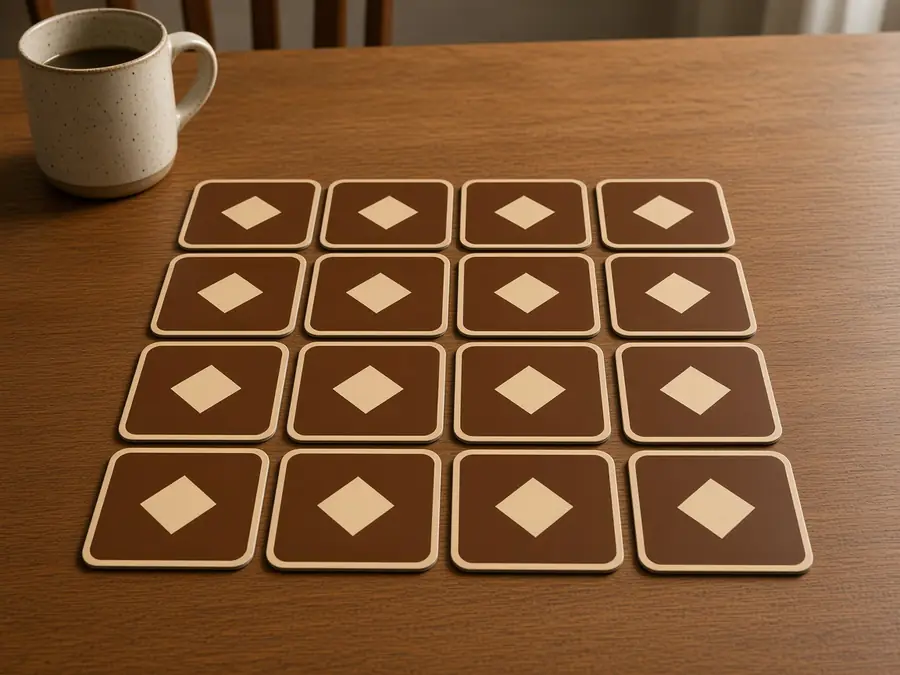
Classic memory match: every card starts face down. Flip two at a time. Matching symbols stay up and count as a pair; mismatches flip back after a short pause. This host deals 6 pairs (12 cards, 4×3), 8 pairs (16 cards, 4×4), or 12 pairs (24 cards, 6×4), with fruit, animal, and shape themes. Changing difficulty reshuffles immediately. Best time, fewest flips, and score are tracked separately per difficulty on this device.
Peek, post-round report, and local bests
Optional peek shows all cards for about two seconds at the start to build a first mental map—not a hidden level. After you clear the board, a post-round report estimates flip efficiency and separates pairs found from memory versus lucky collisions. It is practice feedback, not a clinical test. Shuffling and match checks run in a browser Worker. Input locks while two cards are turning or waiting to flip back. Clearing site data resets local bests.
Practical strategy
Finish an 8-pair board without peek and record flip count.
State the ideal minimum flips and where extras likely came from.
Replay the same difficulty and compare memory vs lucky pairs in the report.
Name which third of the round had denser mismatches.
A common misconception
Faster flips always mean better memory.
Scores shift with difficulty, theme familiarity, and peek—track trends on the same settings.
Position study: You remember a symbol but not the slot
Mid game on 8 pairs after a mismatch flips back.
What is a sensible next flip?
Show the answer and analysis
Turn one card you are sure about, then one candidate you need to test.
Efficiency comes from fewer double-unknown flips, not faster clicking.
This position was constructed for instruction. It is not a tournament record or an engine-verified proof of an optimal move. Evaluate it under the stated conditions; do not assume unlisted features of the complete position.
Structured practice
Understand the rules
Play two runs at the same difficulty and compare total flips.
Assessment: Say whether the second run had fewer wasted flips.
Compare candidate moves
One run with peek, one without.
Assessment: Compare memory-pair share in the report.
Frequently asked questions
When is the round won?
When matched pairs equal the deal size (6, 8, or 12). Timing starts on the first flip and stops on the last pair.
Is this the same as match-3 or solitaire?
No. Any two face-down cards can pair if symbols match; the challenge is position memory. This host is solo—no opponent seat.
Does peek count as cheating?
Peek is an optional study aid here; it does not change pairing rules.
Is progress synced?
No. Bests and reports stay in this browser.
Do I need an account?
No. Open memory.plyyard.com in your browser.
What does the report score mean?
Mostly flip efficiency versus the ideal minimum, plus memory/explore labels for self-comparison on the same settings.
Put your understanding into practice.
Choose one skill to work on in your next game. A clear reason for each move is more useful than an immediate win.
Play Memory MatchRules sources and editorial notes
- Current rules for this game on Ply Yard
Identifies the board variant and interface described here. Platform instructions are not a complete statement of every tournament ruleset.
This guide combines the relevant board's rules with independently constructed examples and exercises. It distinguishes basic rules, variant-specific provisions, and strategic advice. Rules sections draw on the sources listed above. Instructional positions have not been presented as exhaustively engine-verified or certified by professional players.
Written by Ply Yard. Independent review by a named professional player has not been completed. To report an issue, send the game, ruleset, position, and relevant source provision to contact@plyyard.com.