 Ply Yard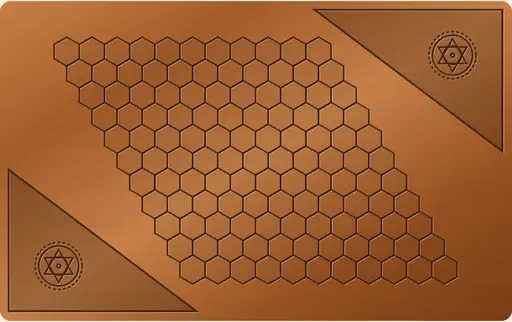
About Hex
Hex is won by connecting assigned opposite edges, not by capturing or counting territory. Local bridges require an analysis of available replies and should not be mistaken for already occupied chains. A single empty cut point can underlie several apparently separate plans. Verify actual edge-sharing adjacency and the complete winning path; the standard filled board cannot produce an ordinary draw.
- Ruleset covered
- 11×11 Hex on Ply Yard: Black connects left to right; White connects top to bottom
- Updated
- · Editorial policy and corrections
HexRules and variant distinctions
Connect your assigned opposite edges
Hex is a connection game, not a territory-counting game or a chess variant. On Ply Yard, Black connects the left and right edges; White connects the top and bottom edges. Your objective is a continuous chain of your own stones reaching both of your assigned edges. No piece has a separate movement ability, and no occupied region receives a territory score. Stones remain where they are placed. There is no movement, capture, or removal of an opposing group. Blocking an opponent therefore means occupying useful empty cells or disrupting a prospective route, not surrounding stones to take them off the board. Begin each calculation by identifying your two target edges. A large connected group that does not reach both edges is not a win. A relatively narrow chain that does reach them is sufficient. Progress should be assessed by connection prospects and the opponent's replies, not merely the number of stones in a local cluster.
Place one stone; distinguish the opening swap from passing
The platform uses an 11×11 grid of hexagonal cells arranged as a rhombus. Black places the first stone, then the players alternate, placing one stone on an empty cell per ordinary turn. A cell already occupied by either color is unavailable. Ordinary turns cannot be passed. Against the computer you may select Black or White; read the current side-to-move display before placing a stone. The published instructions document an opening swap option in computer play. Immediately after the first placement, the second player may choose to exchange sides rather than make the normal second placement. This is the pie rule: the second player takes the Black role and its opening stone, while the original opener takes White and continues from that position. It is not a capture, an ordinary pass, or a permission to exchange sides later in the game. The interface offers the swap only at the eligible opening moment. Do not assume the same control exists in every mode or remains available after further placements. Side selection at setup and an opening swap are different operations; after a swap, verify which color and target edges you now own. The swap option changes the opening decision. A first move that strongly benefits Black may be attractive for the second player to take over. A slightly off-center opening can be considered as a response to that incentive, but no location should be called universally optimal on the basis of this short principle alone. Evaluate the actual cell and both players' connection prospects.
Six-neighbor adjacency and potential connections
Two stones are connected when their hexagonal cells share an edge. An interior cell has six edge-sharing neighbors; cells at the boundary have fewer. Some of those neighbors look diagonal on the screen, but they are ordinary Hex neighbors if an edge is shared. Do not substitute a square board's four-neighbor or eight-neighbor definition. The dark side borders identify Black's left-to-right objective, and the light borders identify White's top-to-bottom objective. To verify a chain, start at a friendly stone touching one target border and follow edge-sharing stones of that same color until you reach the other target border. The chain may bend, branch, or detour. An empty cell between groups is not an existing connection. If two proposed routes both require the same empty cell, they share a single-point weakness rather than provide independent alternatives. An opposing placement there may invalidate both plans; check whether another route still exists before declaring the whole position lost. A two-cell bridge is a potential connection, not a completed chain. In a typical bridge, two friendly stones have two common empty neighbors: if the opponent occupies one, a reply on the other can make a local connection. That observation depends on the other cell remaining available and on the timing of the reply. It is not proof that every larger network containing a bridge is unconditionally secure. Check overlapping weaknesses and competing threats. Distinguish three statements in analysis: the stones are already connected; a connection can be completed in response to a local intrusion; or the plan depends on an empty cell the opponent can occupy. Those are different claims and should not be compressed into 'connected.'
Verify the winning chain and review the critical cut
The game ends as soon as one color forms an actual chain between its assigned opposite edges. The chain need not be straight or shortest. Empty cells, future replies, and unfilled bridge cells do not count as stones in the winning chain. A potential connection can support a strategy without yet satisfying the result condition. On a standard fully filled Hex board, exactly one of the two opposing connections exists. Consequently, ordinary play that continues with legal placements cannot finish as a filled-board draw. This structural property is different from a claim that a particular player wins every position, or that the platform's computer always finds optimal play. For a practical review, reconstruct the final chain cell by cell, confirming its color, adjacency, and contact with both target edges. Then work backward to the move that secured a connection or removed a critical alternative. A single blocking move may be strong locally yet insufficient if the opponent retains a different route. During play, compare extending your own connection with disrupting the opponent's. Prioritize the position's actual threats rather than always responding beside the latest stone. In replay, mark the empty cells your plan depended on and identify whether several apparently separate routes shared one vulnerable point. Winning evidence is the occupied chain; strategic evidence requires the sequence of placements and replies that produced it.
Practical strategy
Choose an interior cell, mark its six edge-sharing neighbors, and identify Black's two target borders. Repeat at a boundary cell.
Use hexagonal edge-sharing adjacency, not square-grid four- or eight-neighbor rules. Explain why a screen-diagonal neighbor can still connect and why boundary cells have fewer neighbors.
Construct two prospective routes that share one empty cell. Then compare that single-point dependency with a local two-cell bridge.
Identify the common cut point rather than counting the routes as independent. Explain the bridge reply condition without labeling unoccupied cells a completed connection.
Replay a finished game and list the winning chain's cells in order from one assigned edge to the other.
Verify an actual continuous same-color chain at every step. Exclude empty points and potential bridges from the winning evidence, and check the correct pair of target edges.
A common misconception
Hex is decided by the amount of empty territory a player surrounds, as in Go.
Hex is decided by an actual same-color connection between assigned opposite edges. It does not use territory scoring or captures.
Position study: A visual gap is not an occupied connection
Black has two groups separated by one empty hexagonal cell. No other occupied Black path currently connects the groups. It is White's turn.
Are Black's groups already connected?
Show the answer and analysis
No. An actual connection requires a chain of Black stones on edge-sharing cells. The intervening empty cell cannot be counted as occupied. White can change that prospective route by playing there, although alternative Black routes must still be checked.
Keep existing connections, reply-dependent potential connections, and single-point weaknesses separate. The example's one-cell gap is not automatically a resilient two-cell bridge. A bridge is a strategic relationship involving future placements, not a rule that lets empty cells count in a winning chain.
This position was constructed for instruction. It is not a tournament record or an engine-verified proof of an optimal move. Evaluate it under the stated conditions; do not assume unlisted features of the complete position.
Structured practice
Understand the rules
Mark an interior cell's six edge-sharing neighbors and Black's two target borders.
Assessment: Use Hex adjacency, not square-grid four- or eight-neighbor conventions. Verify border contact from the actual cell geometry.
Compare candidate moves
Find the empty cell shared by two prospective connection routes.
Assessment: Recognize a common cut point rather than two independent alternatives. Check other routes before claiming the opponent's placement defeats the entire position.
Review and verify
Reconstruct a finished game's winning chain cell by cell.
Assessment: Show continuous occupied stones of the correct color reaching both assigned borders. Do not count empty bridge cells as established links.
Frequently asked questions
Is Hex the same game as hexagonal chess?
No. Hex uses stationary stones to connect assigned opposite edges. Hexagonal chess uses distinct chess pieces with movement rules and a checkmate objective. Sharing hexagonal cells does not make their adjacency, tactics, or victory conditions interchangeable.
Do neighbors that look diagonal on the screen connect?
Yes, when the cells share an edge. An interior hexagonal cell has six such neighbors, including directions that look diagonal in the displayed grid. Verify the shared edge rather than applying square-board assumptions about orthogonal or diagonal contact.
May I pass instead of placing a stone?
No ordinary pass is allowed. The documented opening swap in computer play is a specific choice for the second player immediately after the first stone, not a general skip-turn command. It exchanges player roles; it does not create an empty ordinary turn or remain available throughout the game.
Why might an opening stone be placed away from the exact center?
With the opening swap option, the second player may take over Black and its first stone. That discourages treating the opening solely as the strongest possible placement for the player who initially owns Black. An off-center placement can be considered in that context, but the explanation does not prove a universal best move or describe measured opening frequencies. Evaluate the specific cell and whether swap is available in the current mode.
Are Black's two groups already connected when only one empty cell separates them?
No, if there is no other occupied Black path between them. The gap is not a Black stone. White's placement in that cell changes the prospective route, but Black may still have another way around. Distinguish a completed chain, a locally maintainable bridge, and a single empty point on which a plan depends.
Is Hex scored by counting territory, like Go?
No. Victory requires an actual connection between your assigned opposite edges. There is no territory count, capture score, or bonus for surrounding empty cells. A large region or group matters only insofar as it contributes to the connection contest.
Put your understanding into practice.
Choose one skill to work on in your next game. A clear reason for each move is more useful than an immediate win.
Play HexRules sources and editorial notes
- Current rules for this game on Ply Yard
Identifies the board variant and interface described here. Platform instructions are not a complete statement of every tournament ruleset.
This guide combines the relevant board's rules with independently constructed examples and exercises. It distinguishes basic rules, variant-specific provisions, and strategic advice. Rules sections draw on the sources listed above. Instructional positions have not been presented as exhaustively engine-verified or certified by professional players.
Written by Ply Yard. Independent review by a named professional player has not been completed. To report an issue, send the game, ruleset, position, and relevant source provision to contact@plyyard.com.