 Ply Yard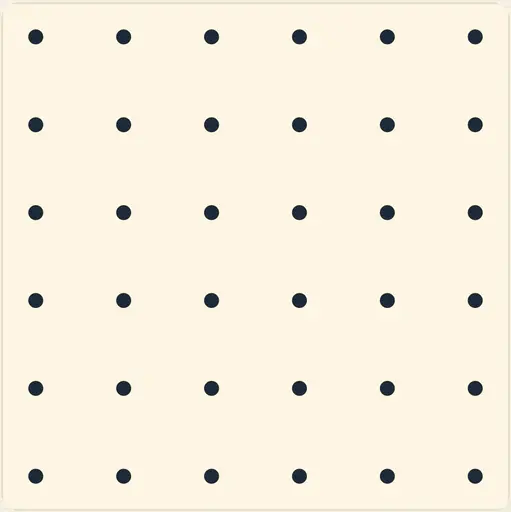
About Dots and Boxes
Dots and Boxes turns on the control of scoring continuations, not merely collecting the nearest box. A third edge can expose a capture, while a chain can bind several points to the same run of moves. Count shared-edge completions accurately, distinguish retained play from a requirement to take every available box, and compare the remaining components before giving up control. The default twenty-five-box board cannot produce a completed equal-score tie.
- Ruleset covered
- Dots and Boxes: completing a fourth edge scores and retains the move; default 5×5 boxes
- Updated
- · Editorial policy and corrections
Dots and BoxesRules and variant distinctions
Five by five boxes, not five by five dots
Dots and Boxes begins with a rectangular lattice of dots and no drawn edges. Ply Yard's default board contains 5×5 boxes, requiring 6×6 dots. That is 25 scoring boxes, 36 dots, and 60 possible horizontal or vertical edges. Online rooms use this fixed 5×5 box size. Blue moves first and Red follows. The objective is to own more completed boxes than the opponent. The display tracks both players' box totals. Edges themselves do not score, and drawing a larger outlined region does not claim every box inside it; each individual box requires all four of its own edges. Before counting a score or analyzing an endgame, distinguish dots, edges, and boxes. An internal edge borders two boxes, while a boundary edge borders one. That difference matters because a single move can complete two neighboring boxes at once.
Draw one unused edge per move
On your move, select an undrawn horizontal or vertical edge between neighboring dots. You may not redraw, erase, or replace an existing edge. A diagonal connection or a line spanning multiple edges is not one legal move. The platform rejects unavailable edge selections rather than treating them as a completed turn. Each accepted action draws exactly one edge. Completing a box lets you take another action afterward; it does not combine several edges into one simultaneous move. If the edge completes no new box, play passes to the opponent. If it completes at least one, you keep the move and choose another unused edge, unless the board is finished. Any unused edge is legal under the placement rule, including one that gives the opponent a scoring opportunity. Strategy must therefore be distinguished from legality: supplying a third edge may be unwise in one position and deliberately useful in another. The interface does not prohibit a legal sacrifice merely because it looks unfavorable locally.
Complete a fourth edge, claim the box, and retain the move
A box is claimed by the player who draws its fourth edge, regardless of who drew the first three. If an internal edge simultaneously completes two boxes, both belong to the mover. That is two points from one edge, followed by continued play; it is not two separate drawing actions. You retain the move after every scoring edge. The sequence continues until you draw an edge that completes no new box, or until no edges remain. Retaining the move does not require you to take every available box: the rules let you choose any unused edge on that continuation. Deliberately giving up the move must occur through a legal non-scoring edge, not by announcing a pass. This rule creates chain and loop endgames. Opening a connected sequence of nearly completed boxes may let the opponent claim several through repeated fourth-edge moves. Trace the actual remaining edges rather than infer a chain from visual proximity. A loop has no simple open end and needs its own continuation analysis. Control can matter more than the next box. A player may consider a handout: leaving some boxes to the opponent through a non-scoring move so that the opponent must later open another component. This is a strategic possibility, not a universal instruction to refuse a capture. Compare the complete box totals, component structure, and turn sequence before calling a sacrifice correct. In particular, do not label two prospective sequences independent if they share a decisive remaining edge. After every scoring move, update box counts and legal edges before evaluating the next continuation.
Final scores and the odd-sized board's draw limitation
When all edges have been drawn, every box has an owner. Compare the box totals: the player with more wins. On the default board the scores sum to 25, so a completed game cannot have equal scores. The closest possible result is 13–12. Securing thirteen boxes establishes a majority, although the published rule describes the final comparison after all edges are drawn. Equal-score draws are possible in the general game on boards with an even total number of boxes, but that statement does not imply the platform's fixed online board can be resized. Do not present a 12–12 score with one unfinished box as a drawn completed 5×5 game. The platform also permits a mutually agreed draw, and online players may resign. An agreed draw is a separate result from a tie after all boxes have been assigned. Keep those procedures distinct when explaining whether this board can end in a draw. Review a close finish by counting claimed boxes, unclaimed boxes, and who must open each remaining component. A current score lead is not the result if an opposing continuation can collect the remaining majority. Count both boxes from a shared-edge completion without counting the edge twice.
A practical routine for safe edges and endgame control
Read whose move it is and select an unused edge. Before drawing, count the existing edges of every box it touches. In an early position, a move that avoids creating any third side is commonly called safe, but that is a local scoring description rather than proof of optimal play throughout the game. When no locally safe edges remain, list the components you could open and the scoring replies they permit. Compare an immediate collection with a continuation that preserves control. Follow the sequence until a non-scoring move passes play, rather than assuming each drawn edge alternates players. Against the computer you may choose Blue or Red; choosing Red lets the computer draw Blue's opening edge. Computer practice includes hints, undo, and replay. Same-device play alternates on one screen, while an online host chooses a side on the fixed 5×5 board. Hints help practice but are not independent certification of an optimal endgame. In replay, identify the first move that opened a chain or gave up control, then count the subsequent scoring run and remaining components. A later large collection may be the consequence of that earlier decision. Evaluate the total allocation of boxes rather than equate taking the nearest available box with best play.
Practical strategy
Draw the first, second, third, and fourth edges of one box in separate actions, noting the mover and score after each.
Award the box only on the fourth edge and retain the move at that point. Attribute ownership to the fourth-edge player, not the player who drew most of its other sides.
Construct two adjacent boxes whose only missing edge is their shared boundary. Draw that edge, then recount scores, unclaimed boxes, and unused edges.
Award two boxes from one drawing action. Keep the move if an unused edge remains, and do not count the shared edge as two moves.
Replay the opening of a long chain and record every subsequent edge until a non-scoring move passes play. Compare the remaining chain or loop components.
Separate a scoring continuation from compulsory capture: the player must continue if edges remain but may choose a non-scoring edge. Evaluate a proposed handout from the complete sequence and final totals rather than assume immediate collection is always optimal.
A common misconception
Every drawn edge immediately changes the player to move.
Completing one or more boxes retains the move. A non-scoring edge passes play; completing the last edge ends the game.
Position study: One edge can complete two boxes
Two adjacent boxes each have three edges. Their only missing edge is the boundary they share. It is Blue's move.
How many boxes does Blue claim by drawing that shared edge, and does play immediately pass?
Show the answer and analysis
Blue claims both boxes from one edge. Because the move scores, Blue retains the move if any unused edge remains. The shared boundary is drawn once, not once per box.
Score and action count are different quantities. After scoring, inspect the remaining components and the legal ways of keeping or giving up control. A continuation can involve several separate moves, and taking one extra box immediately is not proof that the complete sequence is best.
This position was constructed for instruction. It is not a tournament record or an engine-verified proof of an optimal move. Evaluate it under the stated conditions; do not assume unlisted features of the complete position.
Structured practice
Understand the rules
Draw a box's four edges one at a time and track score and player to move.
Assessment: Only completing the fourth edge claims the box and retains play. The ownership does not depend on who drew the first three.
Compare candidate moves
Complete the example's shared edge and recount unclaimed boxes and available edges.
Assessment: Award two boxes from one edge and retain the move where further play exists. Do not double-count the drawing action.
Review and verify
Review a chain opening and record when the scoring run finally gives up control.
Assessment: Include chain and loop structure and compare complete continuations rather than treat immediate collection as necessarily optimal.
Frequently asked questions
Who draws the first edge on Ply Yard?
Blue starts. Against the computer you may choose Blue or Red; if you choose Red, the computer draws Blue's opening edge. Afterward, scoring edges retain the move, so the player does not necessarily change after every line.
Why do I move again after completing a box?
Completing a box awards its point and keeps the move. If your next edge also completes a box, you continue again. You pass play by drawing a non-scoring edge, not by an ordinary pass command. When the last edge completes the board, there is no further move to take.
Can a game on the default 5×5 board be drawn?
A fully completed score tie is impossible because there are 25 boxes. The closest split is 13–12, not equal totals. The general game permits equal-score draws on even-sized box totals, while this site's online board stays 5×5. Players may separately agree to a draw; that is not a tie produced by the completed box count.
What distinguishes Dots and Boxes from an arbitrary line-drawing game?
The rules specify unused edges between neighboring dots, ownership on completing each box's fourth edge, retained play after scoring, and victory by box totals. Drawing a visually larger outline, connecting opposite sides, or counting line length is not the objective. The exact shared-edge and continuation rules determine the strategy.
How many boxes does Blue gain by drawing the only missing shared edge of two boxes?
Two. That single edge completes the fourth side of both boxes, so both are assigned to Blue. Blue retains the move if any edge remains. Distinguish the number of boxes gained from the number of drawing actions; then evaluate the remaining position before deciding how to use the continuation.
Must the player change immediately after every drawn edge?
No. An edge completing one or more boxes keeps the move with the same player. An edge completing none passes it to the opponent. That distinction enables scoring runs and control strategies; a continuation is still a sequence of separate one-edge moves.
Put your understanding into practice.
Choose one skill to work on in your next game. A clear reason for each move is more useful than an immediate win.
Play Dots and BoxesRules sources and editorial notes
- Current rules for this game on Ply Yard
Identifies the board variant and interface described here. Platform instructions are not a complete statement of every tournament ruleset.
This guide combines the relevant board's rules with independently constructed examples and exercises. It distinguishes basic rules, variant-specific provisions, and strategic advice. Rules sections draw on the sources listed above. Instructional positions have not been presented as exhaustively engine-verified or certified by professional players.
Written by Ply Yard. Independent review by a named professional player has not been completed. To report an issue, send the game, ruleset, position, and relevant source provision to contact@plyyard.com.