 Ply Yard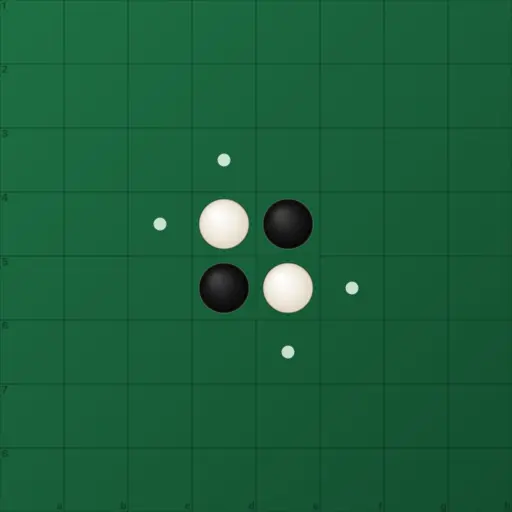
About Reversi
Every Reversi placement must bracket at least one opposing disc, and every qualifying direction must be flipped. Assess mobility, stable discs, and endgame continuations together. A larger middlegame disc count is not necessarily an advantage, and corner-adjacent squares are not universally unfavorable.
- Ruleset covered
- Standard 8×8 Othello/Reversi placement and capture rules; Black moves first
- Updated
- · Editorial policy and corrections
ReversiRules and variant distinctions
The standard starting position
The 8×8 board begins with Black at d5 and e4 and White at d4 and e5. Black moves first. Players place discs on empty squares; existing discs are not moved to new squares. Each placement must make at least one capture under the bracketing rule.
Bracketing and flipping
A placement must bracket a continuous line of one or more opposing discs between the newly placed disc and an existing friendly disc. Lines may be horizontal, vertical, or diagonal, and may not contain a gap. Flip every qualifying line formed by the placement. Adjacency alone is insufficient, and newly flipped discs do not trigger additional chain-reaction captures.
Mandatory passes
If you have no legal placement, you must pass and the opponent continues. If a legal move exists, you may not voluntarily pass. One player's pass does not by itself end the game: it may allow the other player to move again. Check legal moves for both sides before declaring the position finished.
Corners, stability, and mobility
A corner disc cannot be bracketed from beyond the board, so it remains stable. Corners can also support stable edge formations. Legal move availability—mobility—and stable discs often matter more than the current disc count in the middlegame. Squares beside an unoccupied corner can concede access to it, but their strategic risk does not make them illegal.
The end of the game and the result
The game ends when neither player has a legal move, even if empty squares remain. Under the basic rules, the player with more discs wins; equal counts produce a draw. Competition or platform provisions may additionally specify how empty squares, resignation, or other result conditions are scored. Consult the subsite's result description for its implementation.
Practical strategy
Verify every line a move creates
For each candidate square, trace all eight directions until you find a friendly disc, an empty square, or the board edge. Only uninterrupted opposing discs bracketed by friendly endpoints are flipped. Do not add captures created indirectly by discs that have just changed color.
Compare mobility instead of maximizing immediate flips
Count each side's legal moves and compare how two candidate placements change those choices. A move that flips many discs can expose more options to the opponent while restricting your own. Examine stability and corner access together with mobility rather than relying on one measure.
Calculate the endgame through passes
With few empty squares remaining, enumerate the legal continuations for both sides and include mandatory passes. Determine the final disc count rather than extrapolating from a middlegame advantage. Remember that the game can finish with empty squares and that a pass by only one player is not necessarily the end.
A common misconception
C-squares and X-squares must never be played.
They can concede an empty corner, but they are not prohibited. Corner ownership, stable edges, and forcing tactics can make such a move appropriate.
Position study: Verify the opening capture
Standard starting position: Black at d5 and e4; White at d4 and e5. Black to move.
| a | b | c | d | e | f | g | h | |
|---|---|---|---|---|---|---|---|---|
| 8 | ||||||||
| 7 | ||||||||
| 6 | ||||||||
| 5 | ||||||||
| 4 | ||||||||
| 3 | × | |||||||
| 2 | ||||||||
| 1 |
Which discs flip after Black plays d3?
Show the answer and analysis
Only White's disc at d4 flips. The line d3–d4–d5 has black endpoints with a continuous white disc between them. White at e5 is not bracketed by this placement and does not flip.
Legality requires an uninterrupted bracket, not merely adjacency to an opposing disc. Check ranks, files, and diagonals independently. Flip every qualifying line; an empty square interrupts a bracket.
This position was constructed for instruction. It is not a tournament record or an engine-verified proof of an optimal move. Evaluate it under the stated conditions; do not assume unlisted features of the complete position.
Structured practice
Understand the rules
Check Black's four legal opening moves: d3, c4, f5, and e6.
Assessment: For each move, identify the bracketed white disc and the black disc at the far endpoint.
Compare candidate moves
Choose a middlegame position, count both players' legal moves, and compare two candidate placements.
Assessment: Explain which move increases the opponent's choices or forces play toward a risky corner-adjacent square.
Review and verify
With few empty squares remaining, enumerate both players' continuations, including passes, and calculate the final count.
Assessment: Do not confuse a mandatory pass by one player with the end of the game.
Frequently asked questions
What makes a placement legal?
The new disc must bracket at least one continuous line of opposing discs with an existing friendly disc, horizontally, vertically, or diagonally. There may be no empty square within that line. A placement can bracket several directions, and every qualifying direction must be flipped. A strategically attractive square is still illegal if it captures nothing.
Do newly flipped discs cause further flips?
No. Only the bracketing lines directly created by the newly placed disc are captured on that turn. A flipped disc is not a new placement and does not initiate another round of captures. Recalculating from every flipped disc would incorrectly introduce a chain-reaction rule.
May I place anywhere if I have no legal move?
No. You must pass, allowing the opponent to continue. Conversely, you may not choose to pass while a legal placement exists. If neither player can move, the game ends, even with empty squares remaining. The presence of an empty square is not evidence that the game must continue.
Why are corners especially valuable?
A corner has no space beyond it from which an opponent can complete a bracket, so a disc placed there cannot be flipped. Corner ownership can help establish stable edge discs. A placement beside an empty corner can sometimes grant the opponent access to it; evaluate the full edge structure instead of treating every adjacent square identically.
Does having more discs in the middlegame mean I am ahead?
Not necessarily. Unstable discs can change color rapidly. Mobility, stable discs, and corner control often give a better account of the position than raw middlegame disc count. Taking the largest immediate capture can leave you with few useful moves later. Final disc count becomes decisive when calculating the completed game.
How is the winner determined?
Once neither player has a legal move, compare disc counts: the larger count wins, and equal counts draw under the basic rules. The board need not be full. Some competition or software provisions specify additional scoring treatment for empty squares or resignation; follow the current subsite's result rules for online play.
What are C-squares and X-squares?
C-squares are the edge squares orthogonally adjacent to a corner; X-squares are diagonally adjacent to a corner. While the corner is empty, a move on either type can provide the opponent with a route to it. These are strategic classifications, not prohibited squares. Their value changes with corner ownership, edge stability, and forcing tactics.
What does mobility mean in Reversi?
Mobility is the number of legal placements available to a player. Maintaining useful choices while reducing the opponent's options can force an unfavorable placement, such as an X-square move that concedes a corner. It is an important middlegame measure, but it must be considered alongside stable discs and accurate endgame calculation.
Which discs flip after Black plays d3 in the starting position?
Only White's disc at d4 flips. The line d3–d4–d5 has black endpoints and an uninterrupted white disc between them. White at e5 is not bracketed by this move and remains white. Check each direction independently; gaps interrupt a bracket, and simple contact with an opposing disc is not enough.
Should C-squares and X-squares always be avoided?
No. They often risk conceding an empty corner, but they remain legal. Once the corner is occupied, the edge is stable, or a forcing continuation changes the evaluation, such a move may be sound. Assess the actual position rather than treating a strategic warning as a rule.
Put your understanding into practice.
Choose one skill to work on in your next game. A clear reason for each move is more useful than an immediate win.
Play ReversiRules sources and editorial notes
- Current rules for this game on Ply Yard
Identifies the board variant and interface described here. Platform instructions are not a complete statement of every tournament ruleset.
- World Othello Federation: Official Rules
Basic 8×8 bracketing, passing, and end-of-game rules.
This guide combines the relevant board's rules with independently constructed examples and exercises. It distinguishes basic rules, variant-specific provisions, and strategic advice. Rules sections draw on the sources listed above. Instructional positions have not been presented as exhaustively engine-verified or certified by professional players.
Written by Ply Yard. Independent review by a named professional player has not been completed. To report an issue, send the game, ruleset, position, and relevant source provision to contact@plyyard.com.