 Ply Yard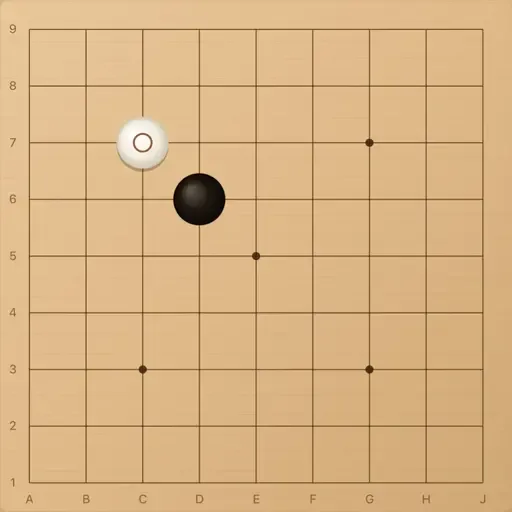
About Go
Go is decided by the final score under the agreed rules, not by the number of captures alone. Start by reading liberties and connections, then examine life and death, move priority, and the efficiency of territory. A smaller board reduces the scale of whole-board planning without removing the difficulty of ko, seki, or scoring.
- Ruleset covered
- Chinese area scoring, with Japanese territory-scoring distinctions
- Updated
- · Editorial policy and corrections
GoRules and variant distinctions
Placement and connection
Black moves first. On each turn, place one stone on a legal empty intersection or pass. Stones do not move after placement. Stones of the same color that touch horizontally or vertically form a connected chain; diagonal contact does not connect them. These placement rules apply to 9×9, 13×13, and 19×19 boards. Opening priorities, local density, and scoring do not scale in direct proportion to board size.
Liberties and capture
A chain's liberties are the distinct empty intersections immediately adjacent to it horizontally or vertically. Count a shared liberty only once. After a move, remove opposing chains with no liberties before checking the liberties of the newly placed stone and its chain. The board described here prohibits self-capture when the move captures no opposing stones. Other rulesets may treat self-capture and repetition differently.
Ko and repetition
The simple ko rule prohibits an immediate recapture that restores the preceding position. A player commonly makes a threat elsewhere before attempting to recapture. Superko rules can also prohibit positions encountered earlier in the game. Chinese, Japanese, and other rulesets do not handle every long-cycle repetition identically. A basic explanation of ko is not a substitute for the repetition provisions of the chosen ruleset.
Life, death, and seki
Two independent, genuine eyes normally establish unconditional life when the enclosing stones are securely connected and outside play cannot invalidate the eye shape. Two enclosed empty points alone do not prove life: examine false eyes, cutting points, and capturable boundary stones. In seki, opposing groups may survive without two independent eyes because filling shared liberties would permit their own capture. The treatment of empty points in seki depends on the scoring rules.
Ending the game and calculating the score
Consecutive passes begin end-of-game confirmation; they do not automatically make every chain alive. Establish the status of disputed stones before scoring. Chinese-style area scoring counts living stones and controlled empty intersections. Japanese-style territory scoring counts territory and accounts for prisoners, with different provisions for dead stones and seki. The Go subsite currently lists 7.5 points of komi for its Chinese rules setting and 6.5 points for its Japanese/Korean territory-scoring setting. These are platform settings, not universal values for every event or board size.
Practical strategy
Count liberties before attacking
In a contact fight, count the liberties of both chains, especially any chain in atari. Atari means that a chain has one liberty; it does not guarantee capture. The opponent may connect, escape, or capture your stones. Repeated attacks do not justify leaving your own cutting points undefended or endangering a larger chain to pursue one stone.
Compare the efficiency of corners, sides, and the center
Corners provide two board edges as boundaries, sides provide one, and central territory requires more stones to enclose. This explains a common opening preference, not a requirement to play every early move in a corner. Once fighting begins, securing a weak group or answering an urgent threat may take priority over an unoccupied corner.
Resolve life and death before estimating territory
An enclosed area is not necessarily secure territory. First establish whether its surrounding stones can live and whether the boundary can be broken. Two independent genuine eyes are a useful starting point, but seki and ko-dependent life require additional reading. Practice making and attacking eyes on a small board before memorizing complicated joseki.
A common misconception
Every living group must have two eyes.
Two independent genuine eyes are a common sufficient condition for life, not a universal requirement. Seki and other life-and-death situations require analysis of outside liberties and legal continuations.
Position study: One remaining liberty
A local position on a 9×9 board: Black at D4; White at C4, D3, and E4; D5 is empty. There are no other stones in this local position. White to move.
| B | C | D | E | F | |
|---|---|---|---|---|---|
| 6 | |||||
| 5 | × | ||||
| 4 | |||||
| 3 | |||||
| 2 |
Why does White at D5 capture, and may Black immediately play at D4?
Show the answer and analysis
White at D5 fills Black D4's final liberty, so the black stone is removed. Black cannot then play at D4: the four surrounding white stones leave it without liberties, and it captures none of them. This is prohibited self-capture, not ko.
Evaluate the complete chains after placement, including any opposing captures, before testing self-capture. A single-stone capture is not automatically ko; ko requires a recapture structure that would recreate a previous position.
This position was constructed for instruction. It is not a tournament record or an engine-verified proof of an optimal move. Evaluate it under the stated conditions; do not assume unlisted features of the complete position.
Structured practice
Understand the rules
List the four points adjacent to Black D4 and explain why diagonal points are not liberties.
Assessment: Identify D5 as the only remaining liberty and state exactly when Black D4 is removed.
Compare candidate moves
Construct a two-eye position and a false-eye position. Inspect the connections among the enclosing stones.
Assessment: Do not infer life from two empty points alone. Identify the cutting point or capturable stones that make an eye false.
Review and verify
Finish a 9×9 game. After passing, list living stones, dead stones, controlled empty points, and komi separately.
Assessment: Name the scoring method and apply its components consistently, without combining area- and territory-scoring formulas.
Frequently asked questions
Which board size is useful for practicing liberties and captures?
Start with 9×9. Games are shorter, captures and territory are easier to examine, and reviewing a finished game is more manageable. Practice liberties, connections, and capture, then learn to confirm the final position before moving to 13×13. A 19×19 board demands broader whole-board judgment; using it is not the only measure of progress.
Is Go about capturing stones or controlling territory?
The objective is to obtain the higher final score under the agreed rules, not simply to capture more stones. Area scoring generally counts living stones and controlled empty points; territory scoring generally counts territory and accounts for prisoners. Komi also affects the result. Sacrificing a large area to capture a few stones may be unfavorable. Confirm the scoring method and the treatment of dead stones before counting.
What is a liberty, and why do diagonal stones remain separate?
A liberty is an empty intersection directly adjacent to a stone or connected chain horizontally or vertically. Diagonal empty points are not liberties, and diagonal contact does not join two stones into one chain. An isolated stone can have at most four liberties in the center, three on an edge, and two in a corner. Count each distinct liberty of a chain once.
Why are two eyes important, and how can I recognize a false eye?
Two independent genuine eyes normally prevent an opponent from filling both with one legal move and capturing the enclosing chain. An apparent eye can be false if the boundary stones are disconnected or vulnerable to capture. Check the connections and outside liberties of the enclosing stones rather than counting enclosed empty points alone.
What is ko, and why is an immediate recapture prohibited?
Certain single-stone exchanges would immediately restore the previous position. The simple ko rule prohibits that immediate recapture, preventing an endless two-move cycle. A player generally plays elsewhere before returning to the ko. Some rulesets also restrict longer repetition cycles; consult the rules in use when a more complicated cycle occurs.
What should happen after both players pass?
Confirm the final position, including dead stones and agreed boundaries. Consecutive passes do not automatically establish that every chain is alive. Apply the relevant provisions for seki and disputed life-and-death status. If the players disagree, follow the chosen ruleset's confirmation or resumption procedure rather than deciding from how full the board appears.
Can stones survive in seki without two eyes?
Yes. In seki, opposing groups can survive through shared liberties and mutual capture constraints without each having two independent eyes. Seki is not limited to one particular number of shared liberties. Verify what happens if either player fills a liberty, move by move. Which empty points count toward the score depends on the area- or territory-scoring rules in use.
What is komi, and how much does White receive?
Komi compensates White for Black's first-move advantage. Its value and unit must be stated with the ruleset. The current board defaults to 7.5 points under Chinese area scoring and offers 6.5 points under Japanese/Korean territory scoring. The traditional Chinese expression of 3.75 stones involves a unit conversion from 7.5 points. Komi does not guarantee perfect balance at every playing strength or in every position.
Does Weiqi Go require registration or installation?
No. Weiqi Go runs in a phone or desktop browser without registration or installation. The current subsite offers multiple AI levels, two-player play on one device, and games shared by link, with 9×9, 13×13, and 19×19 boards. For focused practice, choose a smaller board and a lower AI level. Check the subsite for the settings currently available.
Should I play more games or review my losses against the AI?
Lower the difficulty and review one issue after each game. Find the first major capture and trace it back to a missed atari, cutting point, or opportunity to make eyes. Focus the next game on that issue before increasing the difficulty. Win rate is not the only useful measure: being able to explain a move is evidence of improved judgment.
Why does White at D5 capture, and may Black immediately play at D4?
White at D5 fills the last liberty of the black stone at D4, which is removed. Black cannot then play at D4: the four surrounding white stones leave the new black stone with no liberties, and the move captures none of them. This is prohibited self-capture, not ko. Evaluate the resulting chains before identifying capture, self-capture, or repetition.
Must every living group have two eyes?
No. Two independent genuine eyes are a common sufficient condition for life, not a necessary condition in every position. Seki is one important exception. Life-and-death analysis must also consider outside liberties and the opponent's legal continuations.
Put your understanding into practice.
Choose one skill to work on in your next game. A clear reason for each move is more useful than an immediate win.
Play GoRules sources and editorial notes
- Current rules for this game on Ply Yard
Identifies the board variant and interface described here. Platform instructions are not a complete statement of every tournament ruleset.
- British Go Association: How to Play
Introduces placement, capture, and end-of-game concepts; it is not the complete rules text for every scoring option offered by the site.
This guide combines the relevant board's rules with independently constructed examples and exercises. It distinguishes basic rules, variant-specific provisions, and strategic advice. Rules sections draw on the sources listed above. Instructional positions have not been presented as exhaustively engine-verified or certified by professional players.
Written by Ply Yard. Independent review by a named professional player has not been completed. To report an issue, send the game, ruleset, position, and relevant source provision to contact@plyyard.com.