 Ply Yard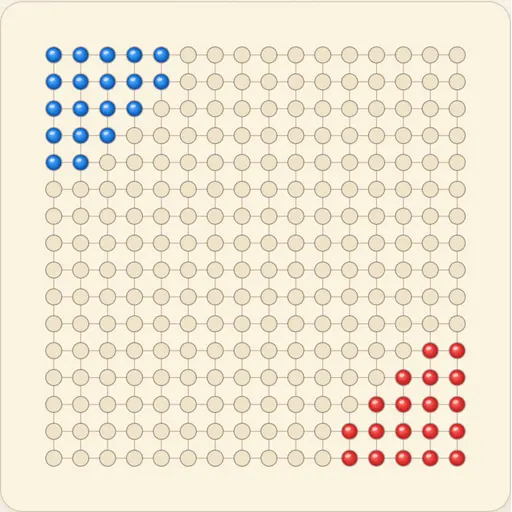
About Halma
Halma and star-shaped Chinese checkers share non-capturing jumps, but their board geometry, camps, and routes differ. On Halma's square grid, eight-direction movement and a nineteen-piece group make shared supports and the release of trailing pieces central to planning. In the ending, reserve access to the remaining destination squares rather than settling each leading piece without considering those behind it. This guide connects legal route selection with the progress of the entire group.
- Ruleset covered
- Two-player 16×16 Halma: nineteen pieces per side; complete occupation of the opposite corner camp
- Updated
- · Editorial policy and corrections
HalmaRules and variant distinctions
A step or multiple jumps with one piece
Halma is a race to move all of your pieces into the diagonally opposite camp. On a turn, choose one of your pieces and either step to an adjacent empty square or jump over an adjacent piece to the empty square immediately beyond it. A step ends the move. After a jump, the same piece may make further legal jumps. Jumped pieces remain on the board. There are no captures, and a piece's arrival in the destination camp has no separate scoring value. The game ends when all nineteen of your pieces occupy that camp together. Empty squares elsewhere on the board need not be filled.
Resolve the entire route within one turn
Select a legal destination reached by one step or a sequence of jumps. The selected piece is the only piece that moves on that turn. Each supporting piece stays on its square, whether it belongs to you or your opponent. A multiple-jump sequence is one move. Complete the route, then check whether your nineteen pieces occupy all nineteen destination squares. If they do, you win immediately; if not, the other player takes the next turn. You cannot combine a step with jumps or make two ordinary steps in a single turn. The move record retains the jumping path, so a review should check every segment rather than treating an empty endpoint as sufficient proof that the whole route was legal.
A 16×16 square board with nineteen pieces per side
This two-player version uses a 16×16 square board. Red begins with nineteen pieces in the northwest corner camp, and Blue begins with nineteen in the southeast corner camp. Red moves first. Each player's destination is the other player's starting camp. The square grid permits horizontal, vertical, and diagonal movement. It is not the six-direction geometry of star-shaped Chinese checkers, and its nineteen-piece camps require a different entry plan from that game's ten-piece triangles. George Howard Monks invented Halma in the United States in the 1880s. Star-shaped Chinese checkers developed from the same racing idea, but the shared use of non-capturing jumps does not make their boards or legal routes interchangeable.
Eight-direction steps and legal jump segments
An ordinary step moves one square in any of the eight adjacent directions, provided the destination is empty. It may be horizontal, vertical, or diagonal. A step cannot cross another piece, cover two squares, or be followed by another step during the same turn. A jump crosses one adjacent piece of either color and lands on the empty square immediately beyond it in the same direction. Both the supporting piece and the landing square must exist on the board. You cannot jump across two consecutive occupied squares to reach a more distant vacancy. After landing, you may change direction for the next jump. Each jump is individually straight; the complete route need not be. Keep the supporting pieces in place while updating the moving piece's location. A change of direction after a legal landing is not permission to bend a single jump.
Stopping a sequence and checking visited landings
You may stop a jumping sequence at any legal landing square, even when another jump is available. There is no requirement to take the longest route, and you may choose a legal step instead of a jump. Within one sequence, you cannot revisit a landing square already visited in that sequence. This restriction applies to the current move, not to all later turns. A piece may return to that square during a subsequent move. Evaluate candidate endpoints by the routes they leave for the rest of your pieces. A short relocation can preserve access to a useful support; a longer sequence can be unfavorable if it strands the rear group. Distance gained by the selected piece is only one part of the position's value.
Victory requires nineteen simultaneous arrivals
You win when your nineteen pieces occupy all nineteen squares of the opposing camp at the same time. Opposing pieces outside that camp do not affect the occupation test. An opposing piece still inside it occupies a square your own group needs, so the camp is not yet complete. The first arrival does not win, and eighteen arrivals are not enough. A piece that entered earlier but later left does not count as occupying the camp. Judge the current position rather than the total number of visits. The rear pieces often determine the finishing time. Check whether the pieces already inside the camp leave access to the remaining empty squares. Settling a leading piece near an entrance can obstruct a later arrival and force a detour; plan the sequence for the whole group.
This platform's camp and continuation rules
Halma has house-rule variations. Some groups prohibit leaving the destination camp, require a started jumping sequence to continue, or use different camp assignments in multiplayer games. Agree on such changes before an in-person game rather than assuming that a familiar edition matches this board. The Ply Yard version allows leaving the destination camp and ending a jumping sequence at a legal landing. A legal step remains available even when a jump exists. It does not award a separate victory because an opponent is blocked or has no movable piece; the winning condition is complete occupation of the opposite camp by all nineteen pieces. Computer play, same-device play, and online rooms use the same movement rules. Distinguish an unfavorable route from an illegal one, and do not import a capture, promotion, or compulsory-jump rule from another game.
A supporting piece needs an empty landing beyond it
An adjacent piece alone does not make a jump legal. The square immediately beyond it, on the same straight line, must be empty. If that square is occupied or lies outside the board, the jump is unavailable. Check this three-part structure for every segment: the moving piece's current square, one adjacent supporting piece, and the empty landing square beyond it. The support's color is irrelevant, but the landing's occupancy is decisive. You cannot remove the support or skip an occupied landing to make a route work.
Compare branches by their consequences for the group
When two continuations are legal, you may choose either or end the move at the current landing. More jumps do not give a route priority under the rules. For strategy, compare the endpoint and the resulting support structure. Does the relocation open a route for a trailing piece, preserve a connection across the center, or leave a needed camp square accessible? Consider whether the opponent can use or change the same shared arrangement on the next turn. A legal route is an option, not a guarantee that its future continuations will remain available.
Reopen an obstructed destination entrance
You may relocate one of your own pieces when it blocks the entrance to the destination camp. This version even allows moving it temporarily out of the camp to make space for another piece. Any such relocation must still be a legal step or jumping sequence. The relocated piece must return before you can win. Eighteen pieces inside the destination do not satisfy the nineteen-piece objective. Compare the moves needed to reopen access and restore complete occupation, rather than assuming that every piece already in camp should remain stationary.
An opposing piece cannot be removed from your destination
You cannot capture an opposing piece that remains in your destination camp, replace it with your own piece, or move it on the opponent's behalf. It must leave through the opponent's legal play before its square becomes available. Filling the other destination squares does not end the game. All nineteen must be occupied by your nineteen pieces. The stated platform rules do not convert an opposing occupant into an arrival or grant a special anti-blocking victory.
Illegal moves and rules borrowed from checkers
You cannot make a two-square step, jump into an occupied square, bend an individual jump, or cross two adjacent pieces in one jump. You also cannot move outside the board, select an opponent's piece to move, or remove a jumped piece. Each segment must use one adjacent support followed by one empty landing in the same direction. Unlike American checkers, Halma has no jump captures, compulsory captures, or promotion to kings. Its 16×16 board uses a square-grid race objective rather than play restricted to the dark squares of an 8×8 board. For a proposed route, check each landing and then evaluate the access left for the other eighteen pieces. Correct movement calculation and coordinated group progress are separate requirements; a long legal jump is not automatically the best move.
Practical strategy
Make one legal step and a separate two-jump move. Record the moving piece's locations and check the pieces used as supports afterward.
Confirm that Halma jumps do not capture and that every landing is empty. Distinguish two jumps within one move from two ordinary steps, which are not allowed.
Design a shared support arrangement for three trailing pieces. List the squares each could reach within two of its own moves, updating the position after each relocation.
Identify which routes disappear when a shared supporting piece moves. Separate routes available in the present setup from routes that require the arrangement to be preserved.
Plan the arrival order of the last few pieces, reserving empty destination squares and access to the camp.
Show that early arrivals do not block the final usable entrance. Include any necessary relocation of settled pieces and finish with all nineteen pieces inside together.
A common misconception
The first piece to reach the opposite corner camp wins the game.
Victory requires the entire nineteen-piece group to occupy the destination camp at the same time under the current board rules.
Position study: A support's advance can reduce the group's mobility
On a legal straight line, your piece occupies A, a supporting piece occupies B, and C is empty. Another of your pieces still relies on B to leave the starting camp. A can jump to C, while B also has a legal one-square step available.
Why shouldn't B's advance be evaluated only by its distance from the destination?
Show the answer and analysis
Moving B can remove a jumping support that the trailing pieces need. The progress made by B alone may be outweighed by the routes lost to the rest of the group. Compare the specific camp-exit routes that remain after B moves.
This is not a blanket instruction to keep every support stationary. Another piece may replace B, or a developing obstruction may make B's relocation preferable. Evaluate access for the entire group in the resulting position, not just the distance gained by one piece.
This position was constructed for instruction. It is not a tournament record or an engine-verified proof of an optimal move. Evaluate it under the stated conditions; do not assume unlisted features of the complete position.
Structured practice
Understand the rules
Make a one-square step and a separate two-jump move. Observe whether the supporting pieces remain in place.
Assessment: Confirm that jumping does not capture and verify the empty landing square of each segment.
Compare candidate moves
Arrange shared jumping supports for three trailing pieces. List each piece's reachable squares within two of its own moves, updating occupancy as the moves occur.
Assessment: Identify the routes lost when a shared supporting piece is relocated, instead of assuming that every initial route survives.
Review and verify
Plan the entry order of the final pieces, reserving destination vacancies and a usable camp entrance.
Assessment: Prevent an early arrival from closing the last route needed by the trailing group, and complete simultaneous occupation by all nineteen pieces.
Frequently asked questions
May I jump over an opponent's piece?
Yes. A legal jump may cross a piece of either color. That piece must be adjacent, and the square immediately beyond it in the same direction must be empty. The jumped piece stays where it is. It is not captured, displaced, or transferred to your side.
Must a multiple-jump sequence stay on one straight line?
No. Each jump must be straight, but you may choose a different direction after landing. Halma permits horizontal, vertical, and diagonal jump segments, using the eight adjacent directions. Verify the supporting piece and empty landing for each segment separately; a direction change cannot occur in the middle of a jump.
Must I keep jumping until no continuation remains?
No. This version allows stopping at any legal landing square. You do not have to choose the longest route, and a legal step is permitted even when a jump is available. A house rule requiring continued jumping must be agreed separately; the online board does not apply it automatically.
Can a piece leave the destination camp after entering?
Yes. A legal relocation out of camp may reopen an entrance or adjust a jumping arrangement. The board does not lock arrived pieces in place. However, all nineteen pieces must occupy the destination simultaneously to win, so a piece that leaves must eventually return.
Can I win while an opponent still occupies a square in its starting camp?
No. The opponent's starting camp is your destination. An opposing piece there occupies one of the nineteen squares required by your own group, and you cannot capture or move it yourself. Opposing pieces outside that camp do not affect the occupation test, but completing only the remaining empty squares is not a win.
How does Halma differ from American checkers?
Halma is a non-capturing race on a 16×16 square board, with nineteen pieces per player moving toward opposite corner camps. American checkers uses an 8×8 board, compulsory captures, and kings. In Halma, a jump may use either player's piece as a support, and that piece remains available for later play.
Why shouldn't I judge B's advance only by its distance from the destination?
In the worked position, B is also a jumping support for pieces still leaving the starting camp. Moving B forward may shorten its own route but remove access for the trailing group. Compare the specific routes available after the move. This is not a rule that supports must never move: another piece might replace B, or relocating B might open a needed passage. The decision concerns the group's access, not B's distance alone.
Does the first piece to reach the opposite corner win?
No. You must bring all nineteen pieces into the opposite camp at the same time. One early arrival, or even eighteen pieces already in place, is not sufficient. Plan access for the last pieces and count current occupation; a piece that arrived earlier but has since left does not satisfy the final condition.
Put your understanding into practice.
Choose one skill to work on in your next game. A clear reason for each move is more useful than an immediate win.
Play HalmaRules sources and editorial notes
- Current rules for this game on Ply Yard
Identifies the board variant and interface described here. Platform instructions are not a complete statement of every tournament ruleset.
This guide combines the relevant board's rules with independently constructed examples and exercises. It distinguishes basic rules, variant-specific provisions, and strategic advice. Rules sections draw on the sources listed above. Instructional positions have not been presented as exhaustively engine-verified or certified by professional players.
Written by Ply Yard. Independent review by a named professional player has not been completed. To report an issue, send the game, ruleset, position, and relevant source provision to contact@plyyard.com.