 Ply Yard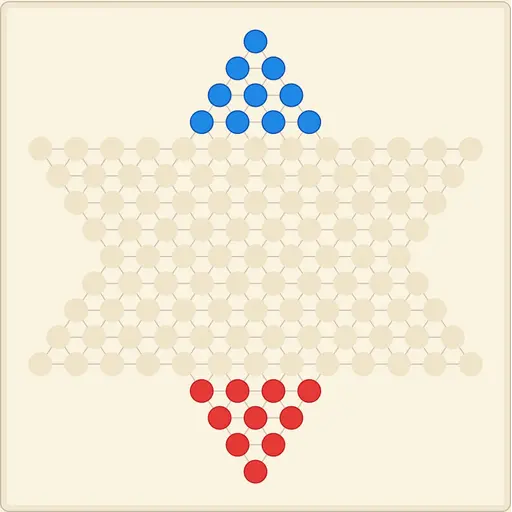
About Chinese Checkers
Chinese checkers rewards coordinated movement of the whole group into the opposite home triangle. Long jumping sequences can accelerate progress, but every segment needs a valid supporting piece and an empty landing point. A fast leading piece does not compensate for disconnected trailing pieces or a blocked destination entrance. This guide connects legal route calculation with reusable jumping arrangements and the entry order needed to bring all ten pieces home together.
- Ruleset covered
- Two-player Chinese checkers: ten pieces each; jumps relocate pieces without capturing
- Updated
- · Editorial policy and corrections
Chinese CheckersRules and variant distinctions
Choose a step or a sequence of jumps
Chinese checkers is a race to transfer all of your pieces into the opposite starting triangle. On your turn, move one of your pieces either to an adjacent empty point or by jumping over an adjacent piece to the empty point immediately beyond it. A step ends the move; a jump can be followed by further legal jumps with the same piece. There are no captures. A jumped piece stays where it is, regardless of its color. Victory requires all ten of your pieces to occupy the ten points of the opposite triangle at the same time. Reaching the destination with a single leading piece does not end the game.
Complete one piece's move before changing turns
Select one of your pieces, then a legal destination reached by a step or a sequence of jumps. The whole jumping sequence is one move, not several turns. Pieces used as jumping supports remain on the board. After the move, check whether all ten of your pieces occupy the destination triangle. If so, you win immediately; otherwise, the other player takes the next turn. You cannot combine a step with a jump, make two steps, or move a second piece within the same turn. Ply Yard preserves the full path in the move record while recording a multiple-jump move as a single turn. Review the path as well as the final destination when checking a move's legality.
The star-shaped board and opposing home triangles
The board has a central hexagonal playing area surrounded by six triangular arms. This guide covers the two-player Ply Yard version: Red and Blue each start with ten pieces in opposite home triangles. Red moves first. Each player's destination is the other player's starting triangle. Do not import multiplayer seating or destination assignments into this two-player game. Identify your own starting triangle and the opposite destination before planning a route through the shared center. Despite its name, Chinese checkers is not a form of xiangqi or American checkers. It derives from the German game Sternhalma; the name Chinese Checkers was used as an American product name in 1928. Its objective is a race between camps, not the capture or immobilization of opposing pieces.
Adjacent steps and direction-changing jumps
A point can have up to six neighboring points. A step moves to one empty neighboring point and ends the turn. For a jump, the neighboring point must contain a piece of either color, and the next point directly beyond it in the same direction must be empty. The piece being jumped does not move or leave the board. After landing, you may jump again from the new point. Each individual jump must have the same structure: a neighboring occupied point followed by an immediately consecutive empty landing point. A multiple-jump sequence may change direction between jumps. It need not follow one straight line, but each separate jump must be straight. Do not confuse a legal change of direction after landing with an illegal bent jump across several pieces.
When to stop a jumping sequence
Select a legal endpoint for the piece you are moving. In this version, you may end a jumping sequence at any legal landing point even when another jump is available. You are not required to make the longest sequence, and the availability of a jump does not prevent you from choosing a legal adjacent step instead. Within a single jumping sequence, you may not revisit a landing point already visited in that sequence. That restriction does not permanently close the point: a piece may return there on a later turn. Evaluate the endpoint rather than the number of jumps alone. A shorter route may preserve a useful connection or make space for a trailing piece. A longer route is valuable only when its resulting position helps the whole group reach the destination.
All ten pieces must occupy the destination together
You win when your ten pieces occupy all ten points of the opposite home triangle. Empty points in the central area do not matter, and opposing pieces elsewhere on the board do not affect this test. An opposing piece still in your destination triangle does matter: it occupies a point that one of your own pieces must eventually fill. The first piece to arrive has no separate scoring value. Nine pieces in the destination are not enough, and pieces that entered earlier but later left do not count toward completion. Check the current position, not the history of arrivals. In the ending, plan the order of entry. A piece near the entrance can obstruct those behind it, while an unfilled deeper point may become difficult to reach. Compare routes for the last few pieces before settling the leading pieces into their final locations.
The platform variant and house-rule differences
Chinese checkers is played with different house rules. Some groups prohibit leaving the destination triangle, require a jumping sequence to continue while possible, or use different camp assignments in multiplayer games. Agree on such changes before a face-to-face game; do not assume that the online board applies them. On the Ply Yard board described here, a piece may leave its destination triangle, a jumping sequence may stop at a legal landing point, and a legal step remains available even when the player could jump. There is no separate loss by blockade or stalemate. Victory is awarded only when all ten pieces occupy the opposite triangle. Computer play, same-device play, and online rooms use the same movement rules. A strategically poor move is not necessarily illegal, and a position that seems blocked does not by itself satisfy the winning condition.
An adjacent piece is not enough to make a jump legal
If the point immediately beyond the adjacent piece is occupied or does not exist on the board, you cannot jump in that direction. The supporting piece may be either color, but the landing point must be empty and directly in line. Check the landing before planning a continuation. You cannot jump over an occupied landing point to reach a more distant vacancy, and you cannot remove the supporting piece to create space. A legal route is a sequence of individually legal jumps, not a line that merely looks traversable.
Choose among branches without assuming a longest-route rule
After a jump, two or more legal continuations may become available. You may choose any legal continuation or end the move at the current landing point. No route takes precedence merely because it crosses more pieces. Compare the resulting endpoints and the connections they leave for your other pieces. Moving farther can be less useful if it dismantles a reusable jumping chain or leaves the trailing group without support. Keep legal route selection separate from the strategic evaluation of that route.
Make room at the destination entrance
If one of your pieces obstructs the entrance to the destination triangle, you may move it to another legal point. This version also permits temporarily moving it out of the destination to open a route for a trailing piece. That adjustment can be useful, but the moved piece must eventually return: all ten must be in the destination together to win. Review the remaining empty destination points and the access routes to them, rather than treating every arrival as permanently settled.
An opposing piece in your destination cannot be captured
The opponent's starting triangle is your destination. If an opposing piece remains there, you cannot capture it, replace it, or move it yourself. It must leave through the opponent's own legal play before your piece can occupy that point. Filling every other available point does not satisfy the victory condition. All ten destination points must be occupied by your own ten pieces. This platform guide does not introduce a special anti-blocking victory or allow an opposing piece to count as one of your arrivals.
Common illegal moves and misplaced checkers rules
You cannot make a two-point step, jump into an occupied point, or bend a single jump around a piece. A jump cannot cross two consecutive pieces: each jump must cross one adjacent piece and land on the empty point immediately beyond it. You also cannot leave the board, move an opposing piece, or remove a jumped piece. American checkers is a different game, played on the dark squares of an 8×8 board with captures, compulsory capturing, and promotion to kings. None of those mechanisms belongs to this Chinese checkers variant. Here, jumping is a means of relocation, and the final test is complete occupation of the opposite triangle.
Practical strategy
Build two legal jumps along one straight line, then construct a jump whose landing point is occupied.
For each segment, identify the moving piece's starting point, the supporting piece, and the empty landing point. Reject the blocked segment without removing any supporting piece.
Use three pieces to construct a reusable jumping arrangement. Compare moving one supporting piece forward with leaving it available for the others.
Explain how each choice changes the routes of the remaining group. Evaluate shared access rather than measuring only the moving piece's progress.
Review the entry order of your final three pieces. Identify whether a settled piece blocked an empty destination point.
Judge completion by all ten pieces occupying the destination together. Explain any temporary relocation used to reopen an entry route.
A common misconception
Jumping over an opponent's piece captures that piece.
Chinese checkers has no jump captures. The supporting piece stays on the board and remains available for later jumps by either player.
Position study: A multiple jump leaves its supporting pieces in place
A, B, C, D, and E are consecutive valid points on one straight line. Your moving piece is on A; B and D contain pieces, and C and E are empty. No other rule restricts this route.
Can A jump through C to E? Are the pieces on B and D captured?
Show the answer and analysis
The piece can jump from A to C over B, then from C to E over D. Each segment crosses one adjacent piece and lands on the empty point immediately beyond it. The pieces on B and D remain where they are; neither is captured.
A supporting piece may belong to either player. Update the moving piece's position at each landing, but leave the supporting pieces on the board. Unlike a capturing combination, this route preserves the supports for later use, and the opponent may be able to use the same jumping connections.
This position was constructed for instruction. It is not a tournament record or an engine-verified proof of an optimal move. Evaluate it under the stated conditions; do not assume unlisted features of the complete position.
Structured practice
Understand the rules
Construct two legal jumps on one straight line and a separate jump with an occupied landing point.
Assessment: Identify the starting point, supporting piece, and empty landing point for every legal segment, and explain why the occupied landing invalidates the other jump.
Compare candidate moves
Use three pieces to build a reusable jumping arrangement. Compare preserving it with advancing one of its supporting pieces.
Assessment: Explain the consequences for the remaining pieces' access routes, not just the progress made by the piece that moved.
Review and verify
Review the arrival order of your final three pieces and check whether your own pieces obstructed empty destination points.
Assessment: Evaluate completion of the entire group: all ten pieces must occupy the destination at the same time, not merely have entered it on earlier turns.
Frequently asked questions
May I jump over an opponent's piece?
Yes. A jump may use a piece of either color as its support. The piece must be adjacent, and the point immediately beyond it in the same direction must be empty. The jumped piece remains in place. It is neither captured nor transferred to your side.
Must a multiple-jump move follow one straight line?
No. Each individual jump must be straight, but you may change direction after landing. From the new point, check for an adjacent supporting piece and an empty point immediately beyond it. Each jump must satisfy that pattern independently; changing direction does not let you bend a single jump.
Once I start jumping, must I continue until no jump remains?
No. This Ply Yard version permits stopping at any legal landing point. It does not require the longest route or continued jumping, and a legal step may be chosen even when a jump is available. A house rule requiring continuation must be agreed separately; the online room does not automatically adopt it.
Can a piece leave the destination triangle after entering?
Yes. This version does not lock pieces inside the destination. A legal move out can reopen an entrance or adjust a jumping route. However, you win only when all ten pieces occupy the destination simultaneously, so a piece that leaves must return before the game can be completed.
Can I win while an opposing piece remains in its starting triangle?
No. In this two-player game, the opponent's starting triangle is your destination. Any opposing piece there occupies a point needed by one of your ten pieces. Opposing pieces outside that triangle do not affect the occupation test, but filling only the remaining nine destination points is not a win.
How does Chinese checkers differ from American checkers?
Chinese checkers is a race across a star-shaped board. Pieces jump without capturing, do not promote, and win by filling the opposite home triangle. American checkers uses an 8×8 board, compulsory captures, and kings. A legal jumping sequence in one game should not be analyzed using the other game's capture rules.
Can the piece on A jump through C to E, and are B and D captured?
Yes, in the example with consecutive collinear points A, B, C, D, and E, a moving piece on A, supporting pieces on B and D, and empty C and E. The move consists of A–C followed by C–E. B and D remain in place throughout. Update the moving piece's location after each jump, but do not remove either support; those pieces may also support later moves by either player.
Does jumping over an opposing piece remove it from the board?
No. There are no captures in this game. A jumped piece stays on its point and can continue to serve as a support for future jumps. Neither its color nor the length of the jumping sequence changes that rule. Only the selected piece changes location during your turn.
Put your understanding into practice.
Choose one skill to work on in your next game. A clear reason for each move is more useful than an immediate win.
Play Chinese CheckersRules sources and editorial notes
- Current rules for this game on Ply Yard
Identifies the board variant and interface described here. Platform instructions are not a complete statement of every tournament ruleset.
This guide combines the relevant board's rules with independently constructed examples and exercises. It distinguishes basic rules, variant-specific provisions, and strategic advice. Rules sections draw on the sources listed above. Instructional positions have not been presented as exhaustively engine-verified or certified by professional players.
Written by Ply Yard. Independent review by a named professional player has not been completed. To report an issue, send the game, ruleset, position, and relevant source provision to contact@plyyard.com.